A workshop on Catholic social teaching and artificial intelligence, exploring how the Church's tradition of humanistic philosophy engages with AI ethics and technology. Part of the Markey Center's monthly Faith Meets World series, this session includes interactive discussion and reflection opportunities for all participants.
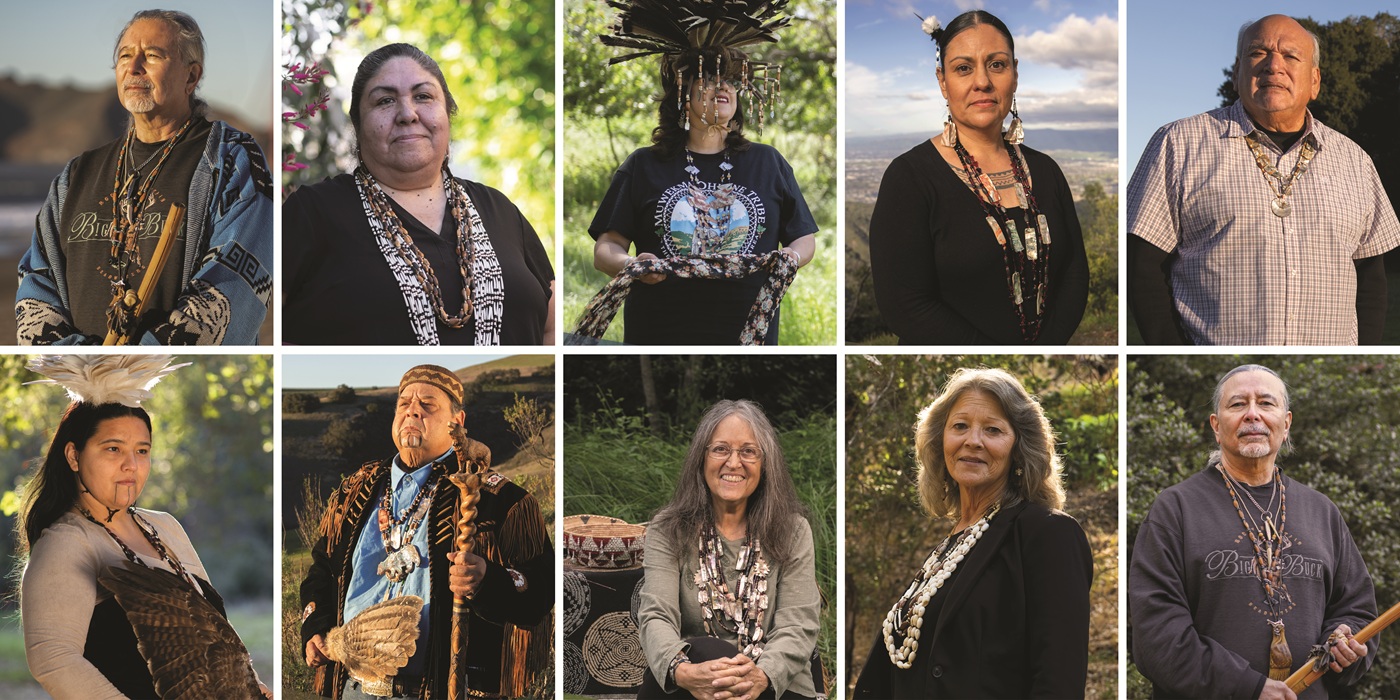
A guided walk and talk led by Kristina Parkison exploring Ohlone plant uses and cultural objects that sustain the Ohlone people's deep connection to the land they have stewarded since time immemorial. The program centers both historical and contemporary Ohlone practices. Ages 8 and up; adult participation required. Bring water, hat, layers, and sturdy shoes.
A Cantor Arts Center exhibition showcasing recent acquisitions from the Asian American Art Initiative (AAAI), founded in 2018 by Stanford art history professor Marci Kwon and curator Aleesa Pitchamarn Alexander. The AAAI has grown from roughly 30 works to over 800, making it one of the nation's leading museum initiatives dedicated to Asian American art. This exhibition presents works by artists including Pacita Abad, Ching Ho Cheng, Tseng Kwong Chi, Young Joon Kwak, Masami Teraoka, and Rupy C. Tut, spanning generations, media, and artistic approaches. Many works are being presented to the public for the first time. The exhibition runs during regular museum hours; admission is always free.
A guided history walk of Lands End's wild northwest corner led by historian and retired National Park Ranger John Martini. Participants will follow the route of the historic Ferries & Cliff House steam train, view the remains of two shipwrecks (weather permitting), and visit the USS San Francisco Memorial to learn about the warship's 1942 Battle of Guadalcanal. The two-hour walk covers uneven terrain; easy grade. Limited to 30 people.
Meet paranormal romance novelist Marilyn Vix at Copperfields Books Calistoga, celebrating the omnibus edition of Thankful in Vegas. A casual drop-by meet-and-greet with the author.
A four-week seminar exploring Dante's *Inferno* as both a masterwork of Western literature and a profound meditation on human striving and justice that resonates in our own historical moment. Led by Timothy Hampton, Distinguished Professor of Comparative Literature at UC Berkeley, the course will read the poem slowly, unpacking its mysteries, medieval philosophical context, and enduring relevance. Open discussion follows each session. Meets Thursdays, October 10, 17, 24, 31, 11 am–1 pm.
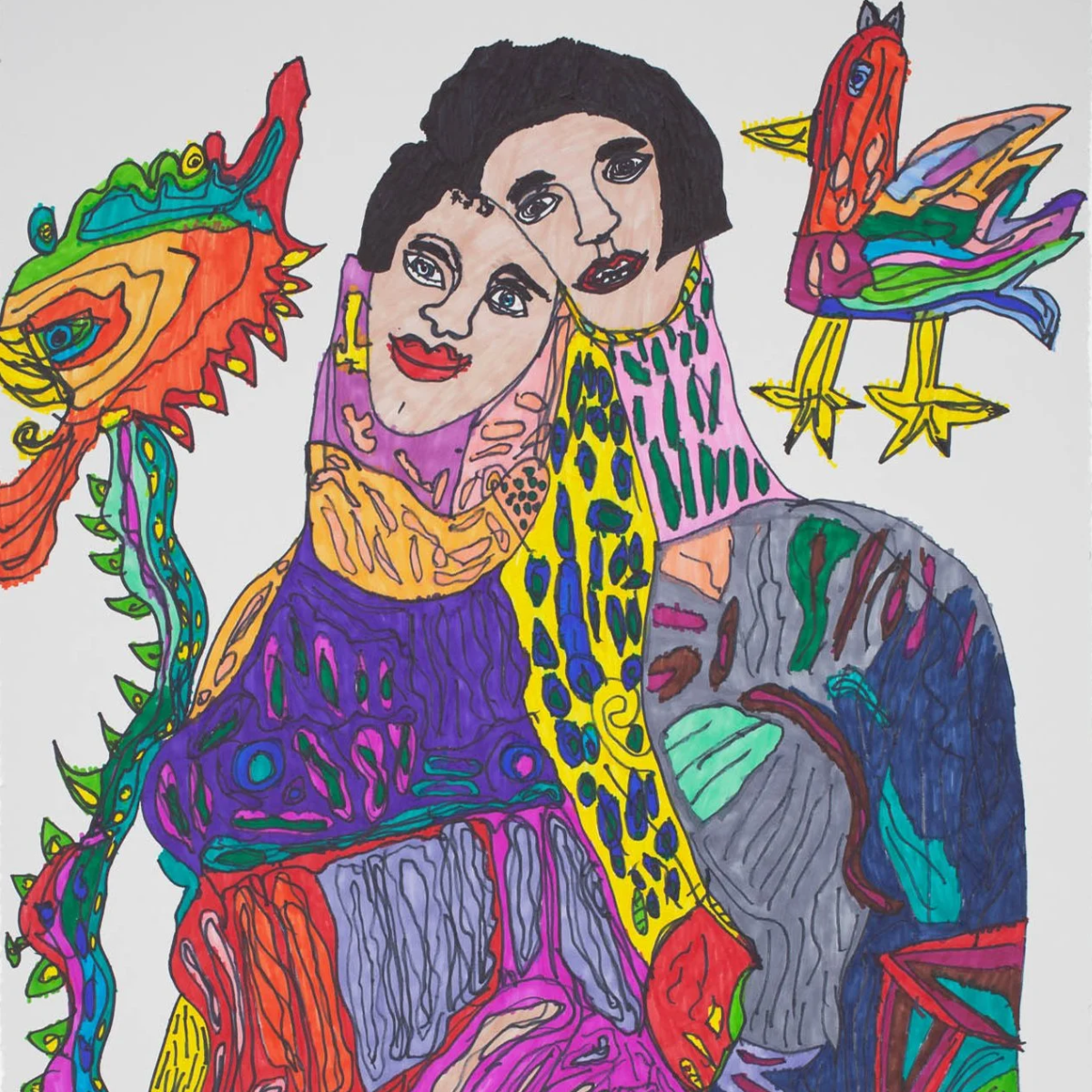
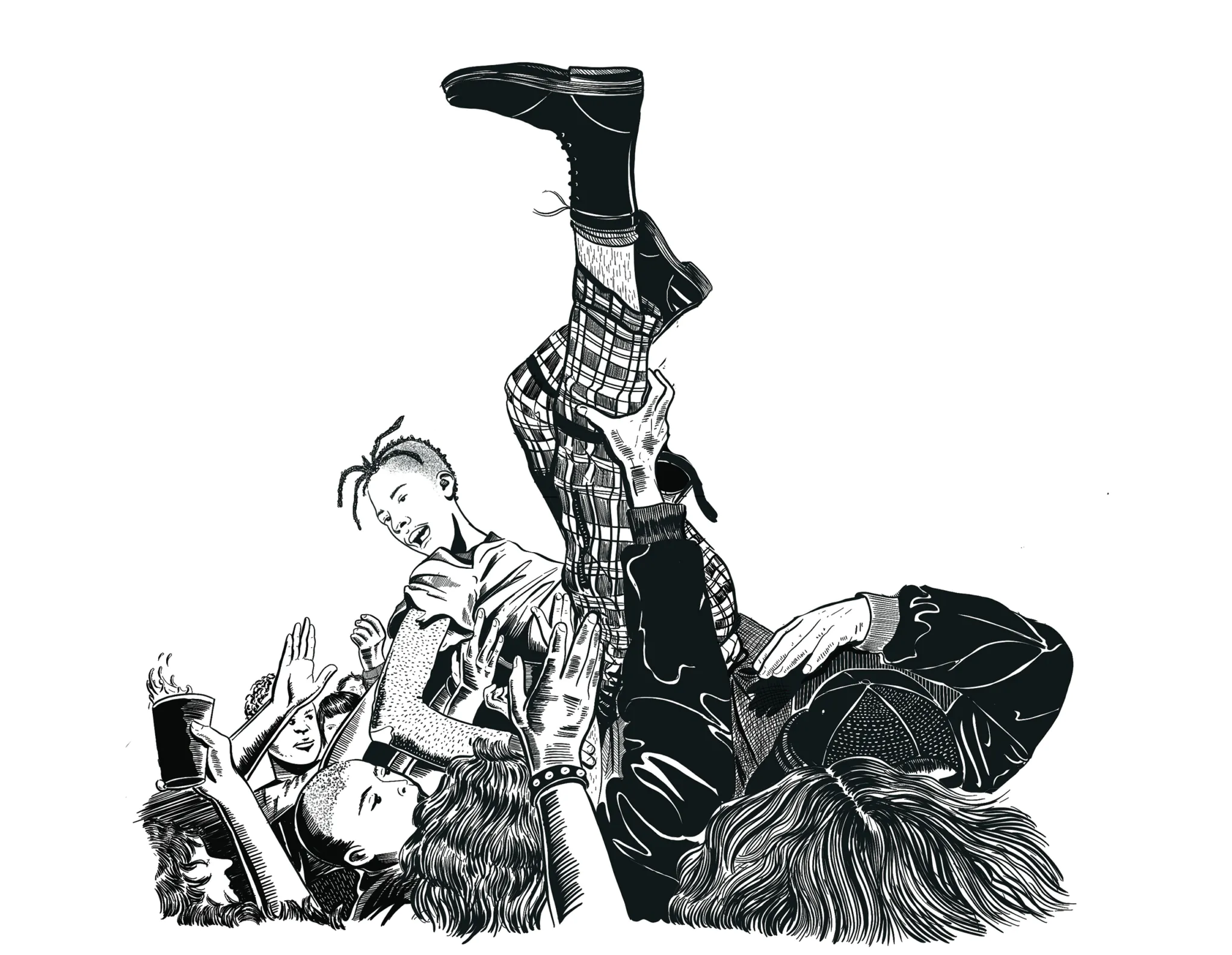
A curator walkthrough of 'Drawn Together,' a group exhibition celebrating human connection through diverse artistic media. Curator Auriel Garza leads visitors through works exploring gatherings of figures—friends, families, teams, dancers—and the expressive power of line work as both structural and emotional force. The exhibition examines how artists depict shared joy, camaraderie, and belonging across varied settings from supermarkets to dance floors to family dining tables, offering a heartfelt tribute to the ties that bring us together.
Author and Education Programs Director at Monterey Bay Aquarium Katy Scott reads and signs her illustrated children's book about a hermit crab's 24-hour journey through a tide pool ecosystem. Through the crab's search for a new shell, readers learn about tide cycles, marine adaptations, predator-prey relationships, and the interconnected life of tide pool creatures. Scott brings expertise from nearly 15 years developing STEM education programs at one of the world's leading aquariums.
An eye-opening guide to understanding and appreciating poetry. John Timpane, author of *Poetry for Dummies*, 2nd Edition, explores how to read, analyze, and write poetry for anyone from curious beginners to practicing writers and devoted poetry lovers. Perfect for aspiring poets and anyone interested in deepening their engagement with the form.
Professor Elisa Tamarkin, Chair of UC Berkeley's English Department, speaks to the UC Berkeley Emeriti Association. Tamarkin is a scholar of American literature and cultural history. The specific topic of her remarks will be announced closer to the event date.
Two hands-on artmaking workshops led by Osher Fellows in the East Garden. 'Marigold and Frames: Make a Frame, Hold a Memory' with Dev Heyrana explores memory and craft, while 'Día de los Muertos: Claude Forever' with Josué Rojas engages the Day of the Dead tradition. All ages welcome, no experience necessary.
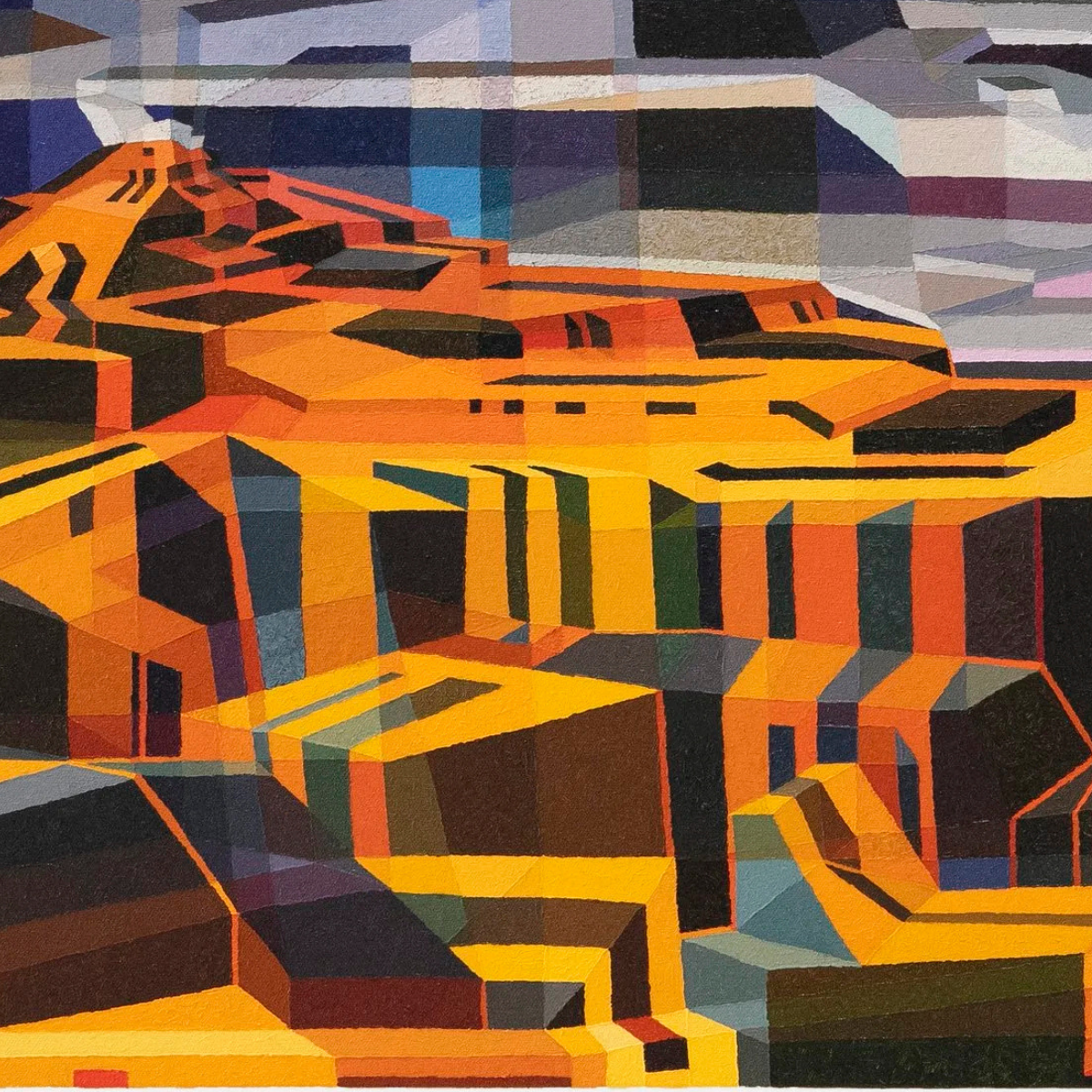
A guided walk-through of Shannon Rogers: Myriad, an exhibition of geometric abstraction paintings by Oakland-based artist Shannon Rogers. The show features expansive, intricately constructed works that move between recognizable landscape and abstraction, drawing from archetypal visions of volcanoes, canyons, ruins, and sunsets while geometric structures disrupt coherent perspective. Rogers explores interconnectedness and multiple readings of space, informed by Daoist philosophy. The artist will lead the walk-through.
Explore the Mediterranean diet and regional Italian culinary traditions with Bernadette Festa, MS, RD. Learn the health principles behind this way of eating—its emphasis on fresh, seasonal ingredients and how food traditions vary across Italy—alongside selections of regional recipes from everyday dishes to traditional favorites. Discover how to bring the Mediterranean approach into your own kitchen.
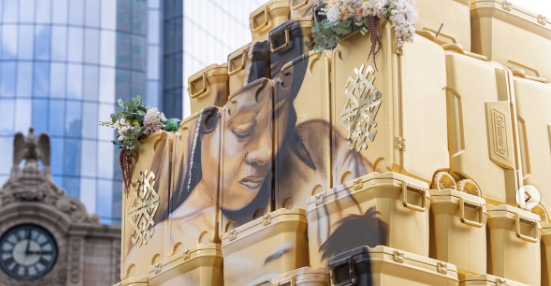
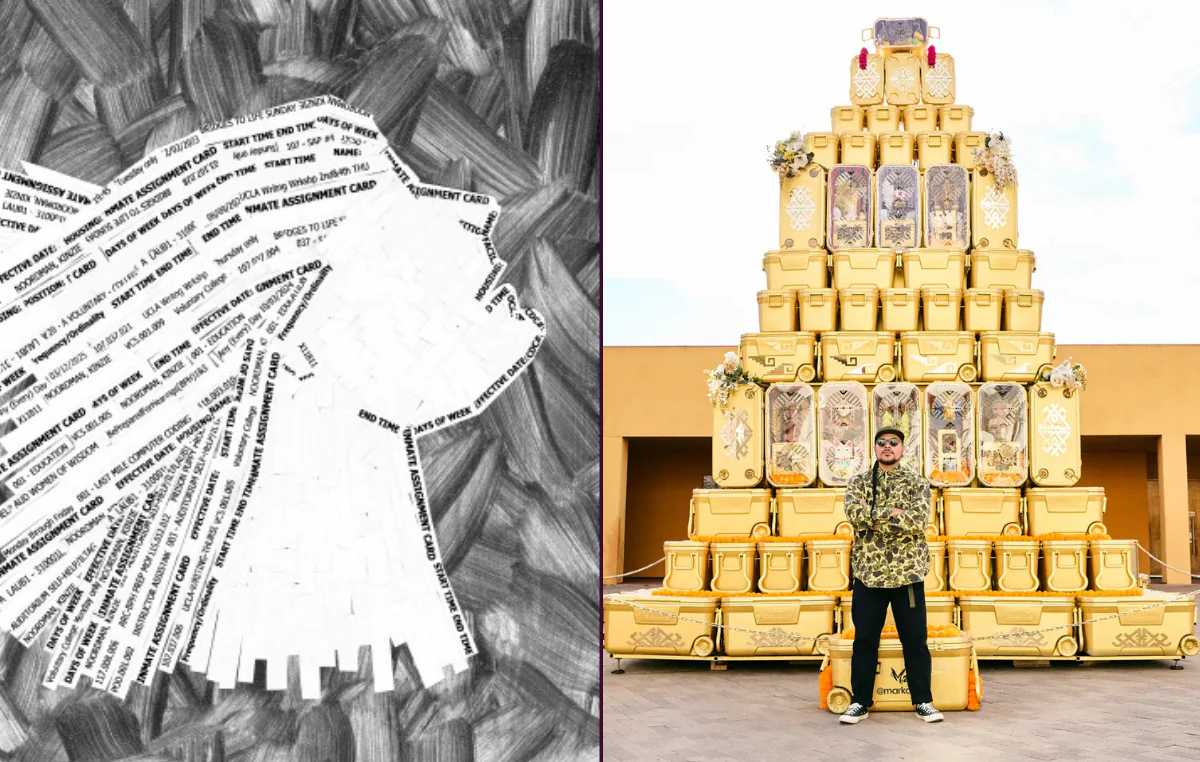
Ni de Aquí, Ni de Allá (Not From Here, Not From There) is a multidisciplinary exhibition by artist Victor 'Marka27' Quiñonez exploring the experience of living between worlds. The show features altars, an immersive botanica, paintings referencing textiles and graffiti traditions, and brightly colored resin sculptures of melting Mexican paletas. Accompanying the exhibition, Elevar la Cultura—a twenty-two-foot-tall pyramid built from ice coolers adorned with ancestral textiles and sacred symbols—will be installed at Santa Cruz Barrios Unidos. The cooler sculptures symbolize immigrant labor and survival in the United States, transforming everyday objects into monuments of resilience and cultural pride.
The Santa Cruz Museum of Art & History hosts an annual Día de los Muertos Celebration honoring Latino cultural heritage. The day features musical and dance performances by Senderos, hands-on activities, live music, and community-created altares (ofrendas). Attendees can explore the museum's installations and learn about the holiday's significance from community partners and Senderos leaders, hearing stories of how Día de los Muertos is celebrated locally.
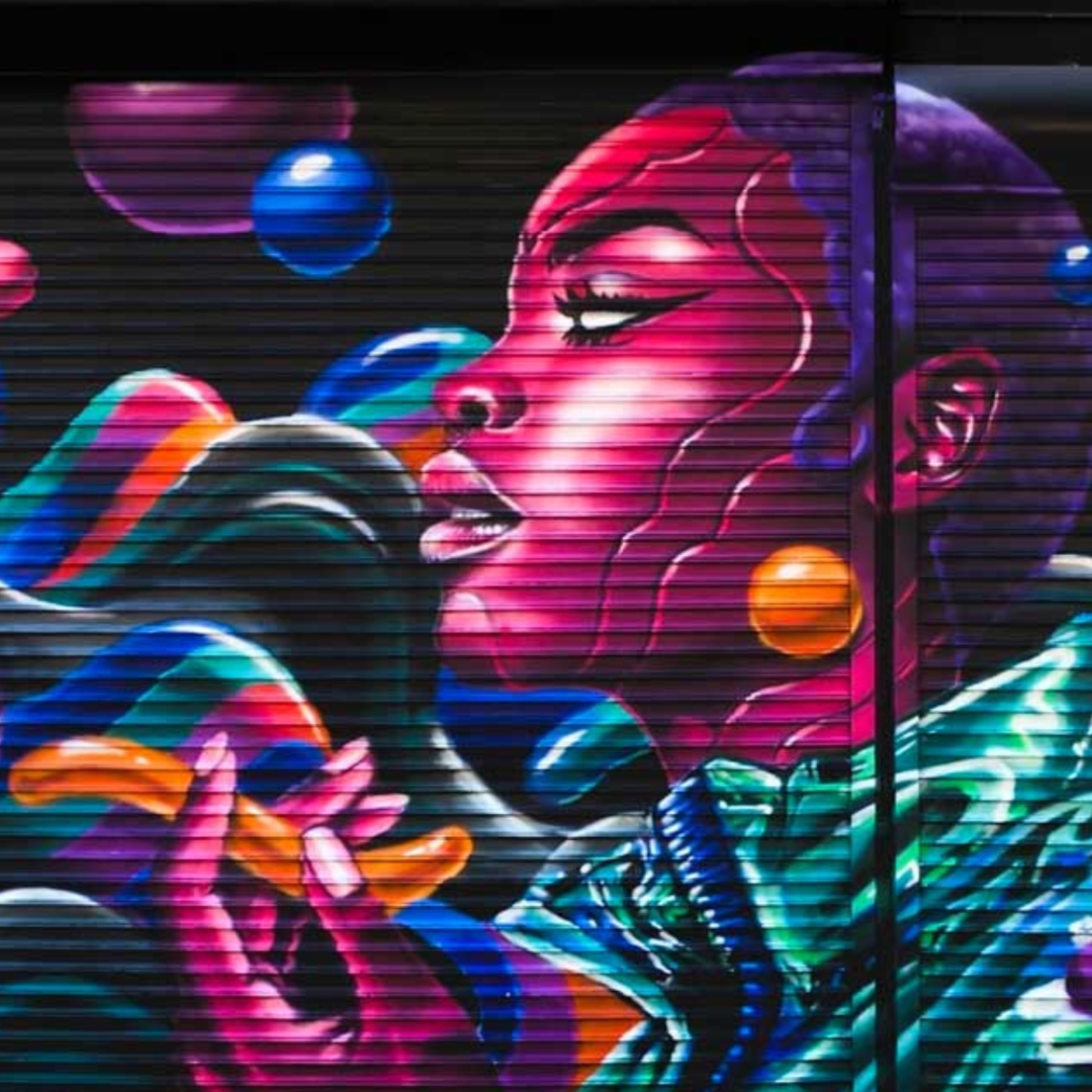
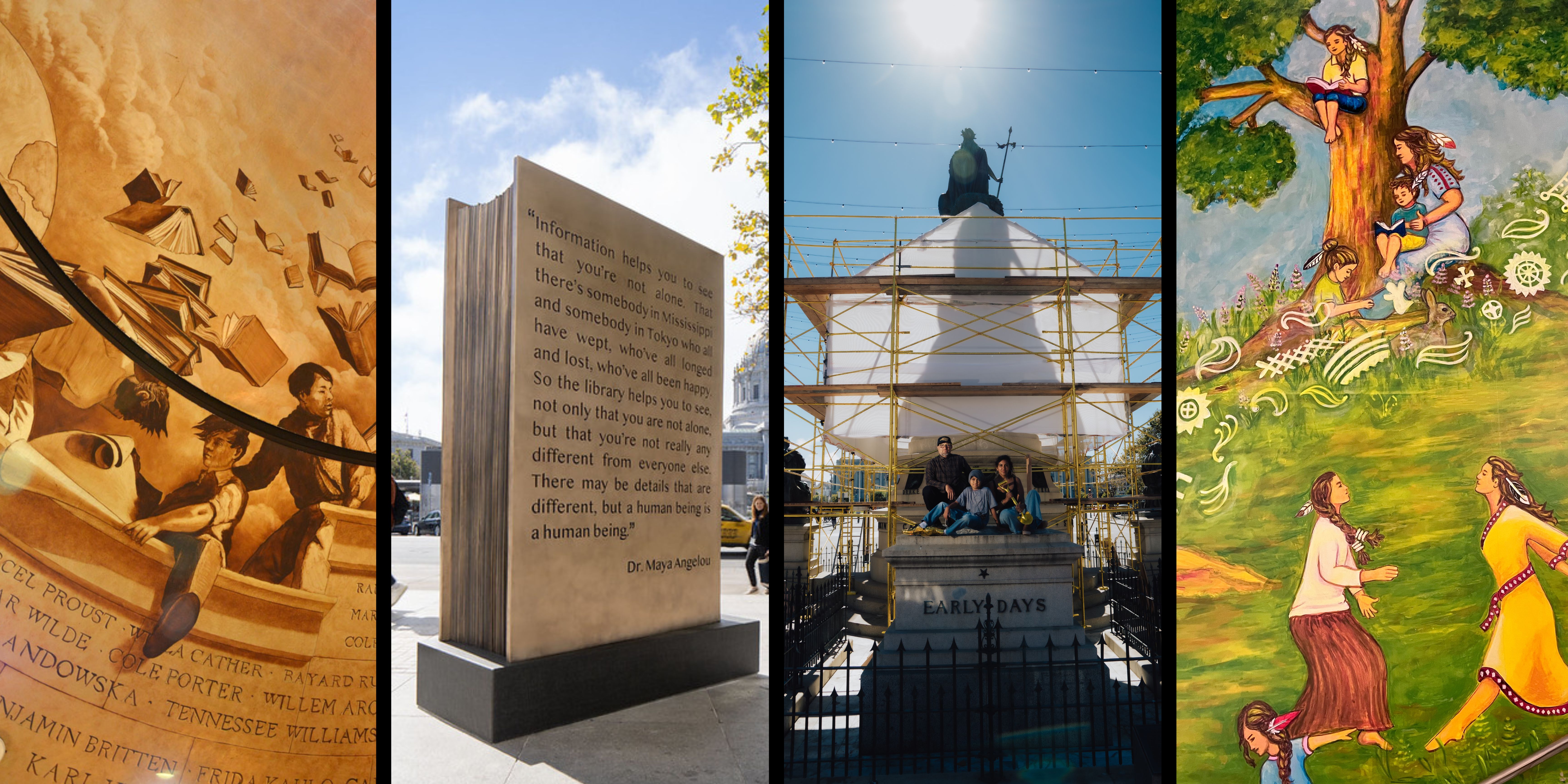
A walking tour through San Francisco's Civic Center, Mid-Market, and SoMa exploring murals, monuments, and public art shaped by collective action and community collaboration. Led by art historian, writer, and skateboarder Ted Barrow, the tour begins at the San Francisco Public Library Main Branch at the Maya Angelou monument by Lava Thomas, traces Market Street to Yerba Buena Center for the Arts and the exhibition *Dread Scott: The Body Politic*, and highlights works celebrating the people and communities that shape San Francisco. The program considers how public art creates spaces for connection, visibility, and collective expression, and examines art as a platform for protest and social justice.
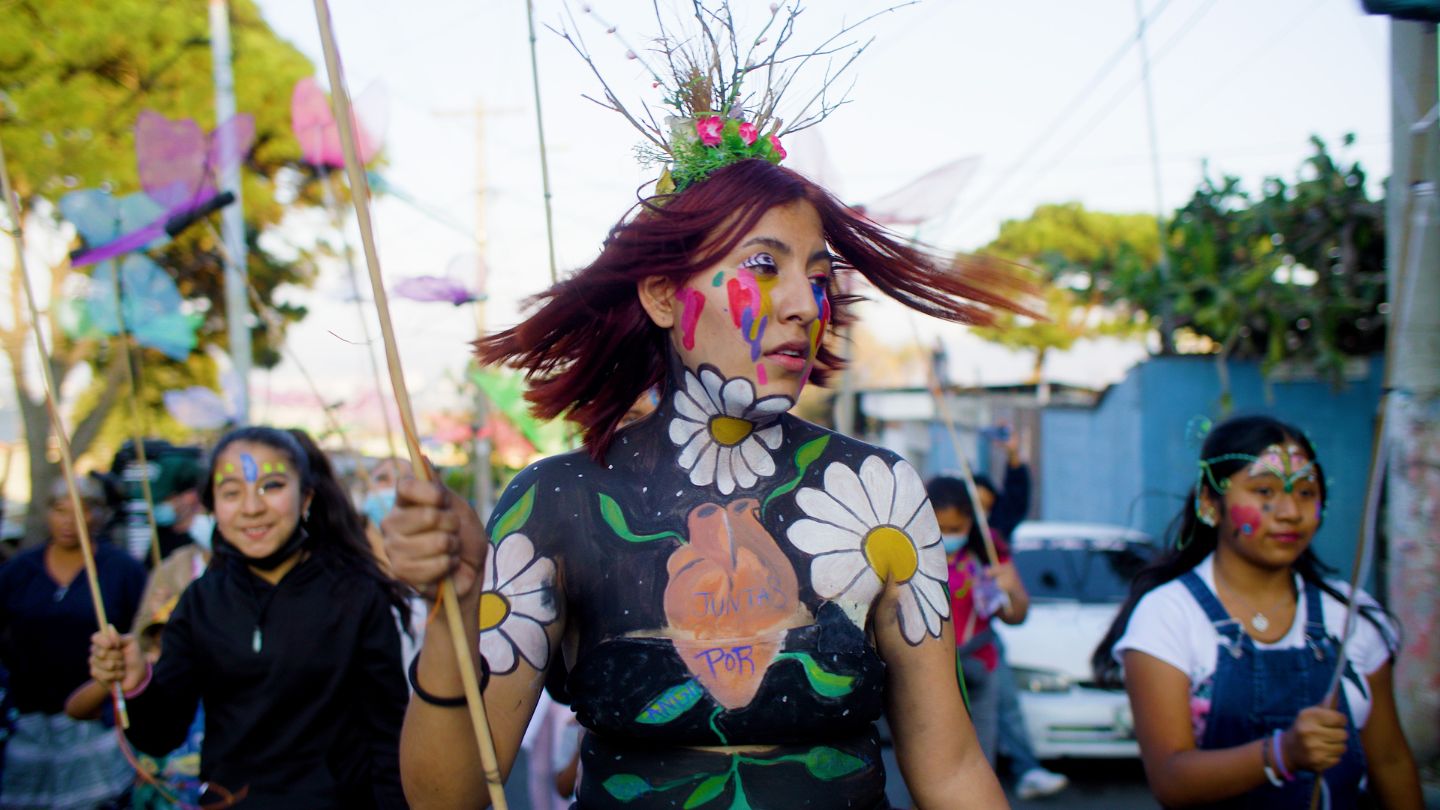
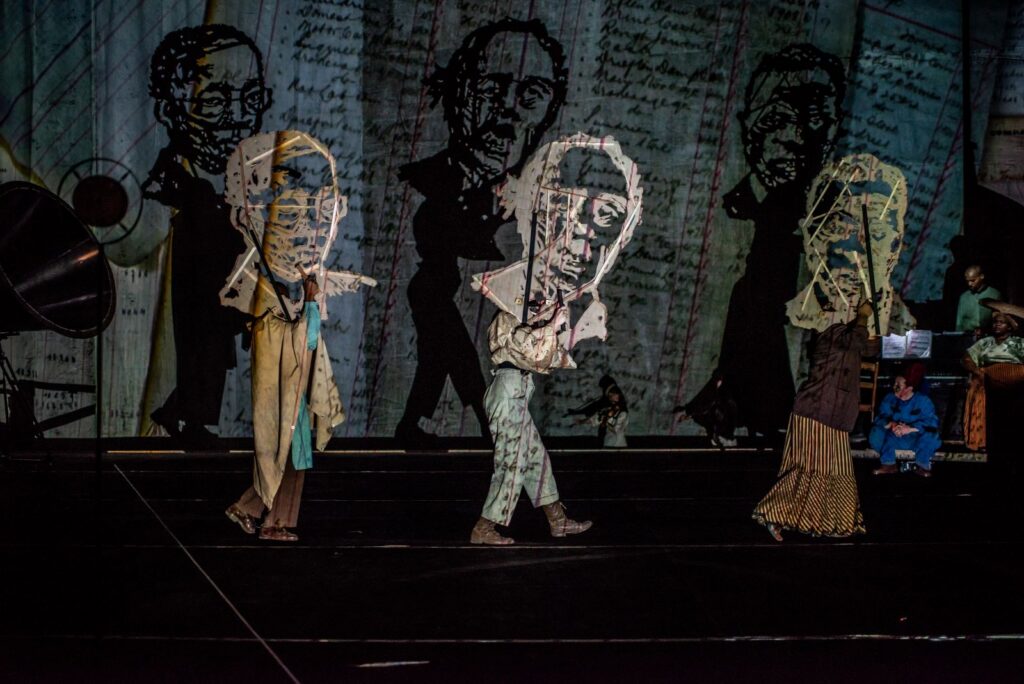
Filmmakers will be in attendance for a post-screening Q&A. A screening of Comparsa, a documentary following sisters Lesli and Lupe in Ciudad Peonia, Guatemala, who use art and performance to heal community trauma and confront violence against women after 41 girls are killed in a state-run facility. The film explores how they organize a youth movement featuring exuberant street performances, towering puppets, and fire-breathing stilt walkers to reclaim public space and challenge corruption. Built on a 15-year relationship between filmmakers and subjects, it is a portrait of sisterhood, peacebuilding, and art's transformational power.
An afternoon of civic performance and dialogue exploring the U.S. Constitution's historical role and modern relevance. Artist Christy Chan performs readings from the Constitution in reverse, interrogating whose rights it protects and whose it excludes, followed by a moderated panel discussion titled "Whose Constitution?" featuring cultural historian Jeff Chang (moderator), Michael Schulze-Oechtering (CSU East Bay community organizer), and Nicole Ozer (UC Law SF's Center for Constitutional Democracy and Electronic Frontier Foundation). The panel examines citizens' relationship to the Constitution in the present moment.
A curator-led walkthrough of OBJECTS: USA, the landmark 1969 Smithsonian exhibition of American studio craft, now reimagined at the Museum of Craft and Design. Chief Curator Ariel Zaccheo shares curatorial insights and stories behind select works in clay, fiber, glass, metal, and wood, exploring the materials, techniques, and ideas connecting makers across generations. The exhibition features over 70 historic and contemporary works by leading artists and designers, reflecting the Bay Area's central role in developing American studio craft and challenging postwar art hierarchies.
A conversation about Harold Pinter's play Betrayal with Carey Perloff, artistic director of American Conservatory Theater, and Larry Eilenberg, contemporary theatre expert. The discussion explores the themes and dramatic structure of one of Pinter's most celebrated works.
ACX Everywhere is a community gathering hosted by Rationality, AI, and forecasting enthusiasts. Attendees will break into conversation groups by topic—Work after AI, Elections, Book review reviews, Prediction markets & forecasting, The All Souls fishbowl (reading the world's hardest exam questions), and ACX articles that changed your mind—or mingle freely. Organized by Nate Sternberg, Andrew Gaul, and ACX SF, with hosts Austin Chen and Jen Baik.
A hands-on workshop with award-winning author and non-financial retirement coach Larry Jacobson on designing a retirement centered on meaning and fulfillment. Jacobson, a sought-after speaker and circumnavigator, works with participants to develop a purposeful next chapter beyond financial planning.
Join Kepler's Community Reads program for an interactive event centered on *Her Right Foot*, Dave Eggers and Shawn Harris's illustrated exploration of America's identity, borders, immigration, and Lady Liberty's meaning. The afternoon features a collage workshop led by illustrator Shawn Harris (2:00–2:45 PM, all ages welcome) followed by an open community discussion (3:00 PM) about the book's themes of resistance, oppression, and American ideals as the nation marks its 250th anniversary.
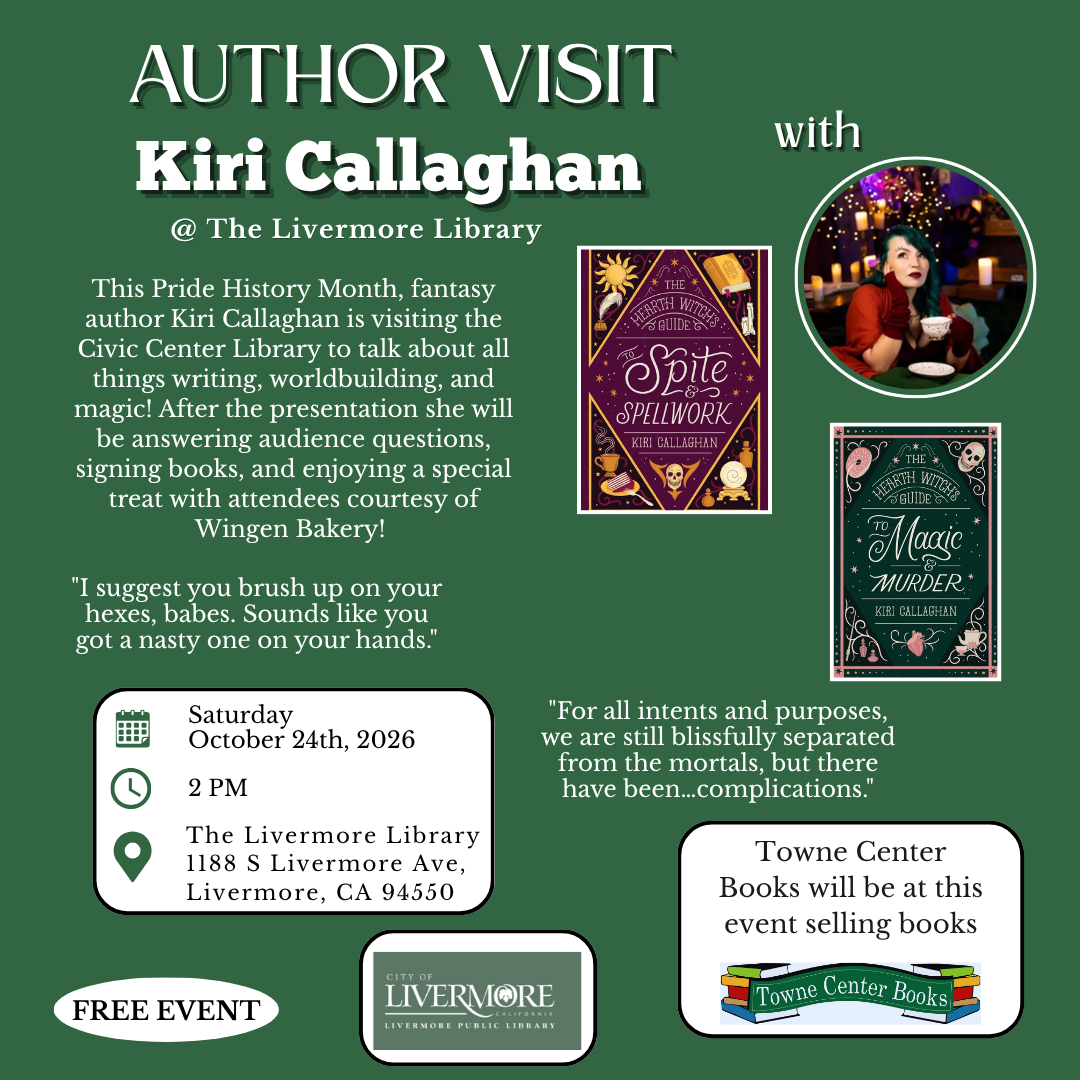
Fantasy author Kiri Callaghan discusses writing, worldbuilding, and magic, drawing on her USA Today bestselling works including The Hemlock Saga and The Terra Mirum Chronicles. The event includes a Q&A, book signing, and a special treat courtesy of Wingen Bakery. Books available for purchase from Towne Center Books.
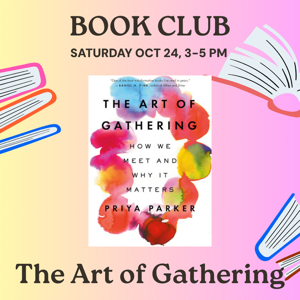
A bimonthly book club discussion of Priya Parker's *The Art of Gathering*, exploring how to create meaningful, intentional gatherings. Hosted by Climate Action Club, a Bay Area community turning climate anxiety into collective action and civic power. Participants bring snacks and discussion, meeting in Washington Park in Burlingame. No prior experience required. Friends, children, and furry companions welcome.
Ethel M.H. Reddy discusses her memoir *I, Ethel*, sharing career advice, beauty guidance, personal stories, and wisdom from close friends and colleagues. The book offers insight into her entrepreneurial spirit and lifelong commitment to excellence.
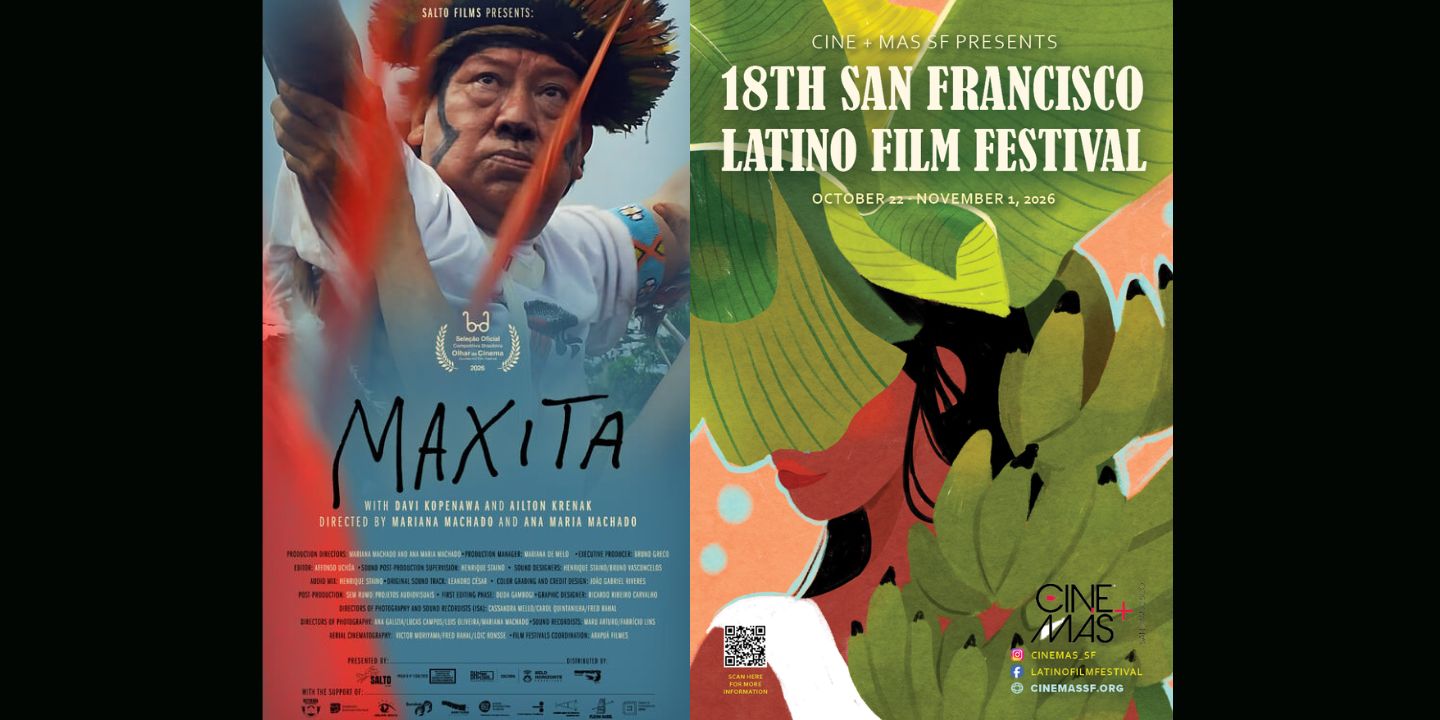
Filmmakers will participate in a post-screening Q&A. A screening of eight short films from the SF Latino Film Festival's Community Voices program, featuring works by local filmmakers including James Hall, Alma Amancay Herrera-Pazmiño, Naomi Garcia Pasmanick, Noemi Ochoa, Xander R. Trejo, and Nicolas Jara. The program includes narratives ranging from cultural documentation and community art to speculative fiction, with runtimes from 4 to 15 minutes.
Post-screening Q&A with director Jack MacInnes and film subject Israa, moderated by Carrie Lozano. A screening of One in a Million, a ten-year documentary following Israa from age 11 as she and her family flee Syria across the Aegean Sea to Germany, navigating adolescence, identity, and belonging in exile. Co-directed by Itab Azzam and Jack MacInnes, the film chronicles war, displacement, and the tension between new freedoms and Syrian traditions.
Colin Jost, Emmy-winning writer and co-anchor of Saturday Night Live's "Weekend Update," discusses his career in comedy and media. Jost has been a writer on SNL since 2005 and published the New York Times bestseller "A Very Punchable Face: A Memoir" in 2020. He also hosted "Pop Culture Jeopardy!" on Prime Video in 2024, earning an Emmy nomination. Part of the Silk Speaker Series during CelebrateUSF at the University of San Francisco.
A guided walking tour through San Francisco's Castro neighborhood exploring LGBTQIA+ resistance history, created by Shawn Sprockett, a former senior adjunct professor and practicing designer. The tour traces queer activism from the White Night riots through the AIDS crisis and subsequent police violence, introducing figures including trans doctors, lesbian healthcare workers, and community organizers. Approximately 90 minutes of walking on city sidewalks with one moderate hill, ending at the Lookout bar with a complimentary drink. The tour closes Sprockett's three-part history of queer San Francisco (following North Beach and Tenderloin tours). Runs monthly; ages 21+.
Litquake's closing-night poetry crawl hosted across three simultaneous events at Medicine for Nightmares. 'Grandmas are Griots' (5–6pm, hosted by Allie Jones) honors oral storytelling traditions and matriarchal resistance through readings by Ashia Ajani, Liftawiya, mel, Sara Borjas, and Jones. 'In the Spirit of Kapwa' (6:30–7:30pm, hosted by Tiffani Patton) is presented by Mesa Refuge. 'Pochx Deluxe: An Ode to the California Lengua' (9–10pm, hosted by Lourdes Figueroa) concludes the evening. Each program centers embodied practice, cultural memory, and collective commitment.
Chef and food writer Fuchsia Dunlop celebrates the launch of her cookbook *Five Tastes* with a banquet-style dinner at Mister Jiu's. The evening features dishes from the book prepared by Mister Jiu's kitchen, and each ticket includes a signed copy of *Five Tastes* to take home. Dunlop is the author of *The Sichuan Cookbook* and *Every Grain of Rice*, and her work explores the depth and regional diversity of Chinese cuisine.
A panel discussion with three accomplished YA horror writers — Yuvashri Harish, Stephanie Kuehn, and Hannah Jayne — exploring their work in the genre. Held at Copperfield's Books just before Halloween.
A screening of the documentary Steal This Story, Please! with journalist Amy Goodman and director Tia Lessin for a post-screening Q&A. Oscar-nominated filmmakers Carl Deal and Tia Lessin examine three decades of Amy Goodman's career as a trailblazing investigative journalist at Democracy Now!, covering global conflicts and stories silenced by commercial media. The film explores how Goodman navigates a news landscape reshaped by corporate consolidation and political assaults on truth, offering both a portrait of resistance and a meditation on democracy when the press surrenders to power.
A hands-on poetry translation workshop where participants aged 12–18 (all ages welcome) unlock creativity by translating poems from around the world. Guided by 2025–2027 Poetry Inside Out Teaching Fellows and local translators, attendees work with glossaries and collaborate to dismantle and reassemble poems in new languages. No prior poetry or language skills required. The workshop celebrates translation's multiple possibilities, encouraging participants to share and defend their language choices, followed by spontaneous performance by youth writers.
SpectreVision Radio presents a live Liminal Mic podcast recording exploring Bigfoot encounters and folklore. Real audience members share paranormal experiences with a live panel including Bryce Johnson (Expedition Bigfoot), The 418 Project, and SpectreVision Radio Director Daniel Noah. The event explores the cultural history and contemporary reports of Sasquatch and related cryptids across North America, with particular focus on Northern California sightings. SpectreVision Radio is an independent podcast network founded by filmmaker Elijah Wood and Daniel Noah, exploring the paranormal, esoteric, and unexplained across 62 shows reaching millions of monthly listeners.
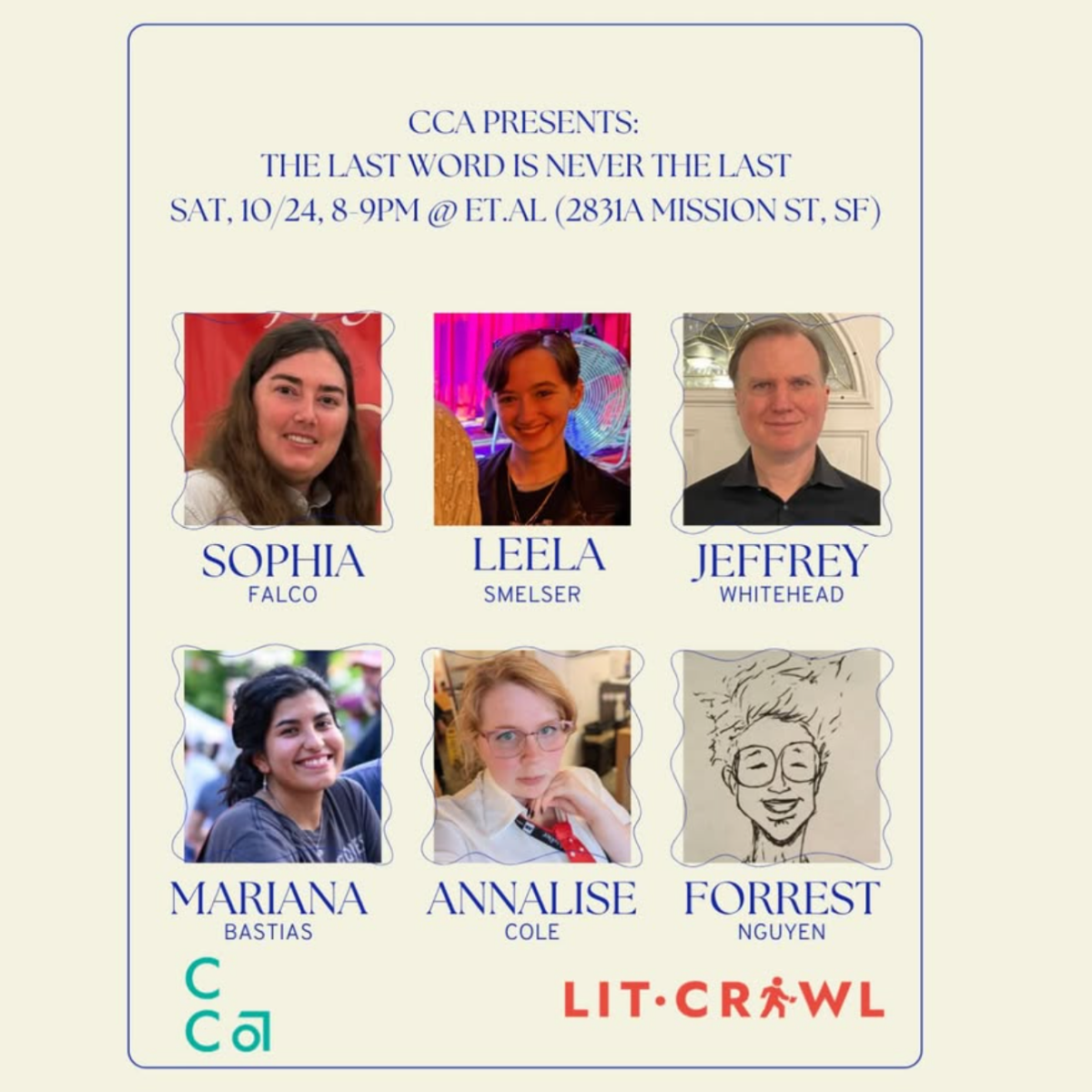
The final graduating class of California College of the Arts' MFA in Writing program reads from their work at this Litquake event. The emerging writers—working in fiction, memoir, poetry, and hybrid forms—present pieces that move across borders, histories, families, and imagined futures with wit, ambition, and emotional precision. This reading marks both a farewell to a decades-long program and an introduction to the writers who will carry its legacy forward, affirming that literature remains one of our most powerful ways of attending to one another, to history, and to ourselves.
An evening of poetry and prose centered on resistance and radical dreaming, featuring queer, immigrant, and trans writers speaking to justice and imagining alternatives. Curated and hosted by Baruch Porras Hernandez, the program features poets Preeti Vangani and Gio!, with musical guest Mobby Rosas.
An immersive workshop exploring the esoteric meanings within the poetry of Indian mystic saints—Kabir and Guru Nanak—through indigenous folk songs of the Malwa region. Priyal Maheshwari, a musician and yoga teacher, guides participants by singing and interpreting these 600-year-old oral-tradition songs while accompanying himself on tambura and kartaal. The workshop alternates between song, storytelling about Kabir's life and India's oral traditions, collective reflection, and shared silence. Printed translations enable participants to follow along and join the singing. A contemplative experience designed to deepen self-discovery and a sense of connection.
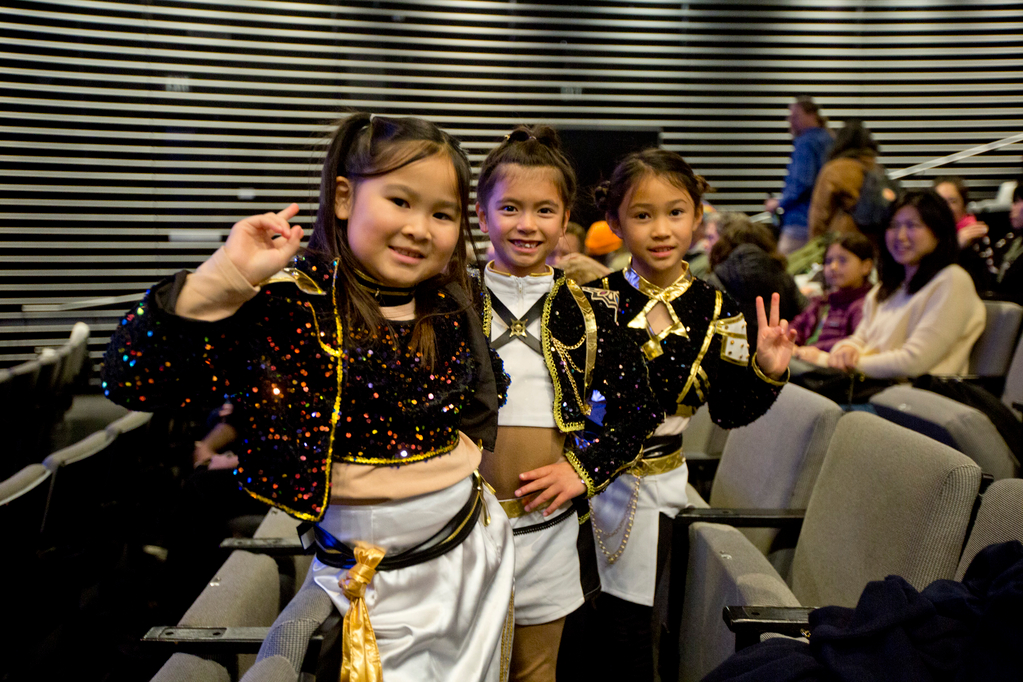
A free family day at SFMOMA featuring K-pop, art, and creative activities for all ages. Two adults accompanied by a child 18 or younger receive free museum admission; children are always free to RM x SFMOMA: Between You and Me (adults require a separate timed ticket). Activities run 10 a.m.–4 p.m. Early RSVP encouraged due to capacity limits.
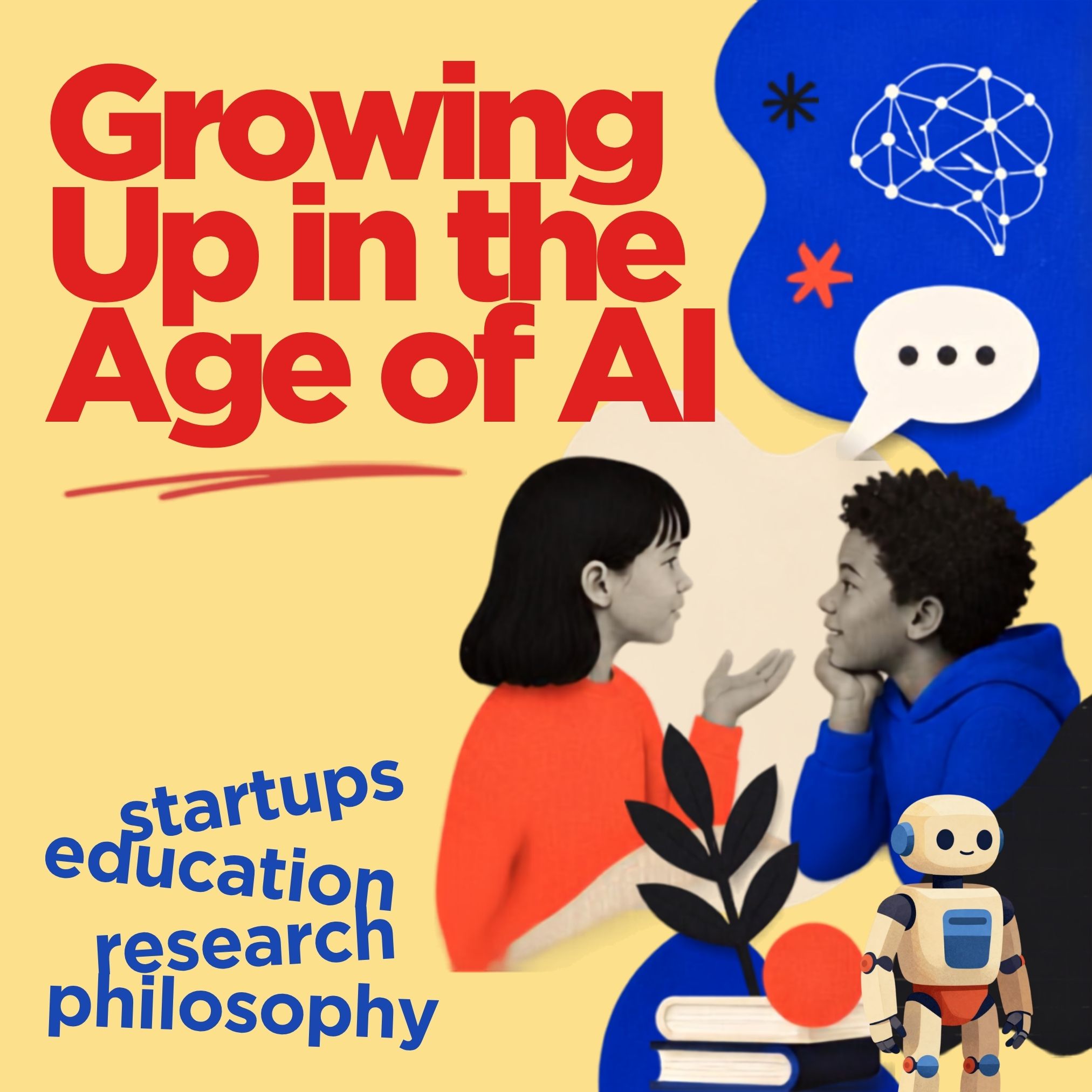
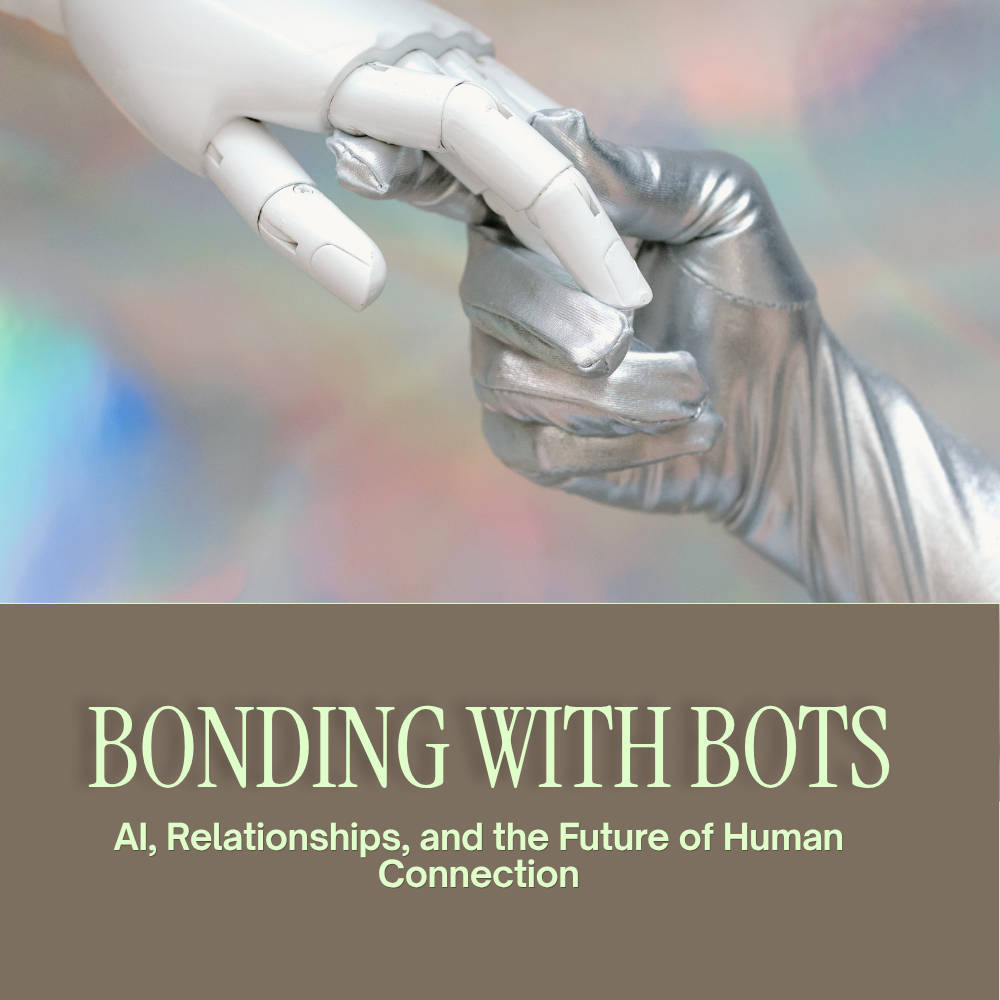
A full-day family event exploring AI's impact on child development, education, and human connection. The program features research presentations and founder conversations on how generative AI is reshaping childhood learning; panels on skills children need for an AI-driven world; workshops including a philosophy discussion ('Can a robot be a friend?') led by The Paradox Lab; an exhibition on brain development co-created with illustrator Linda Liukas; and a startup showcase where families can try emerging AI products for children. Speakers and workshop leaders include researchers, educators, and builders from leading institutions and startups.
A workshop for aspiring authors seeking to improve their chances of publication with a literary agent or publisher. John Geoghegan, a publishing professional, guides participants through manuscript preparation, agent query strategy, and the submission process for memoirs, novels, and nonfiction works. Hands-on and Q&A focused.
A book discussion for adult children of immigrants exploring mixed cultural identity and belonging. Participants will gather in a small-group salon format to discuss Sahaj Kaur Kohli's memoir and reflect on how bicultural experiences shaped their upbringings and sense of self. The event centers on shared questions about navigating multiple cultural worlds.
The Oakland Museum of California hosts its 32nd annual Día de los Muertos Community Celebration, a vibrant day honoring people, traditions, and stories that connect communities across generations. The day opens with a procession led by the Día de los Muertos Committee, featuring music, movement, and collective acts of remembrance. The event includes gallery access and garden programming. ASL interpretation will be provided for outdoor stage events. $10 admission; members and children under 12 are free with advance reservations.
Professor Galen Crantz displays her personal tax returns from 1963–2018 in a one-day public installation, inviting visitors to witness the accumulation of bureaucratic effort embedded in decades of filing. Attendees are welcome to bring their own tax documents (older than 7 years) to shred manually onsite or deposit in secure bins for later shredding at Berkeley Shreds. The exhibition critiques the collective time investment required by tax filing and asks what more productive uses of our effort might look like.
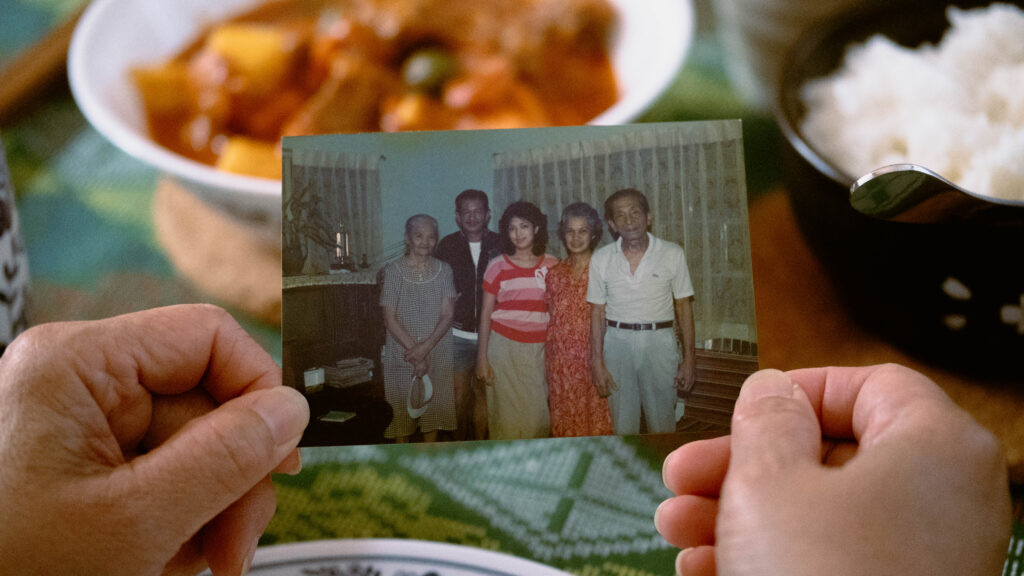
Join the Asian Art Museum's Kasama Festival celebrating Filipino American History Month. Michelle Sterling, children's book author, discusses *When Lola Visits*, her story of a young girl spending a summer with her grandmother from the Philippines. The book weaves Tagalog songs and mango jam into an evocative tale of familial love spanning oceans and generations.
Nebula and Hugo Award–winning author Charlie Jane Anders celebrates the launch of her new Star Trek comic series, Star Trek Zero Point, set a few years after Star Trek: Picard season 3. Anders will discuss the inspiration behind the series, Trek's message of fighting intolerance in 2026, and why it resonates now. The story follows Captain Raffi Musiker commanding a starship tasked with preventing future disasters, guided by a powerful A.I. wearing the face of a familiar ally. Meet-and-greet and signing follow. Special guests include the USS Golden Gate fan club, formed in 1993, which celebrates Infinite Diversity in Infinite Combinations across the Bay Area.
An open house at the Headlands Center for the Arts' Marin County campus offering a seasonal chance to visit artist studios, meet residents and fellows, view works in progress, and attend screenings, performances, and readings. Tour the various buildings, see current installations in the Project Space, and enjoy lunch at the Mess Hall. Limited parking; carpooling and biking encouraged.
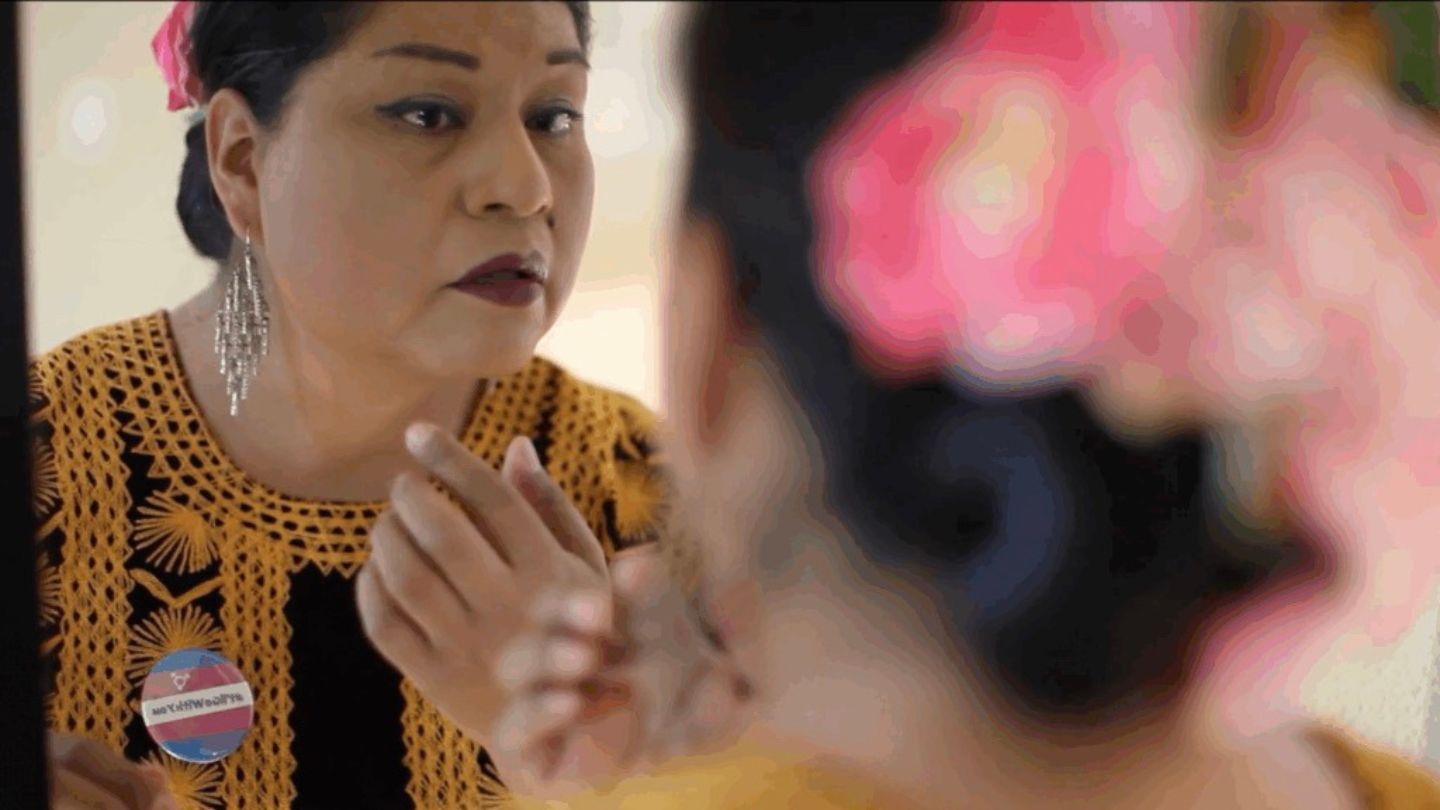
Post-screening Q&A with the filmmaker. A screening of Libertad, a documentary about Alejandra, an Indigenous transgender woman from Oaxaca, Mexico who fled violence 30 years ago and now seeks reunion with her elderly mother while advocating for immigrant, LGBTQ+, and indigenous rights in California. The film explores family, identity, and the transnational challenges of survival and solidarity across borders. Part of the 18th annual SF Latino Film Festival at the Roxie Theater.
Introduction by directors Stephens and Sprinkle with Q&A moderated by Madison Young. A screening of Playing with Fire: An Ecosexual Emergency, a documentary by Beth Stephens and Annie Sprinkle about ecological grief, resilience, and transformation in the aftermath of California's wildfires. When lightning forces the longtime lovers to evacuate their Boulder Creek home, they channel loss into ecosexual art and environmental activism, weaving stories from formerly incarcerated firefighters, Indigenous scholars, fire artists, and community members. The film explores fire as destructive, regenerative, and erotic force while centering queer resilience amid climate crisis.
A 30-minute gallery talk with Batul True Heart, a 2Spirit Yaqui-Chicane and Panamanian death and grief worker, herbal medicine maker, and emotional release specialist. Batul will share their personal experience practicing traditional medicine during times of mourning, discussing the path to earth-based ancestral medicine, Indigenous perspectives on emotion, and practical ways to connect with feelings, the earth, and natural elements. As part of OMCA's Día de los Muertos Community Celebration, they will introduce cempoalxóchitl (marigold) and how to work with it during grief. Batul co-creates Floripondio End of Life Planning and Services and produces Maaso Medicina: Flower Medicine for Ancestral, Generational, and Personal Pain.
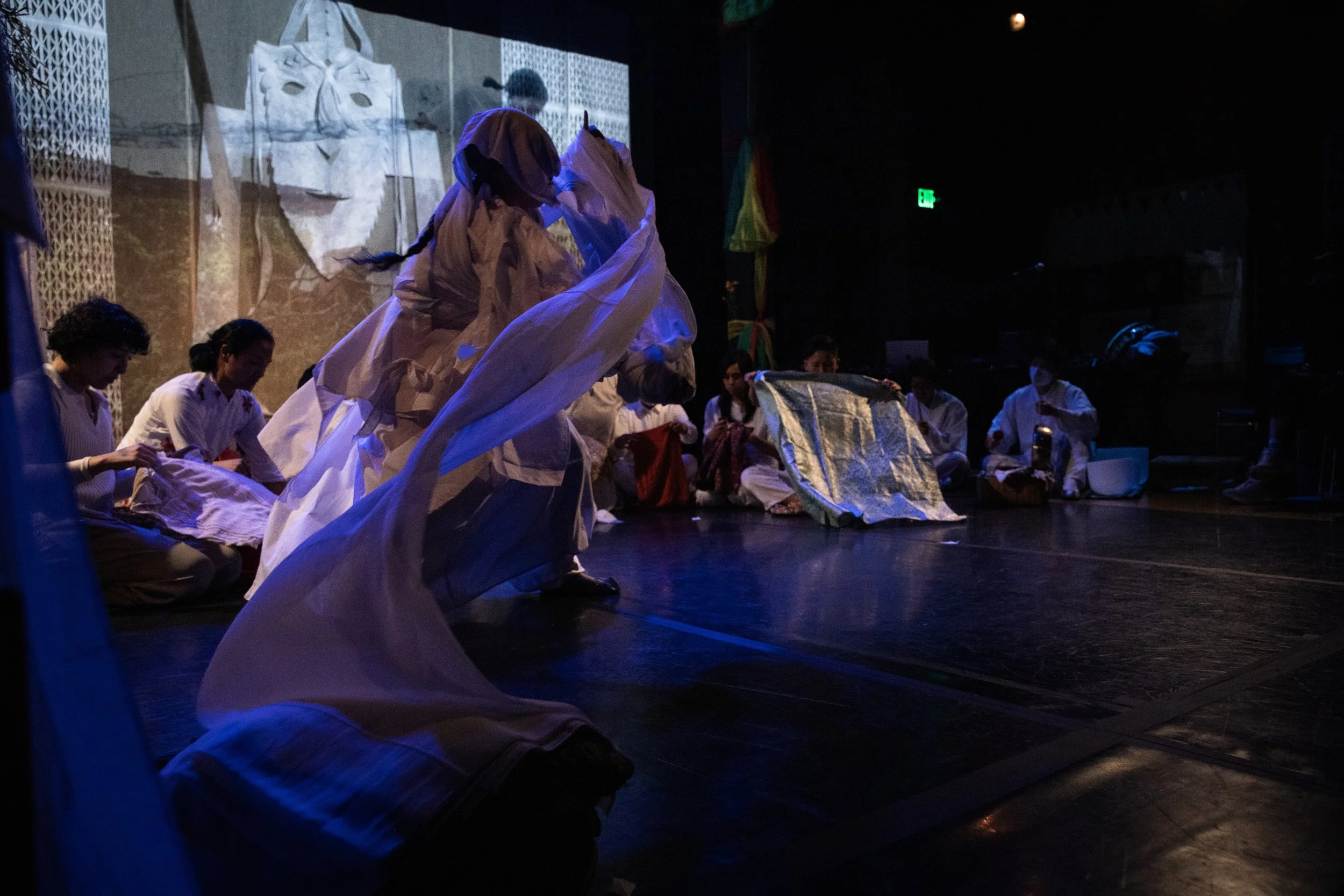
Rite Life is a workshop blending automatic writing with ancestor veneration practices, designed to confront difficult emotions and celebrate what sustains us. Facilitated by Gabe alongside local writers and spiritual practitioners, the workshop carries forward the vision of poet and spiritual teacher Honeysun, who conceived it in 2016. Participants of all ages engage in guided writing and reflective practice in the museum's cemetery setting. All ages welcome.
Examining the rise and fall of the Voting Rights Act from its triumphant passage in 1965 to its recent evisceration by the Supreme Court's Louisiana v. Callais decision, Kevin T. Morris explores the ongoing struggle to protect voting rights in America. Morris contextualizes the landmark 1965 legislation within decades of civil rights history and analyzes the legal and political forces that have systematically dismantled its protections.
Adam Wilson discusses his darkly comic novel *Fail Sons*, about two estranged brothers who drive their father's cryonically frozen body across a divided America to its final resting place. A 21st-century story exploring masculinity and grief. In conversation with Nina Schloesser Tárano.
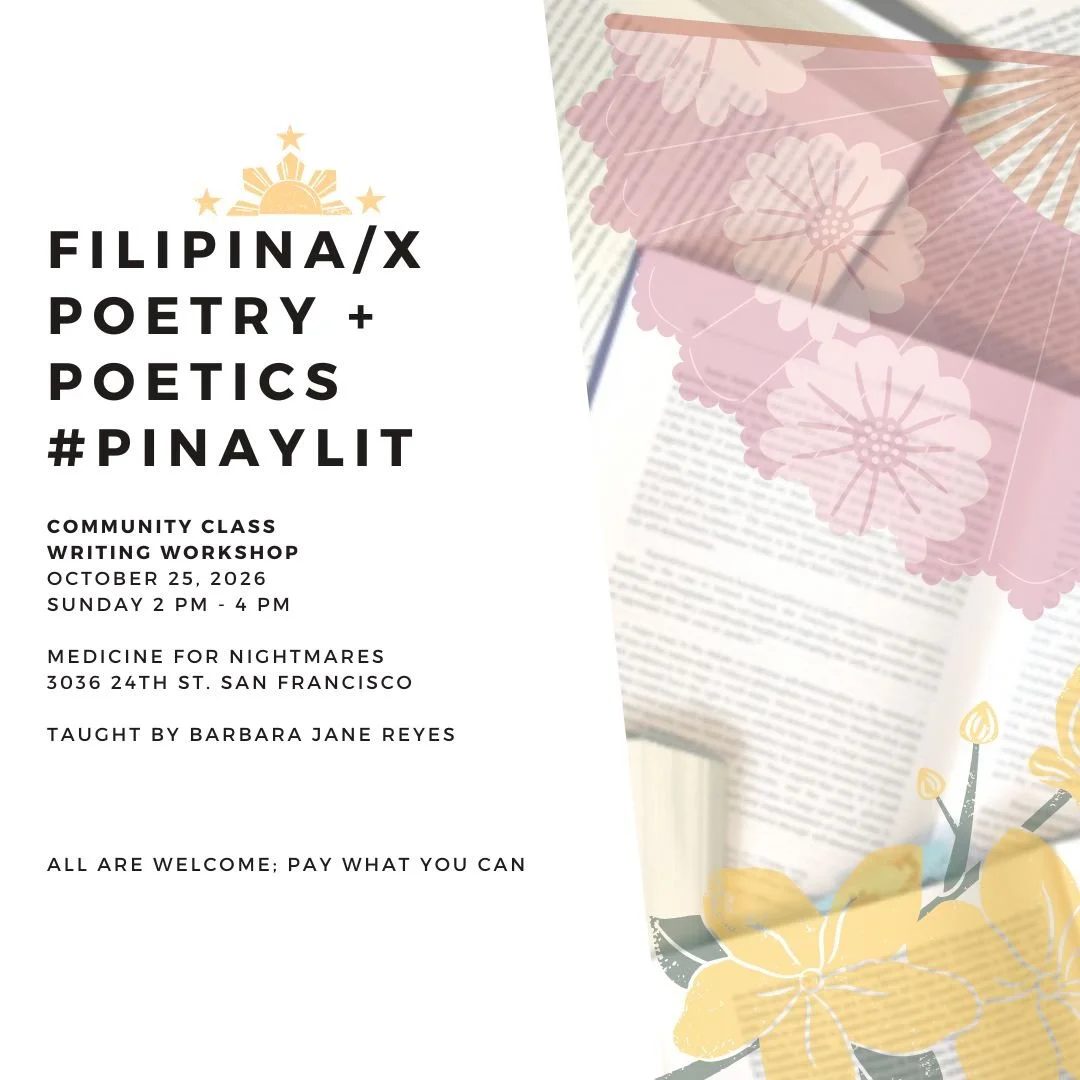
A writing workshop on Filipina/x poetry and poetics hosted by Barbara Jane Reyes, Bay Area author and educator. Participants will read and discuss poems by Filipina/x poets from the Philippines and diaspora, examining language, form, and themes of power, patriarchy, and subversion. The workshop concludes with participants writing their own poems. Reyes has published six books including Gravities of Center, Diwata, and Letters to a Young Brown Girl, with Daughtersong Diaspore forthcoming from Black Lawrence Press in 2027.
A workshop exploring Catholic Social Teaching as a living tradition of shared discernment on justice and human dignity. Fr. William O'Neill, a Jesuit scholar and resident at Santa Clara University's Markkula Center, draws on his work in refugee camps across Kenya, Uganda, and South Sudan to address how we embody CST's vision today—encompassing human rights, ecological ethics, immigration policy, and restorative justice. The session includes structured conversation and reflection, open to Christians and non-Christians alike.
A double panel discussion featuring participants from the Jack Mason Museum's ongoing oral history projects. The first panel explores Growing New Food Systems: Innovative Agriculture and Land Conservation in West Marin County; the second, Building Community: Young People Transform West Marin in the 1970s. Panelists include Dennis and Sandy Dierks and other local participants whose lived experience shaped the region's agricultural and social landscape. Hosted by The Dance Palace and moderated by Dewey.
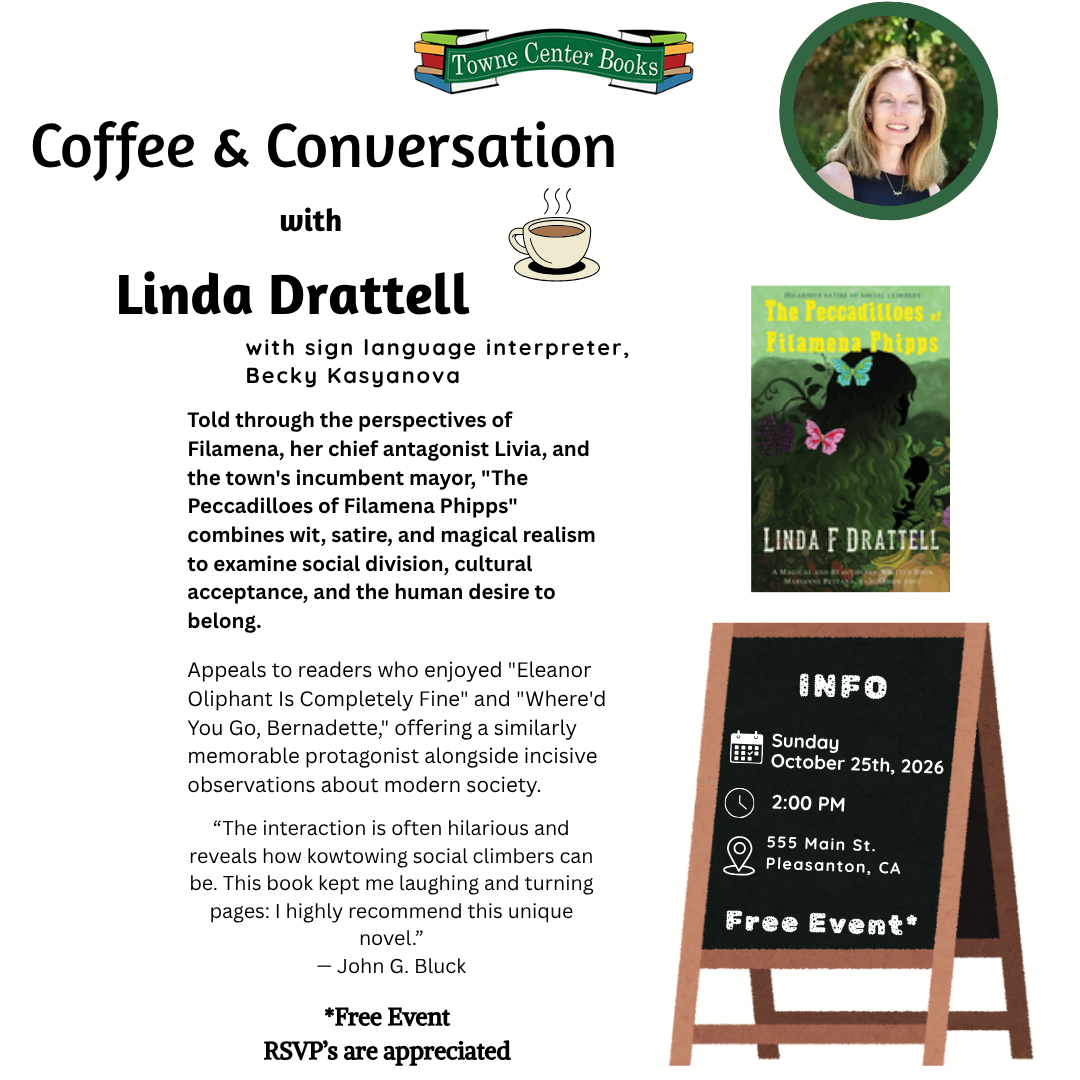
We are pleased to host author Linda Drattell for Coffee & Conversation on Sunday, October 25, 2026 at 2:00 pm at Towne Center Books (555 Main St, Pleasanton, CA). We will also be joined by sign language interpreter Becky Kasyanova.
This is a free event but RSVP's are appreciated. You can RSVP below or you can call 925-846-8826 during store hours.
Open house at Winslow House Project featuring the exhibition 'Truth Burial: Text It from the Tub', with artists Quim McLauchlan, Isabella Marie Garcia, Dana Morrison, Maria Dolores A. Matienzo, and Kris Goodie. RSVP to kim@winslowhouseproject.org.
Comedian and Monty Python founder Eric Idle discusses his memoir *Idle in Provence: A Brief History of Thyme*, an equal-parts memoir and travelogue exploring his time in the French countryside. In conversation with author Dave Eggers, Idle reflects on a life of comedy, creativity, and misadventure. Hosted by Book Passage.
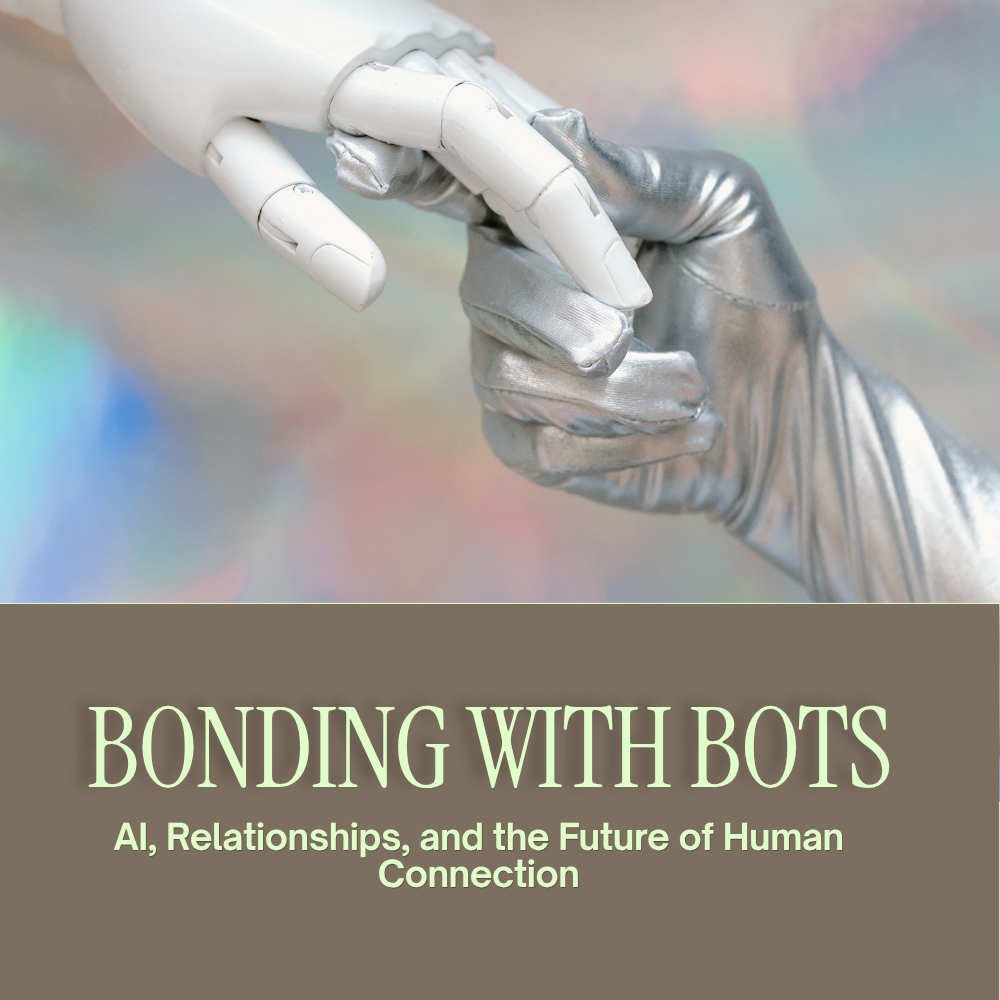
An intimate, facilitated philosophical dialogue on how AI is changing everyday life. Resonance Salons bring together people across tech, art, care, and community for Socratic-style conversation on rotating monthly themes. Each session includes guided group discussion and a creative share—music, writing, poetry, or other forms of expression. Dinner and drinks provided.
A witty, chess-playing stray cat tries to elude a catnapper while helping two tournament-bound schoolkids navigate life's challenges. Authors Ilona Bray and Stephen C.S. Soong discuss their novel.
John Briscoe, SF poet, lawyer, and restaurateur, discusses the plagiarism of women's writing in the Western canon—examining how female authors have been erased, misattributed, or had their work appropriated within literary history.
Medical anthropologist and author Sherine Hamdy discusses her debut graphic novel Landing in Place (Penguin Random House, 2026), illustrated by Myra El Mir. The coming-of-age story follows Anisa, an Egyptian American college freshman navigating premed expectations, identity, and artistic aspiration as she spends time in Cairo discovering her own voice. Hamdy is a leading scholar of Muslim medical ethics and the political economy of disease in Egypt, and a pioneering advocate for academics sharing research across multiple media forms, including her co-authored graphic novel Lissa: A Story of Friendship, Medical Promise, and Revolution.
Drag Story Time as a Site of Resistance, Queer World-Making and Community Building — a lecture by Danny Castillo (they/them), an emerging queer scholar and multidisciplinary artist specializing in queer anthropology and child development at San Jose State University. Castillo recently co-organized "Rhinestone Skies: A Night of Drag and Poetry," a family-friendly evening at the San Jose Museum of Art, and is a fellow for the Bay Area Artist Census. Part of the Carol Mukhopadhyay Feminist Lecture Series.
Sharon Weill, Professor of International Law and Director of the Justice Lab at American University of Paris, discusses her ethnographic study of terrorism trials in France, published by Cambridge University Press. Based on hundreds of courtroom observation days spanning small cases to landmark trials including the Charlie Hebdo and Bataclan proceedings, the book examines how terrorism logics are negotiated within criminal proceedings. Through courtroom immersion, legal performance analysis, and interviews with judges, prosecutors, lawyers, and victims, Weill investigates how justice actually functions in practice and traces three generations of evolving trial approaches. The work offers both empirical insights into French criminal procedure and comparative perspective for Anglophone readers unfamiliar with civil law systems.
Hiroyuki Murase, CEO and Creative Director of suzusan, discusses the textile brand's mission to bring traditional Japanese shibori dyeing into contemporary fashion. Murase reflects on the relationship between tradition and innovation, local identity and global exchange, and design's role in shaping a sustainable future for craftsmanship.
Judge Thelton Henderson, UC Berkeley Law Class of 1962, shares stories and insights from his career as a civil rights lawyer and federal judge, in conversation with Federal Appeals Court Judge and UC Berkeley Law Professor William Fletcher. Henderson's work spans landmark civil rights cases and his tenure on the federal bench, offering a window into judicial reasoning and social change advocacy.
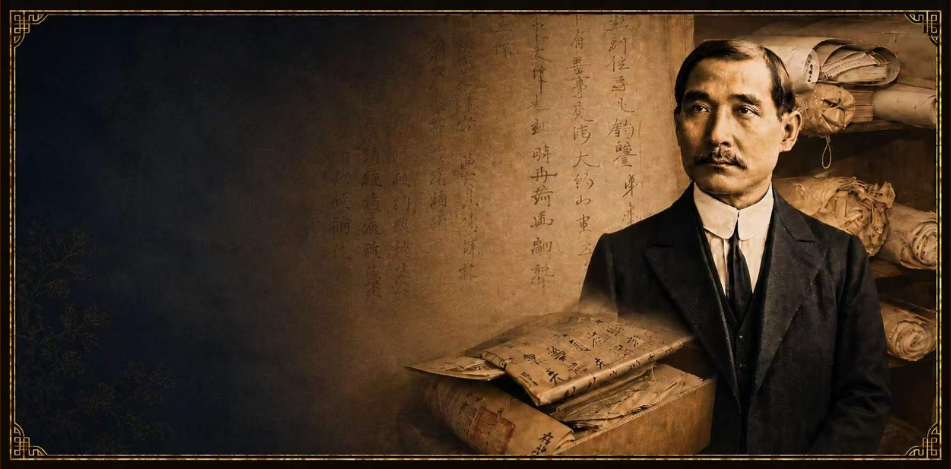
A screening of Young China, a documentary retracing Sun Yat-sen's travels across six American cities through historic sites, archival materials, and interviews with descendants and community members. The film explores Sun Yat-sen's deep connections to the United States and the Chinese American communities who supported his revolutionary work over a century ago. Following the screening, a live panel with descendants, scholars, and community members invites reflection on immigration, identity, community involvement, and trans-Pacific history. Part of a special program marking the 160th anniversary of Dr. Sun Yat-sen's birth.
How did Iraq and Syria navigate independence in the 1940s–50s, balancing constitutional democracy with military intervention and emergency rule? Matthieu Rey, senior researcher at CNRS-EHESS and former director of the Contemporary Studies Department at IFPO Beirut, examines this contradictory political legacy — the flourishing of parliaments, parties, and civil society alongside authoritarian constraints and military interference. Drawing on 15 years of fieldwork across the Middle East and his book *Histoire de la Syrie*, Rey explores the foundational questions both countries faced: who deserved citizenship, how to develop the nation, and how to distribute power between executive and legislature. These tensions, he argues, prefigure struggles that continue today.
A panel discussion on Abiya Ahmed's new book *Being Muslim on Campus: Religion, Inclusion, and Agency at a Secular University* (OUP, 2026), examining the intersection of scholarship and institutional practice. Ahmed, PhD '21, is Director of the Markaz Resource Center and Associate Dean of Students at Stanford. The panel features Anna Bigelow (Associate Professor of Religious Studies), Anthony Antonio (Associate Professor of Education), and Samuel Santos (Senior Associate Vice Provost of Student Affairs), chaired by Shirin Sinnar (William W. and Gertrude H. Saunders Professor of Law) and Alexander Key (Associate Professor of Comparative Literature).
A lecture on aging and eldercare in fin-de-siècle Russian and Yiddish theater, examining how playwrights Anton Chekhov and Jacob Gordin represented old age and care on stage. Gabriella Safran, professor at Stanford University, explores how these two literary traditions approached the theme of aging during this period of cultural and social transformation.
Blake J. Harris discusses his authorized biography of Larry David, the legendary comedian and co-creator of Seinfeld and Curb Your Enthusiasm. The book draws on exclusive interviews with David himself and explores his career, creative process, and cultural impact. Harris is a bestselling author and cultural critic.
A Theory of Operatic Scene Type. Joy H. Calico, Professor of Musicology at UCLA, presents her theory of operatic scenes as recurring narrative and musical nodes — love duets, diegetic songs, rage arias — that constitute a kind of operatic DNA recognizable across centuries and musical styles. Drawing on examples from twentieth- and twenty-first-century opera, including Kaija Saariaho's L'amour de loin, Calico demonstrates how scene types transcend composer, subgenre, and style to reveal deep structural patterns in how opera makes meaning through music, character, and performance.
Brandon Mull discusses his new novel Guardians: Forbidden Mountain, sharing insights into his writing process and answering questions from readers. The bestselling author of The Fablehaven series and Beyonders returns to Rakestraw Books for an after-school event.
Emily Ogden discusses her biography *Darkness Becomes Bright: On the Brief Life and Immortal Art of Edgar Allan Poe* (Viking) in conversation with Point Reyes Books owner Stephen Sparks. Ogden explores Poe's life and enduring influence on American literature and culture.
Has the Democratic Party lost its soul? Author and former Democratic operative Evan Barker discusses her inside story of departing from the party, arguing it has been hijacked by out-of-touch activists, coastal elitists, and special interests. She explores her political disillusionment in conversation with Sarah McCammon, National Correspondent for NPR.
A book talk on China's prison camps, their Soviet roots, and the threats to journalists investigating them. Orville Schell, Arthur Ross Vice President of the Center on U.S.-China Relations at Asia Society and former Berkeley Journalism dean, discusses his research with Adam Hochschild, author of *The Unquiet Ghost* and *King Leopold's Ghost* and lecturer at Berkeley Journalism. Welcoming remarks from Sasha Schell, supervising reporter at the Human Rights Center. Hosted by the Human Rights Center at Berkeley Law.
Twenty writers pitch their unpublished books in one-minute rounds, judged by publishing professionals Arielle Eckstut and David Sterry. Modeled on American Idol but gentler, Pitchapalooza gives aspiring authors direct feedback on their pitch and a chance to connect with agents, editors, and fellow writers. Open to writers at any stage of development.
Timothy Pakron, cookbook author and food blogger, discusses his latest book *Garden Variety*, a collection of recipes inspired by his garden. Pakron is the creator of Mississippi Vegan, which explores plant and mushroom cooking by merging Southern culinary traditions with veganism. His work has been featured by NPR, Garden & Gun, Food & Wine, and other national outlets. He will be joined by Erica Schneider.
Daniel Peña, Pushcart Prize-winning writer and Associate Professor at the University of North Texas, discusses his essay collection How to Look Away, which explores how fringe elements of his Texas childhood—AM radio, conspiracy theories, post-Cold War paranoia—came to dominate American political discourse and enabled tolerance for human rights abuses against Latin American migrants. Through journalism, cultural criticism, and memoir, Peña reflects on American citizenship, belonging, and complicity, asking: what compels us to look away from these abuses, and how do we wake ourselves into action?
Who gets called a witch—and what happens when people believe them? UC Berkeley PhD candidate Ilyssa Forman traces the history of American witch hunts from Salem through the Lavender Scare, exploring how the idea of the witch has been weaponized against those deemed dangerous by society: women who refused to obey, LGBTQ+ people, immigrants, sex workers, and other criminalized "others." Through centuries of American fear and difference, Forman asks what makes witch hunts possible, why people become convinced danger hides among them, and what happens when the hunt outlasts the supposed threat. A lecture on power, persecution, and the language of exclusion, followed by Q&A and discussion.
A celebration of Fatimah Asghar's sophomore poetry collection *Daughter of the Mountains*, with writers R.O. Kwon and Ingrid Rojas Contreras. Asghar's collection explores exile, ancestry, spirituality, and belonging through meditative poems that grapple with loss, longing, and love. Kwon is author of the National Book Critics Circle finalist *The Incendiaries* and *Exhibit*. Rojas Contreras is author of the Pulitzer Prize finalist memoir *The Man Who Could Move Clouds* and the novel *Fruit of the Drunken Tree*. Hosted at The Booksmith. Seats available by advance book purchase or $3 sliding-scale donation; general admission on a first-come, first-served basis.
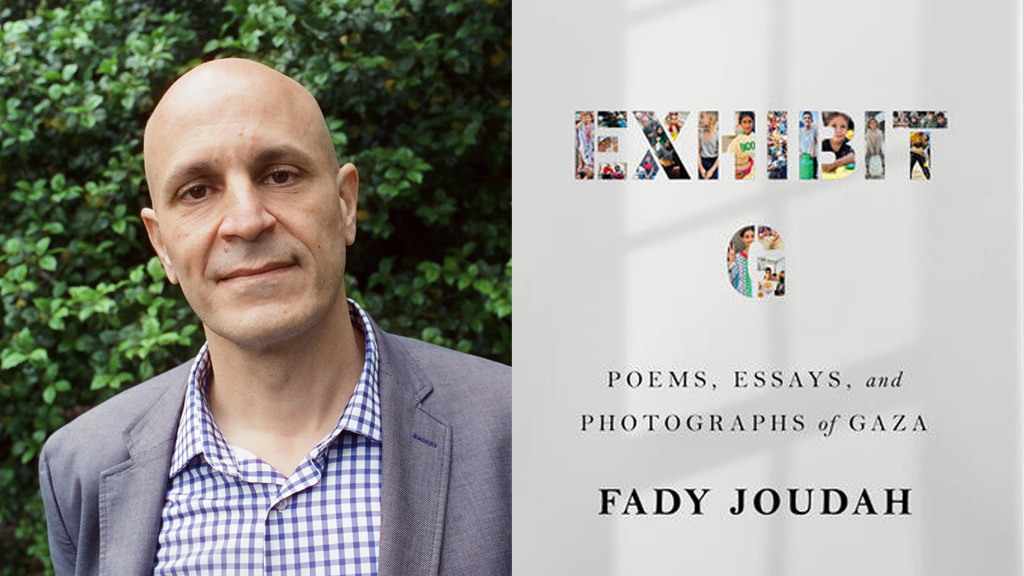
National Book Award finalist Fady Joudah discusses Exhibit G, a collection of poems, essays, and photographs offering a Palestinian representation of Gaza's devastation and resilience. Writing from his perspective as a Palestinian American physician, Joudah explores the paradoxes of witnessing destruction from afar while caring for the sick in the US. The book combines personal reflection with images from Gaza, insisting on Palestinian interiority and the survival of beauty amid genocide. Proceeds benefit Gaza Soup Kitchen.
A talk with Ken Knabb, translator of Guy Debord and the Situationist International and author of The Joy of Revolution. Knabb's masterwork examines modern revolutionary possibilities through a situationist lens, analyzing radical tactics across ordinary and extraordinary conditions, and envisioning postrevolutionary liberated communities. This new edition includes updates, detourned comics, reviews, analyses of Occupy and Trump-era resistance, and reflections on the coronavirus shutdown.
A screening of Alejandro Jodorowsky's Santa Sangre (1989), followed by discussion with local photographer and film enthusiast Tommy Milutin. This haunting, dreamlike odyssey follows a traumatized circus performer navigating a surreal world shaped by his mother's influence, past violence, and distorted love—blending horror, spirituality, and psychological turmoil into a strikingly unconventional cinematic experience.
Ken Goldberg, Professor of Industrial Engineering and Operations Research at UC Berkeley, discusses his work as part of the Berkeley Writers at Work series. The event takes place Tuesday, October 27, noon–1:30 pm.
Maisha T. Winn, Excellence in Learning Professor at Stanford's Graduate School of Education, discusses her historical ethnography *Futuring Black Lives*, examining Black institution builders of the late 1960s–70s who used publications and literary imagination to shape education for Black children. The book traces how Independent Black Institutions anchored shared Black values while preparing students in identity, purpose, and direction—a model Winn argues remains vital amid current racial disparities in schooling, disproportionate discipline of Black students, and attacks on children's literature through censorship and book bans. She demonstrates how historical archives of Black educational thought can inform contemporary equity and justice work in schools.
An introduction to materia's yearly theme exploring micropower and the non-human. The reading session engages Foucault's concept of the microphysics of power from *Discipline and Punish*, examining how power operates between state apparatuses and material bodies—understood in an expanded, non-human sense. Participants will consider contemporary manifestations like algorithmic governance and corporate attention capture. The session includes excerpts from Foucault, Jane Bennett's *The Force of Things*, Clarice Lispector's *The Hour of the Star*, and Nerea Barjola Ramos' *The Sexist Microphysics of Power*. Organized by materia, a Stanford-based Latin Americanist humanities collective.
A reading and conversation with Palestinian American physician, poet, and translator Fady Joudah, whose newest collection, Exhibit G, comprises poems, essays, and photographs offering a Palestinian perspective on grief, resilience, and survival amid genocide. Joudah is an acclaimed translator of Arabic poetry, including works by Mahmoud Darwish, and has won the Yale Younger Poets Prize, Griffin Poetry Prize, Guggenheim Fellowship, and American Book Award, among others. He co-founded the Etel Adnan Poetry Prize and practices internal medicine in Houston.
A presentation and discussion of *Depose: Luigi Mangione, the Right to Health, and the Unfinished American Revolution*, written by the December 4 Legal Committee, which created Luigi Mangione's legal defense fund. The book brings the American healthcare debate to fundamental political questions: Who profits from sickness? Who gets access to health? What would a healthcare system serving everyone look like? A spokesperson for the authors will present.
An open class session of the Institute for Diversity in the Arts' Intro to IDA course, exploring power, art, and practice through conversation with scholars working across disciplines—theater, performance, visual art, music, and film. Associate Professors Matthew Morrison (African and African American Studies) and Usha Iyer (Art and Art History) lead a facilitated discussion using the Long Table format, inspired by the practice of legendary queer performance duo Split Britches (Peggy Shaw and Lois Weaver), examining how artists engage these themes both within and beyond the university.
A series of educational sessions throughout October exploring the history and traditions of Día de los Muertos (Day of the Dead), culminating in the 4th Camino de los Muertos on November 1st. The program examines the meanings behind key elements of the celebration—the ofrenda (altar), calaveras (skulls), catrinas (dapper lady skulls), cempasúchil (marigolds), and more—with particular focus on place, memory, and resistance in altar-making practices. Hosted by Santa Clara University, open to the community.
A conversation with past and current leaders of UC Berkeley's Center for the Study of Sexual Culture surveying trans and queer studies scholarship, documenting attacks on LGBT studies, and exploring how the field might move beyond defensive responses. The dialogue will highlight the social movements, artistic interventions, and research reshaping the field. Featuring Mel Y. Chen (Gender & Women's Studies), Michael Lucey (French and Comparative Literature), and Roshanak Kheshti (Theater, Dance, and Performance Studies), moderated by Eric A. Stanley (Gender and Women's Studies).
A reading and conversation with Fady Joudah, Palestinian American physician, poet, and translator. Joudah will discuss his newest collection, *Exhibit G: Poems, Essays, and Photographs of Gaza*, which combines poetry, essays, and photographs to document Palestinian grief, resilience, and life under genocide. A multiple-award winner—including the Yale Younger Poets Prize, Griffin Poetry Prize, and American Book Award—Joudah has also translated works by Mahmoud Darwish and co-founded the Etel Adnan Poetry Prize. *Exhibit G* will be available for purchase and signing.
Nicholas Kristof, Pulitzer Prize–winning New York Times columnist, bestselling author, and documentarian, discusses his path from an Oregon farm to leadership on global justice and climate issues. Kristof's journalism and films have brought urgent humanitarian and environmental stories to millions, bridging the gap between reporting and advocacy. This talk explores how journalism can drive change on the world's most pressing challenges.
USA Today bestselling author Adam Plantinga discusses his latest thriller, Dark Country, the newest installment in the Kurt Argento series. Argento finds himself shielding a teenage boy caught up in a dangerous manhunt in this explosive crime novel.
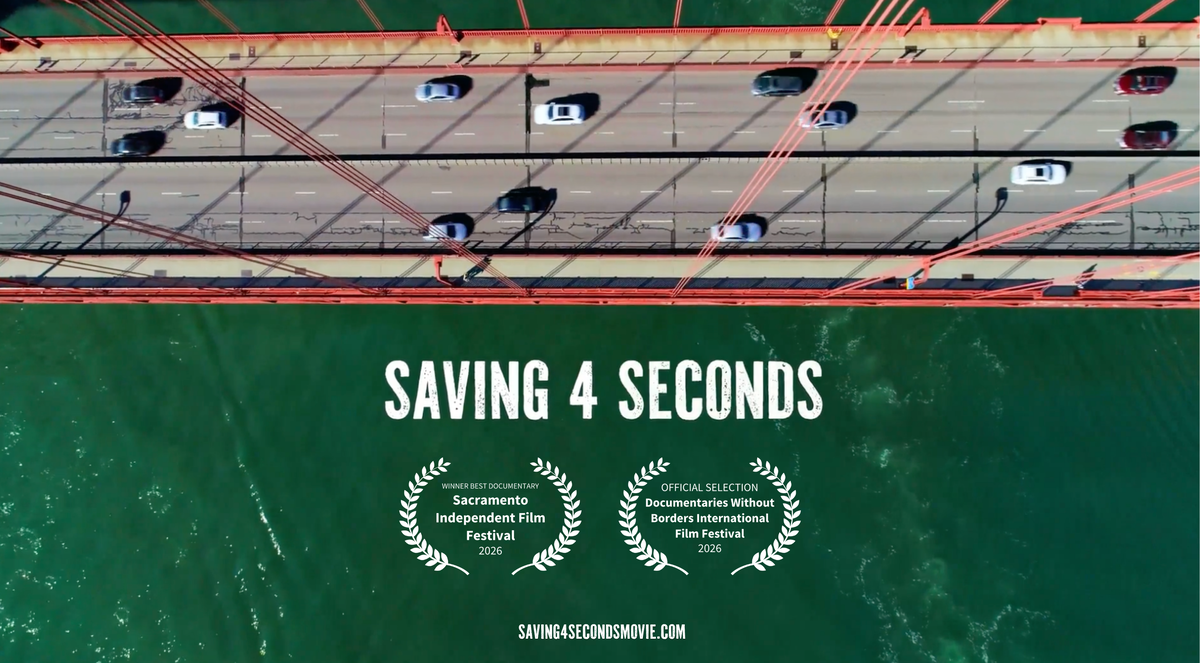
A screening of Saving 4 Seconds, a documentary about Bay Area efforts to implement life-saving suicide-prevention policy on the Golden Gate Bridge. The film features interviews with local families, advocates, and elected officials who championed the policy, along with never-before-seen CCTV footage of bridge employees intervening to save lives. Hosted by SPUR Urban Center, a trusted civic institution.
A screening of The Unbroken Sky, a narrative dramatic film adapted from the memoirs of Francisco Jiménez, chronicling his family's journey as immigrant farmworkers in California—their labor in the fields, struggle to access school, and fear of deportation. The screening is followed by a fireside chat between Francisco Jiménez, Professor Emeritus at Santa Clara University, and Tomás Jiménez, Professor of Sociology at Stanford and Founding Faculty Director of the Institute for Advancing Just Societies. A Q&A with the production team—director Josh Peterson, executive producer Normandie Ramirez, and producer Robin Mortarotti—concludes the evening. Jiménez's four-book memoir series, The Circuit, Breaking Through, Reaching Out, and Taking Hold, is recognized among the American Library Association's 50 Best Young Adult Books of All Time.
Dr. Catie Cuan, founder of ART Lab (AI Robot Technology) and pioneer in choreorobotics, explores what happens when artificial intelligence moves beyond screens into physical robots. Drawing on her background in dance and robotics, she argues that movement is not merely functional but expressive—shaping emotion, trust, and human connection. Through examples including robots trained to improvise, respond to human gestures, and move collectively, Cuan demonstrates how choreography informs the design of intuitive, responsive, and human-centered machines. Part of UC Berkeley's Design Field Notes lecture series.
What happens when humanitarian workers operate in one of the world's most closed and repressive regimes? Kathi Zellwegger shares firsthand insights from her experience providing humanitarian aid on the ground in North Korea, offering rare perspective on daily life, state control, and the possibilities for engagement with the isolated communist state. In conversation with Mike Chinoy, journalist and Korea expert.
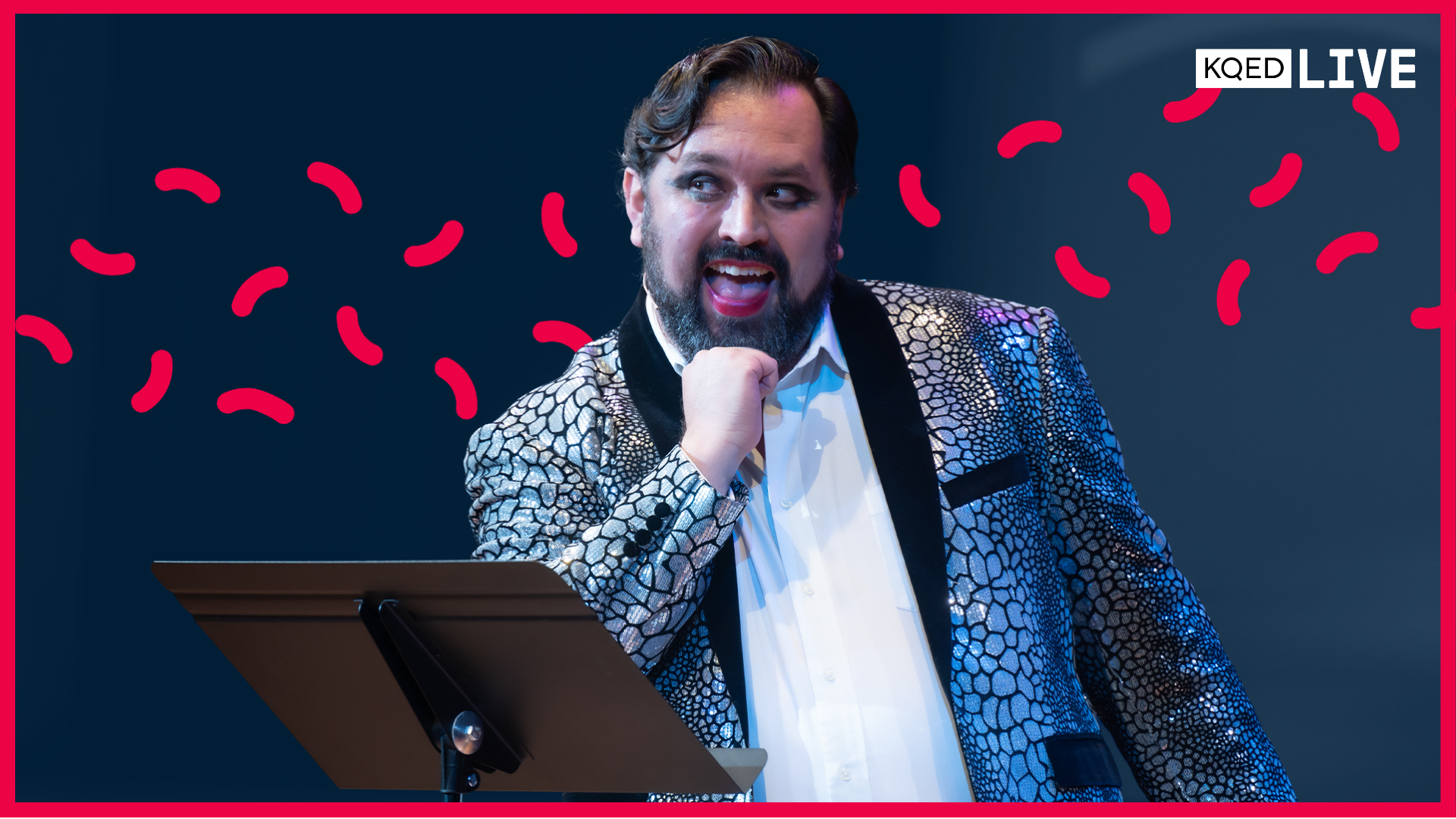
A screening and conversation around Lynn Novick's forthcoming PBS documentary Crime and Punishment in America, executive produced by Ken Burns and Sam Pollard. Novick, an acclaimed filmmaker whose previous work includes documentaries on American history and institutions, will discuss how the United States became the world's leading incarcerator and explore the forces behind mass incarceration. Co-presented by Commonwealth Club World Affairs and KQED Live.
A teach-in and conversation exploring Stanford's legacy of student activism and multiracial solidarity. Student organizers from the Stanford Asian American Action Committee, League of Filipino Students, and Stanford Students for Justice in Palestine reflect on how the 1980s Rainbow Coalition won resources for communities of color, including the establishment of the Asian American Activities Center, and discuss lessons for contemporary organizing.
A reading and conversation celebrating *Best Literary Translations 2026*, an annual anthology edited by National Book Award winner Arthur Sze featuring poetry and prose translated from 62 languages—from French to Xitsonga, Korean to Guaraní. Translators Wendy Call (author and co-founder of the anthology, recent Fulbright Scholar to Colombia), Dmitri Manin (whose translation of Nikolay Zabolotsky's *Columns* was shortlisted for the NCBA and ALTA First Translation Prize), and Ilze Duarte (translator of Marilia Arnaud's *The Book of Affects*) will read from their work, discuss the craft and discovery of translation, and answer questions. The event concludes with a book signing.
Explore how our relationships with cities, parks, and the more-than-human world shape our future in this panel inspired by Susanna Kwan's *Awake in the Floating City*, the 2026 One City One Book selection. Drawing on five years of the Parks as Ancestors series, the conversation expands beyond protected parklands to consider urban spaces as living legacies. Local community leaders working on place-based environmental justice—including moderator Yakuta Poonawalla of the Golden Gate National Parks Conservancy—reflect on memory, loss, connection, and responsibility across generations and cultures. The panel coincides with Indigenous Peoples' Day, Día de los Muertos, and Diwali, inviting participants to consider what we inherit from places and people who came before us, and what we will leave behind. Attendees may bring a photograph or sentimental object honoring someone they have lost.
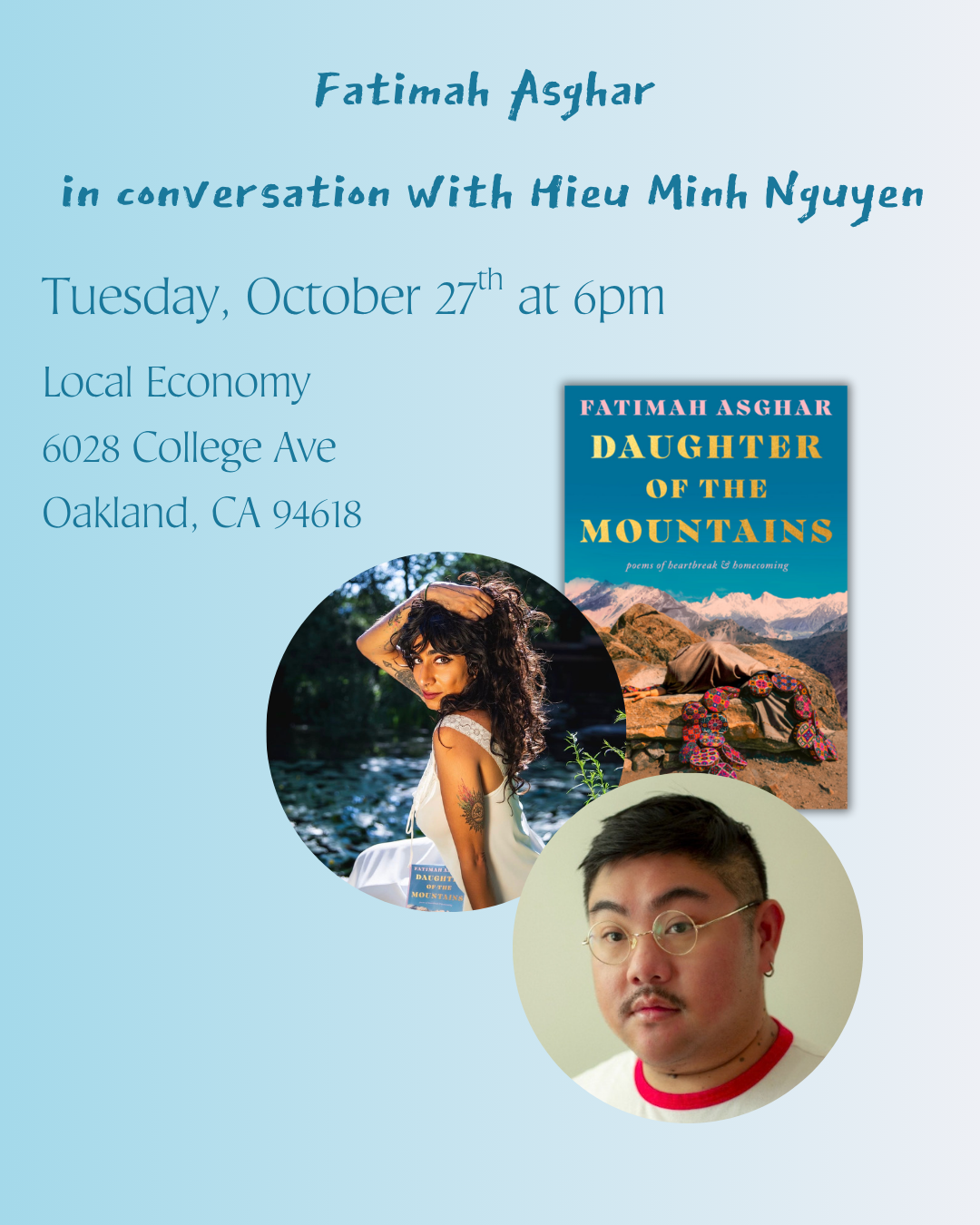
Fatimah Asghar discusses her debut poetry collection *Daughter of the Mountains*, which explores exile, displacement, belonging, spirituality, and lineage through meditative, formally inventive verse. The collection grapples with fulfillment, betrayal, love, loss, and longing, using vivid imagery and disruptive form to examine how place and environment inform spiritual practice. Asghar appears in conversation with poet Hieu Minh Nguyen.
A panel exploring film, the internet, and human agency in the digital age. Bara Kolenc, Gregor Moder, and Jure Simoniti (University of Ljubljana, Department of Philosophy) discuss where subjectivity is located when AI shapes cinema and ideology shapes desire online. Topics include Lubitsch's *To Be or Not to Be* as a meditation on theatrical power, and the dialectic between image and narrative in American versus European cinema. Moderated by Pavle Levi, Stanford Department of Art & Art History.
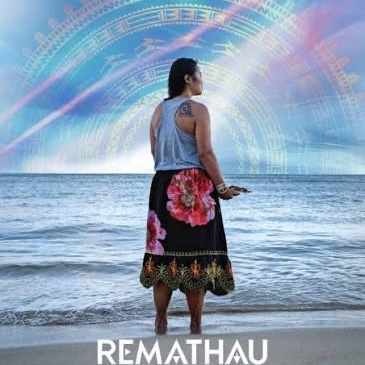
A screening of the 70-minute documentary Remathau: People of the Ocean featuring Dr. Nicole Yamase, the first Micronesian to earn a PhD in Marine Biology and reach the bottom of the Mariana Trench. The film explores her historic dive alongside themes of identity, culture, and belonging, reconnecting with the resilience of her people and the ocean navigation wisdom of earlier generations. Yamase, Director of Impact at OneReef, leads efforts to advance ocean science, conservation, and community-led stewardship across Micronesia. Hosted by Stanford's Doerr School of Sustainability.
A release-night celebration for the new ACOTAR novel featuring wine tasting with a special guest winemaker, book & wine trivia, costume prizes, photo opportunities, and the Suriel's Prophecy Board for reader predictions. Attendees are encouraged to dress in character — Night Court black, Spring Court florals, full Illyrian leathers, or power wear of choice. NA options available.
A moderated conversation with legendary turntablists DJ Qbert and DJ Shortkut exploring their creative journeys, technical innovation, and impact on turntablism as a respected musical discipline. The discussion covers their Filipino heritage, artistic longevity, and commitment to supporting the next generation through education and workshops. Moderated by Kendo the DJ, founder of Mixsterious. A short live demonstration of their technical skill and performance style may be included.
Julie Orringer, bestselling author of *The Invisible Bridge*, discusses her new novel *Luna, Phoenix, Queen*—a work exploring infidelity, literary provenance, and storytelling's transformative power. Orringer's fiction is known for its intricate narratives spanning continents and eras, weaving together historical and contemporary themes. This is an opportunity to hear directly from the author about her creative process and the ideas animating her latest work.
Learn how to craft a powerful pitch to land an agent, secure a book deal, or succeed at self-publishing. Arielle Eckstut and David Henry Sterry, co-authors of *The Essential Pitch*, share strategies for one of publishing's most critical but underestimated tools. Ideal for aspiring and established writers seeking to navigate the publishing landscape.
Poet, author, filmmaker, and educator Amber Allen-Peirson reads from her poetry collection *The Unrooted Bloom*, exploring race, biracial identity, motherhood, family, grief, love, ancestry, and belonging. The intimate, lyrical poems move through the spaces between identities and expectations, asking where we belong, who we are when freed from others' needs, what we've inherited, and what we choose to carry or release. Throughout the reading, audience members are invited to turn these questions toward their own lives and identities.
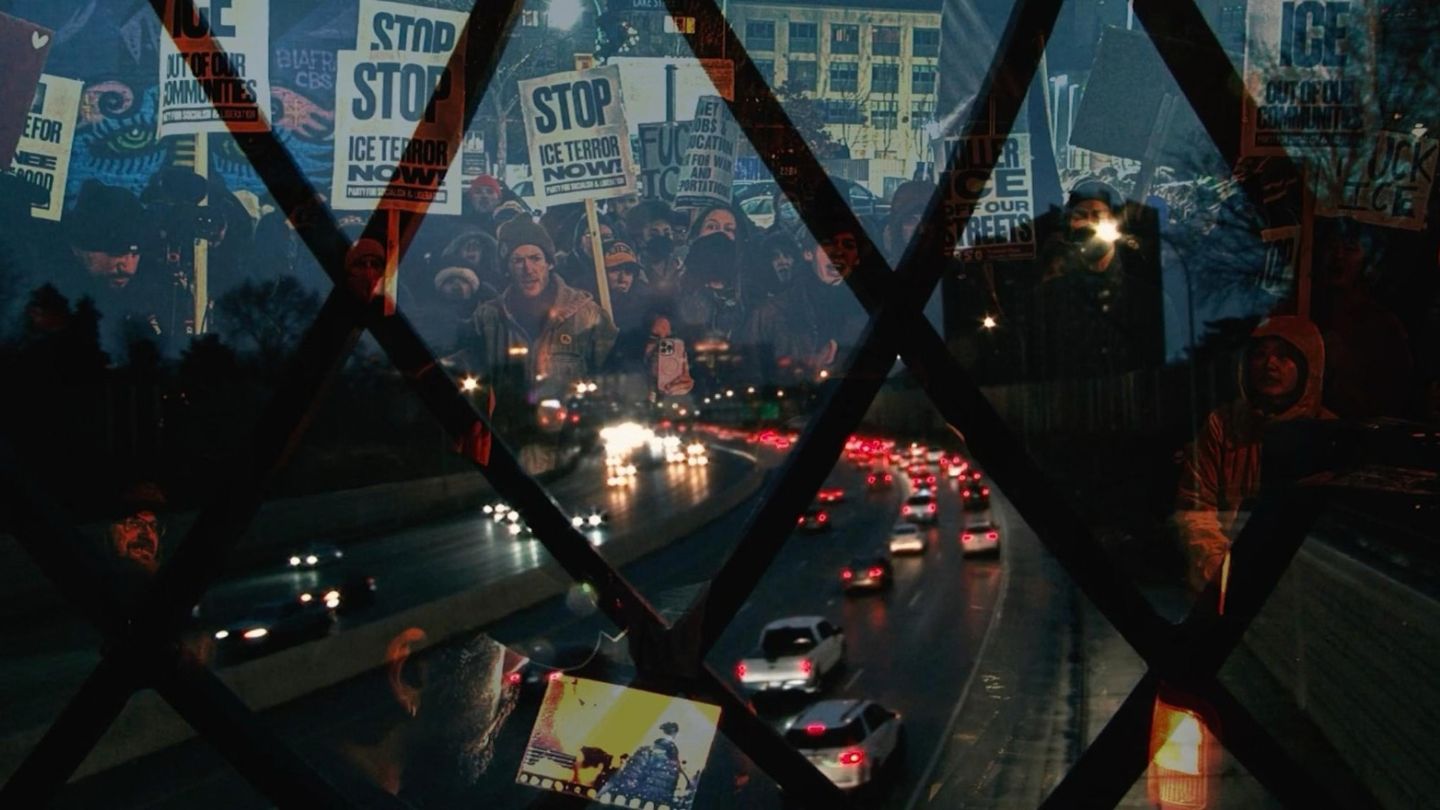
A screening of When ICE Melts, a feature-length documentary about resistance to Operation Metro Surge and ICE enforcement in Minnesota's Twin Cities, with director Kip Hedges in person for a post-screening Q&A moderated by SFSU Faculty and CFA member Blanca Missé. The film follows organizers, community leaders, and working-class resistance across neighborhoods, workplaces, and unions, including footage of the January 23 mass strike. It examines strategic lessons in building democratic structures and solidarity to confront authoritarianism, designed as a resource for organizers and activists in other cities.
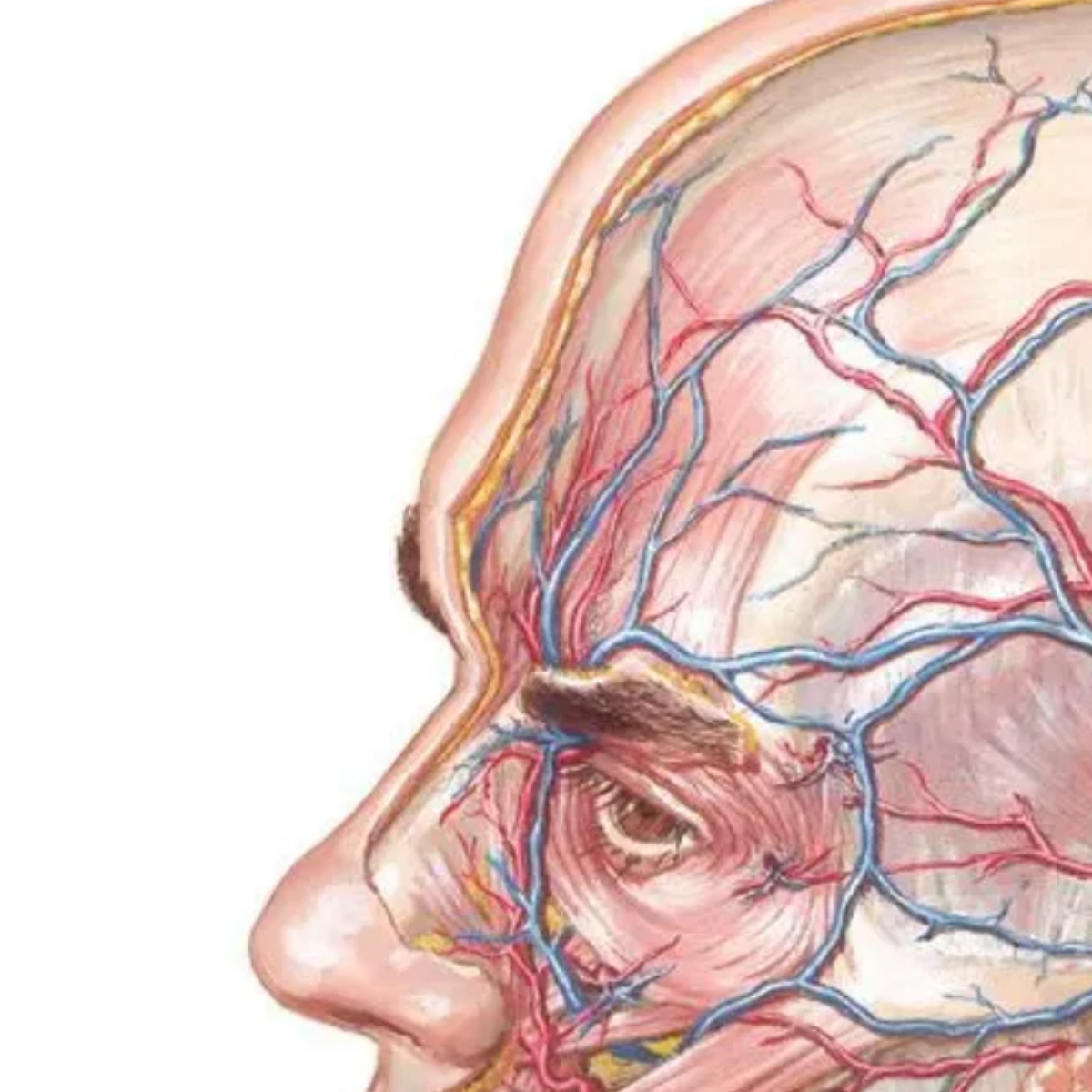
A lecture on Frank Netter's groundbreaking medical illustrations and the intersection of art and science in medical education. Dr. Wen Shen, an endocrine surgeon with a master's degree in the history of medicine, explores Netter's career and his profound influence on how physicians visualize and understand the human body. Part of the Orlo H. Clark Lectureship series.
A fireside chat with Patrice D. Douglass on the philosophical and social dimensions of Black ontology, absence, and what theorists call social death—the historical and ongoing erasure of Black humanity and presence. Douglass brings critical scholarship to bear on how Blackness has been theorized, negated, and reclaimed.
Morgan Eckroth (@MorganDrinksCoffee), 2022 US Barista Champion and Director of Onyx Academy, discusses their book *Coffee, for Here*, a practical handbook for brewing with confidence at home. From bean origins and flavor profiles to approachable brewing techniques, Eckroth meets readers at every level—whether beginners or refiners—breaking down each step with the warm hospitality and inventive approach that has made them a leading voice in coffee education across TikTok, Instagram, and YouTube.
A monthly gathering for graphic novel enthusiasts featuring author talks, participant recommendations, and collaborative drawing and writing sessions. The October 27th meeting features Rina Ayuyang, an Eisner-nominated cartoonist and 25-year veteran of the Bay Area indie comics scene. Ayuyang's latest graphic novel, *The Man in the McIntosh Suit*, was named one of the best books of 2023 by the New York Public Library. Meetings held the fourth Tuesday of each month.
Rabbi Shais Rishon, spiritual leader of Ohel Eidot CHeMDaT"A (the first African American-led and -centered synagogue in Washington, D.C.), discusses his book *The Souls of Black Jewish Folk*, published under his pseudonym MaNishtana. Drawing on a personal legacy of African American Judaism stretching to the 1780s and his upbringing in the Chabad-Lubavitch community, Rishon explores how Jewish tradition, racial identity, and contemporary American life intersect. He will be in conversation with a member of the USF faculty.
Elena Dudum celebrates her debut memoir, *They Told Me Back Home Would Be Beautiful*, at the independent bookshop where she grew up in the West Portal community. Dudum discusses her new work exploring memory, identity, and homecoming.
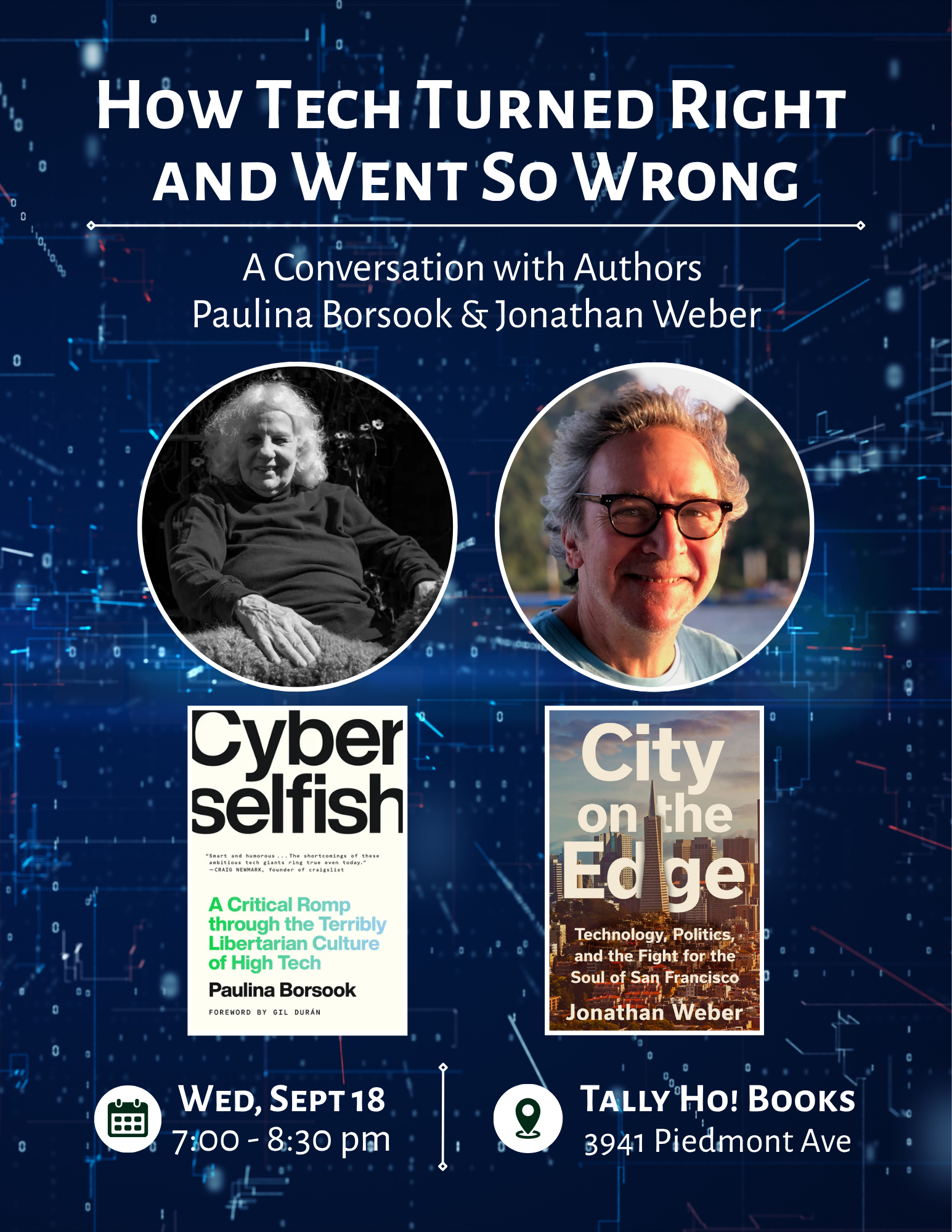
Veteran journalist Jonathan Weber, founding editor of The San Francisco Standard, discusses his book *City on the Edge* in conversation with Bloomberg Businessweek editor Brad Stone. Drawing on nearly 200 interviews with elected officials, tech leaders, activists, and artists, the book chronicles San Francisco's transformation from cultural hub to global technology center, exploring the conflicts and pivotal decisions that shaped one of the world's most influential cities—and what they reveal about its future.
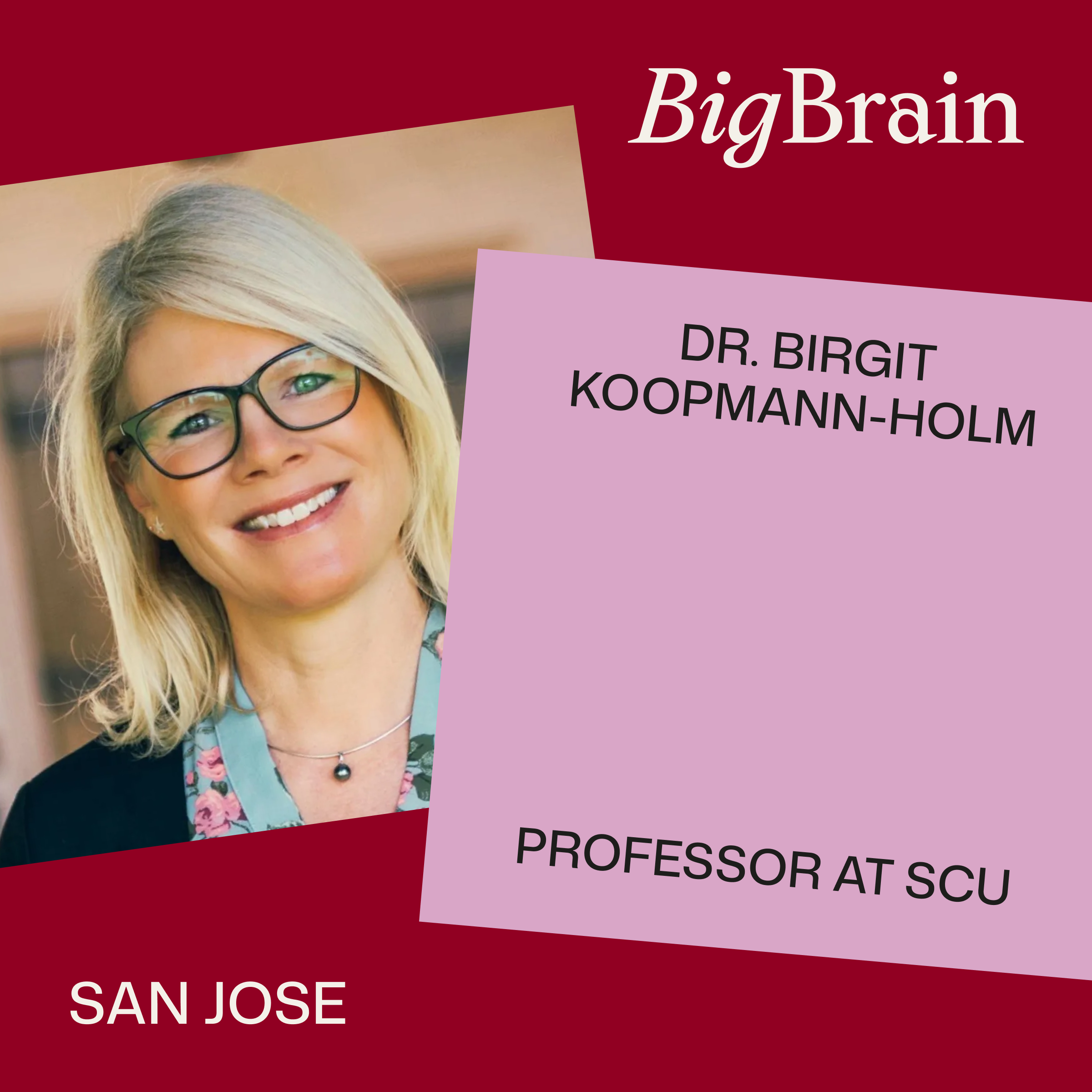
How does compassion differ across cultures? Birgit Koopmann-Holm, Associate Professor of Psychology at Santa Clara University, presents research on how people in the United States, Ecuador, Mexico, China, and Germany understand compassionate responses to suffering. Drawing on hypothetical scenarios and real experiences of bereavement, she shows that cultures systematically differ in whether they favor sharing in someone's pain, helping them toward positive emotions, or balancing both. These differences persist in real grief experiences, suggesting people from different backgrounds may need different kinds of support while grieving. The lecture explores what true compassion means across cultural contexts.
Bestselling historian and former criminal defense attorney Mark Shaw discusses his book *Girl Around the World*, which reveals the untold friendship between pioneering journalist Dorothy Kilgallen and aviator Amelia Earhart in the mid-1930s. Shaw explores how these trailblazing women supported each other's groundbreaking achievements—Kilgallen's famous 1936 24-day solo race around the globe and Earhart's historic transatlantic flights—and Kilgallen's response to Earhart's mysterious disappearance in 1937. Shaw is the author of *The Reporter Who Knew Too Much* and nearly 30 other books, with presentations garnering over 16 million YouTube views.
A discussion of Jenn Scott's debut novel *All the Tiny Beauties*, which spans 90 years in Oakland and explores shifting notions of self across generations through interconnected stories: a reclusive man, his estranged daughter, and a young housemate who form an unlikely friendship that defies age and expectation. Scott and facilitator Andrea Gough examine how the novel grapples with the fragility of identity, societal constraints on authentic selfhood, and the question of who we might become under different circumstances. Scott's work has appeared in *Fiction*, *Gettysburg Review*, and *Alaska Quarterly Review*; her debut collection *Her Adult Life* was longlisted for the PEN America/Bingham Award. Gough is an educator specializing in discussion-based curricula and the transformative power of literature to unsettle and expand thinking.
Zara Marielle reads from and discusses her debut fantasy novel *The Café of Infinite Doors*, a story woven from Scottish mythology and feminist themes. The novel follows Marceline, a sheltered twenty-three-year-old who discovers a magical café—a refuge from her controlling husband—run by a mysteriously feathered woman named Lucretia, her partner Kilda, and Sylvan. When the café's portals begin closing and darkness looms, Marceline must choose between her hard-fought freedom and protecting her newfound family. Marielle is a former ESL teacher and holds an MFA in creative writing from the University of Edinburgh.
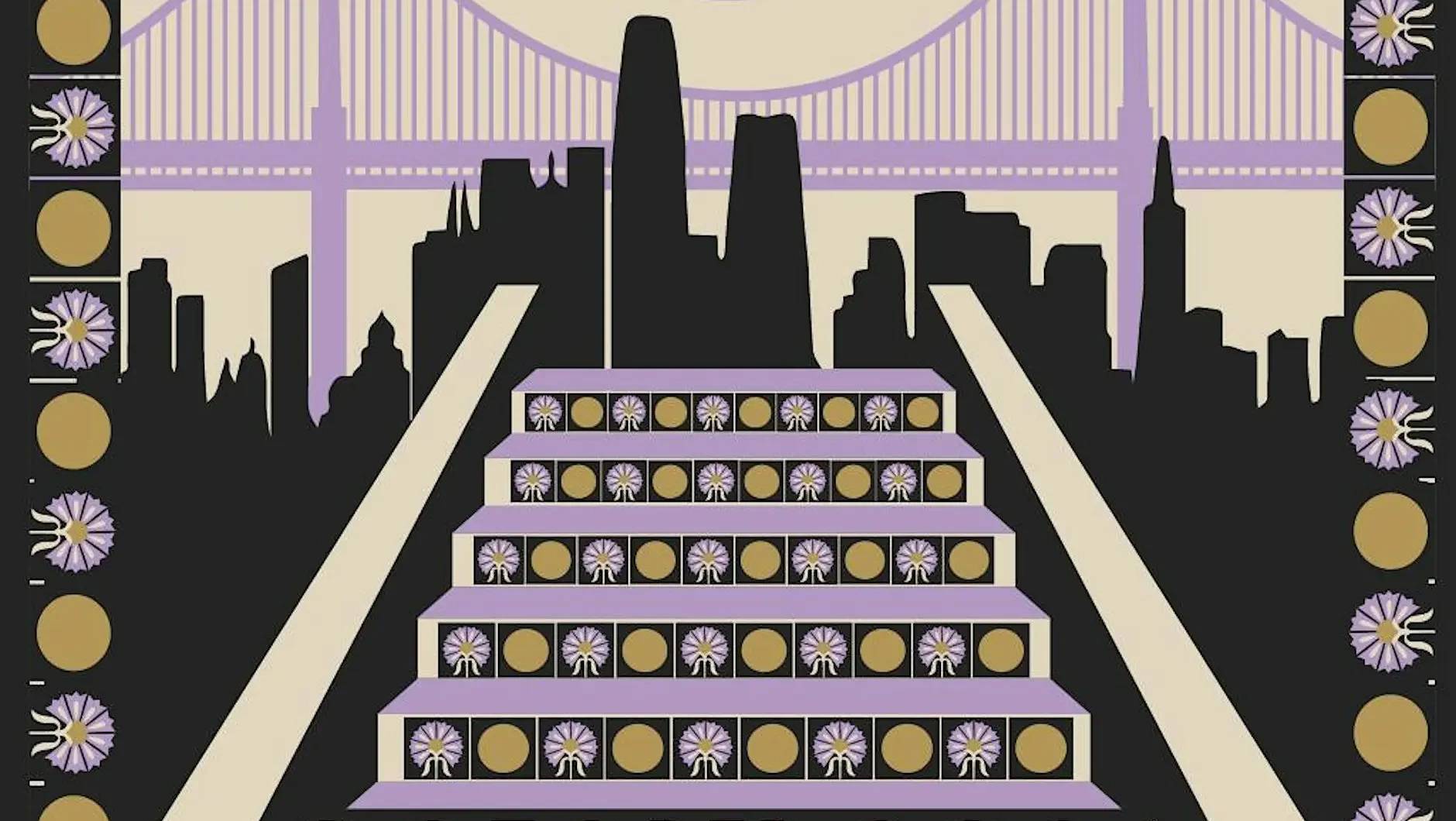
A celebration of San Francisco's stairways featuring authors Mary Burk (Stairway Walks in San Francisco) and Alexandra Kenin (Urban Trails series). Moderator Liz Novoa hosts an SF stairway trivia game while Burk and Kenin share stories of the city's known and hidden stairways, best views, secret gardens, and a detailed map of SF's roughly 1,000 stairways. The grand finale of SF Stairway Month, organized by Glen Park Beautiful as part of the inaugural Walktober celebration.
Screenwriter Matthew Aldrich discusses his debut novel about a billionaire tech visionary who discovers a method to stop aging. A propulsive exploration of ambition, mortality, and the ethics of technological transcendence, featuring a book signing.
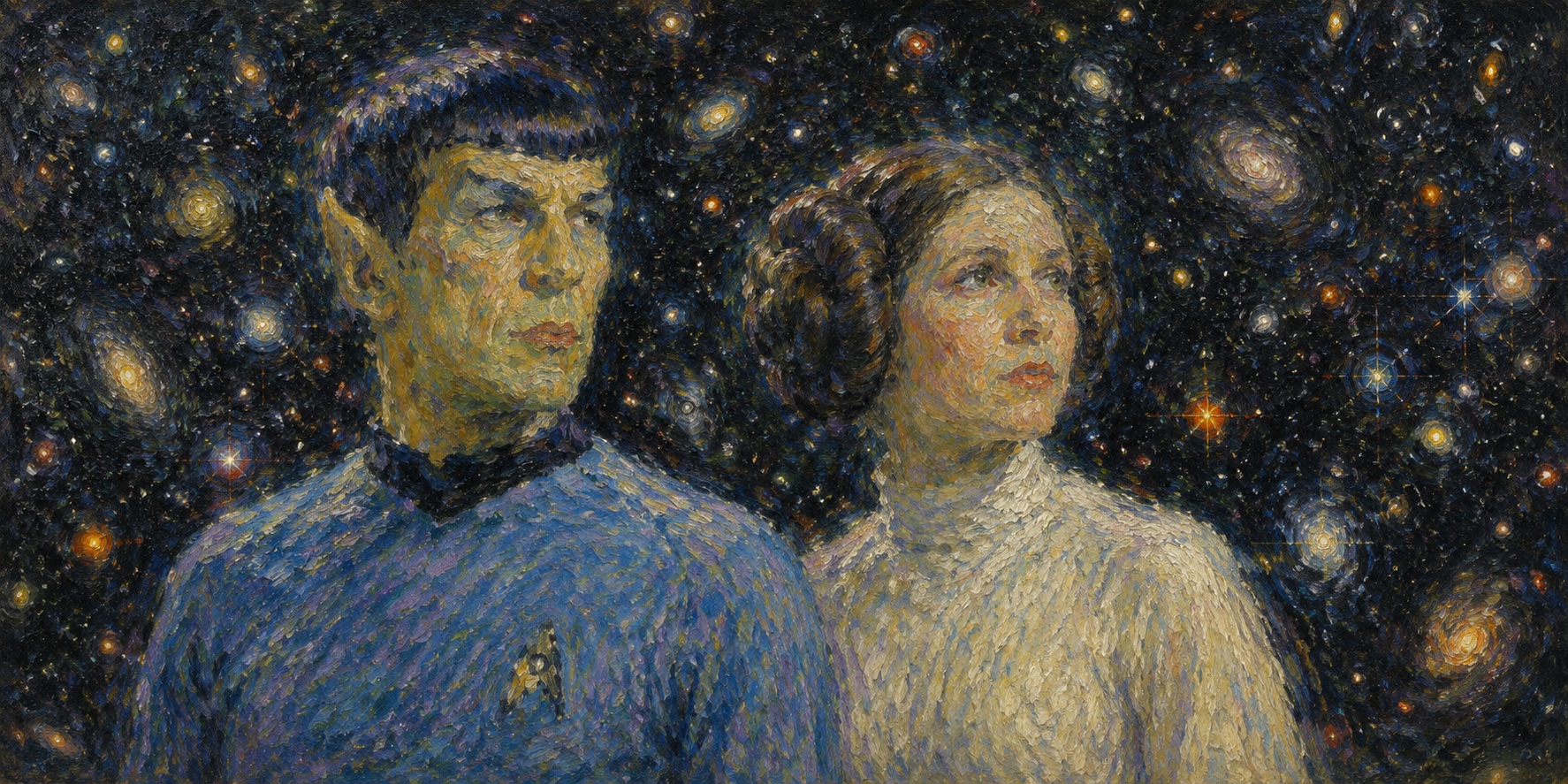
Prof. Thomas Targett separates fact from fiction in depictions of outer space, examining how Hollywood's portrayals in Star Trek, Star Wars, and other films and television shows compare to actual astronomy. A fun and informative exploration of where science and entertainment intersect.
A book talk and launch celebration for critical theorist and UC Berkeley author Grace Lavery's new work, *Personal Demons*. Lavery discusses her writing with Damon Young.
Theatre and Dance Professor Katie Dowse discusses the pedagogy of her course on costume design as world-building, examining how visual design communicates identity, hierarchy, environment, and ideology across theatre, film, and television. The course approaches costume as an interdisciplinary interface between fantasy, technology, contemporary global conditions, and visual storytelling, exploring how costume shapes relationships between body, space, material, and audience.
Historian David Henkin (UC Berkeley) discusses *Out of the Ballpark* (Oxford, 2026), a reconsideration of baseball's character and meaning that challenges familiar mythologies about the sport. Rather than treating baseball as uniquely American or examining only on-field action, Henkin traces the game's history across borders and centuries, exploring its structures, rituals, and resonances with labor, imperialism, race, media, and modernity. He's joined in conversation by philosopher Alva Noë (UC Berkeley), followed by audience questions.
Economic historian Jan de Vries, Ehrman Professor Emeritus of History at UC Berkeley, presents his newly published book *Life, Death, & Migration in the Early Modern City*, which explores urban demographic dynamics, migration patterns, and social life in a German city around 1700. De Vries is a pioneering scholar of Dutch economic development during the industrial revolution whose work has fundamentally shaped our understanding of early modern European urbanism and economic change.
Two UC Berkeley PhD researchers present work on postcolonial Africa and the archive. Derek Allen (Hispanic Languages and Literatures) discusses postcolonial identity in Luso-Afro-Brazilian literature and film depicting the Luso-African wars for independence and the Mozambican and Angolan civil wars. Chukwudi Isiani (History) explores how architecture functioned as an archive of imperial power in Eastern Nigeria from 1857 to 1960. Part of Berkeley's African Studies lunch seminar series.
A panel examining Isaac Julien's 1991 film Young Soul Rebels, exploring temporality, memory, Black culture, and film theory. Rizvana Bradley (UC Berkeley) discusses the intervallic and phenomenology in Julien's work and Black critical theory. Donna V. Jones (UC San Diego) reflects on how film communicates history through multiple simultaneities, drawing on her experience watching the film in post-Thatcher Britain. Isaac Julien is present. Hosted by the Humanities Institute at UC Santa Cruz.
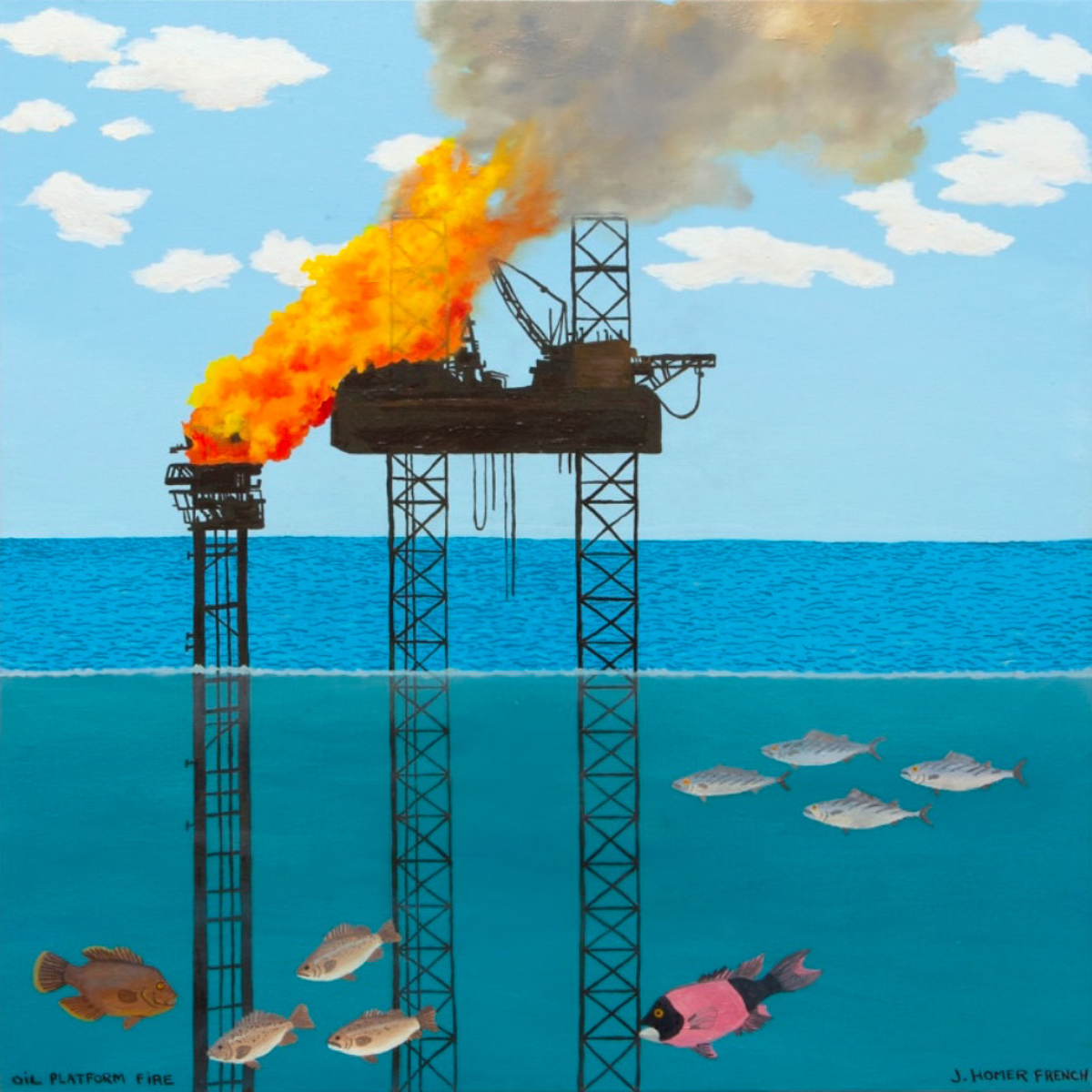
A guided observation-based exploration of 'a small ocean swallowed', an exhibition of contemporary art centering water, ecology, and human-environmental relationships. Led by Shelby Hendricks, the museum's group tour and family programs manager, participants will engage in close looking and discussion of work by six intergenerational and international feminist artists—Sholeh Asgary, Patricia Belli, Kiyo Gutiérrez, Jessie Homer French, Erin Jane Nelson, and Sunaura Taylor—whose pieces explore the material, sociopolitical, and cultural histories of specific waterways and grieve lives lost to human intervention while celebrating paths of collective healing and resistance.
A discussion of decolonial approaches to human rights practice, examining the power imbalances between Global North and Global South advocacy organizations. The authors of *Decolonial Human Rights Practice: Tactics, Obstacles, and Futures* explore how domination persists within transnational human rights work and strategies for transforming it.
A conversation on critical race theory with Osagie K. Obasogie, Haas Distinguished Chair and Professor of Law at UC Berkeley, and Savala Nolan. They will explore CRT's core tenets, its applications and misapplications across law, politics, and culture, and how students can deploy its analytical frameworks for social justice work inside and beyond law school. Obasogie's research spans law, race, and medicine, examining policing, bioethics, and reproductive technologies.
Lesley Currier of Shakespeare for Social Justice discusses the organization's work bringing Shakespeare courses and performing arts programs to fourteen California state prisons and rehabilitation centers since 2003. Participants will explore the crisis of mass incarceration in California and the U.S., and engage in creative exercises demonstrating theater's capacity to build empathy, foster connection, and transform lives. The event combines lecture with interactive workshop components.
A conversation with Professor Emeritus Charles P. Henry about his new memoir exploring his involvement in pivotal social movements—the search for social identity and the fight for civil and human rights. Drawing on personal experiences of place, memory, family, and Black Studies, Henry's narrative expands to broader issues including the Black diaspora, global community, and intersectionality. Henry is Professor Emeritus of African American Studies at UC Berkeley, former chair of Amnesty International U.S.A., and author of eight books on Black politics, public policy, and human rights.
A screening of two films centering disability narratives and experiences, part of UC Berkeley's commitment to accessible public programming. The event highlights filmmaking that amplifies disabled voices and perspectives, fostering dialogue around disability representation and social inclusion. Free and open to the public with accessibility accommodations.
A conversation on Pakistan's democracy, secularism in the global South, and the political demands of the current moment with Dr. Pervez Hoodbhoy, a distinguished Pakistani physicist, public intellectual, and longtime advocate for science and secular thought. Hoodbhoy taught physics for 47 years at Quaid-e-Azam University in Islamabad and founded The Black Hole, a community space dedicated to science, art, and culture.
A roundtable discussion with Yu Miri, 2022 Berkeley Japan Prize winner, on her work-in-progress play *OBON*, based on oral history interviews with approximately fifty members of the Japanese American community in Chicago. Yu Miri discusses her approach to writing the play, emphasizing how she listens to her interviewees' voices without authorial appropriation. She is joined by Dan O'Neill (EALC), Miryam Sas (Comparative Literature), and Andrew Leong (English) to explore key concepts including postmemory and tojisha. Yu Miri is author of *Tokyo Ueno Station* (winner of the 2020 National Book Award for Translated Literature) and *The End of August*, both translated by Morgan Giles.
Award-winning author Erika Krouse, the 2026 Joyce Carol Oates Prize recipient, reads from her work and discusses writing, storytelling, and the art of paying attention in conversation with Hannah Onstad. Krouse's most recent collection, *Save Me, Stranger*, was longlisted for The Story Prize; her memoir *Tell Me Everything* won the Edgar Award for Best Fact Crime and was a New York Times Editors' Choice. Her fiction has appeared in The New Yorker, The Atlantic, Esquire, and The Kenyon Review, and her story "Eat My Moose" won the 2025 Edgar Award for Best Short Story. She teaches at Lighthouse Writers Workshop in Denver.
Llisa Demetrios, Chief Curator of the Eames Institute of Infinite Curiosity and granddaughter of Ray and Charles Eames, discusses infinite curiosity, design, and possibility. The conversation offers fresh perspective on the Eames legacy—one of design's most enduring influences—and invites makers, thinkers, students, and anyone seeking to create with intention and joy to connect and learn together.
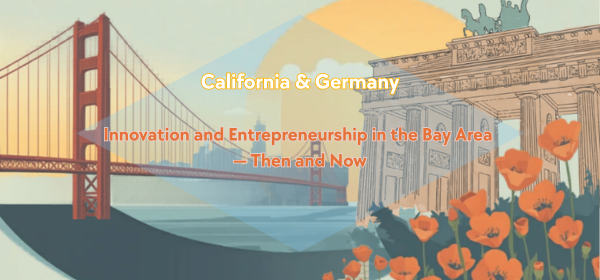
Explore the German-American influence on Bay Area innovation from the Gold Rush through Silicon Valley. Award-winning author Sandra Bonura discusses Claus Spreckels, the German-born 'Sugar King of California' who built an industrial empire. German journalist Arndt Peltner examines German immigrants' broader role in shaping the region. Silicon Valley entrepreneurship specialist Anne Cocquyt traces continuing connections between German innovation and contemporary Bay Area enterprise. Reuters editor Judith Langowski moderates, followed by audience Q&A.
How can decolonization take shape within a former colonial power's political framework? Audrey Célestine (NYU) examines Aimé Césaire's cultural policy as mayor of Fort-de-France through the lens of Léopold Sédar Senghor's 1976 visit to Martinique. Drawing on Césaire's work as both intellectual and elected official, Célestine explores the tensions between local, national, and diasporic political imaginaries—and the central role culture played in defining an emancipatory project pursued within, rather than outside, the French political framework.
A Medical Humanities Research Workshop exploring the intersection of medicine, culture, and human experience. Speaker Bryant Lin, MD, a primary care physician, educator, and researcher at Stanford University, discusses how the humanities inform and transform medical practice and understanding. Part of Stanford School of Medicine's ongoing Medical Humanities Research Workshop Series, supported by the Humanities Center, Division of Literatures, Cultures & Languages, and Department of Anthropology.
A delightfully eerie celebration of Edward Gorey, the iconic artist and 'Godfather of Goth,' featuring short performances, behind-the-scenes stories, film clips, and surprises hosted by author Carol Verburg. Guests are invited to wear Gorey-inspired costumes or bat attire for prizes, though dressing up is optional.
How does architecture shape society, and what can we learn from the built environment's relationship to political and cultural change? Laura Sánchez Carrasco and Íñigo Cobeta, both associate professors at Madrid's School of Architecture (ETSAM), present research on postwar North American and Spanish architecture and their transatlantic connections. Sánchez Carrasco specializes in architectural history combined with digital analysis; Cobeta's recent work focuses on public schools and the relationship between architecture, territory, and civic space. Both are part of an ongoing research project tracing connections between Spanish and American architecture from 1976–2006.
Mark Applebaum, Edith & Leland Smith Professor of Composition at Stanford University, explores what made the Beatles unique and transformative. Over seven years across thirteen albums, the band evolved dramatically and changed music for decades. Applebaum—a composer, jazz pianist, and TED talk speaker seen by over five million viewers—examines whether their impact came from innate musical ability, creative songwriting, commitment to experimentation, or sheer charm. Leave hearing the Beatles in a new light.
A celebration of *Mark of the Warrior*, the sequel to the New York Times bestseller *Breath of the Dragon*, featuring authors Shannon Lee and Fonda Lee in conversation with Andrea Stewart. The novelists discuss their collaborative fantasy epic.
Award-winning poet, translator, and physician Fady Joudah discusses and reads from Exhibit G: Poems, Essays, and Photographs of Gaza (2026), a finalist for the National Book Award. Writing from the perspective of a Palestinian American doctor witnessing Gaza's destruction from the United States, Joudah examines the paradoxes of his position—caring for the sick while complicit in their suffering, writing in English while defending a colonized people, finding beauty and survival amid devastation. The book explores how beauty persists through Palestinian resilience and the nonhuman world as refuge from human-inflicted war. Hosted by UC Santa Cruz's Center for the Middle East and North Africa with the Humanities Institute.
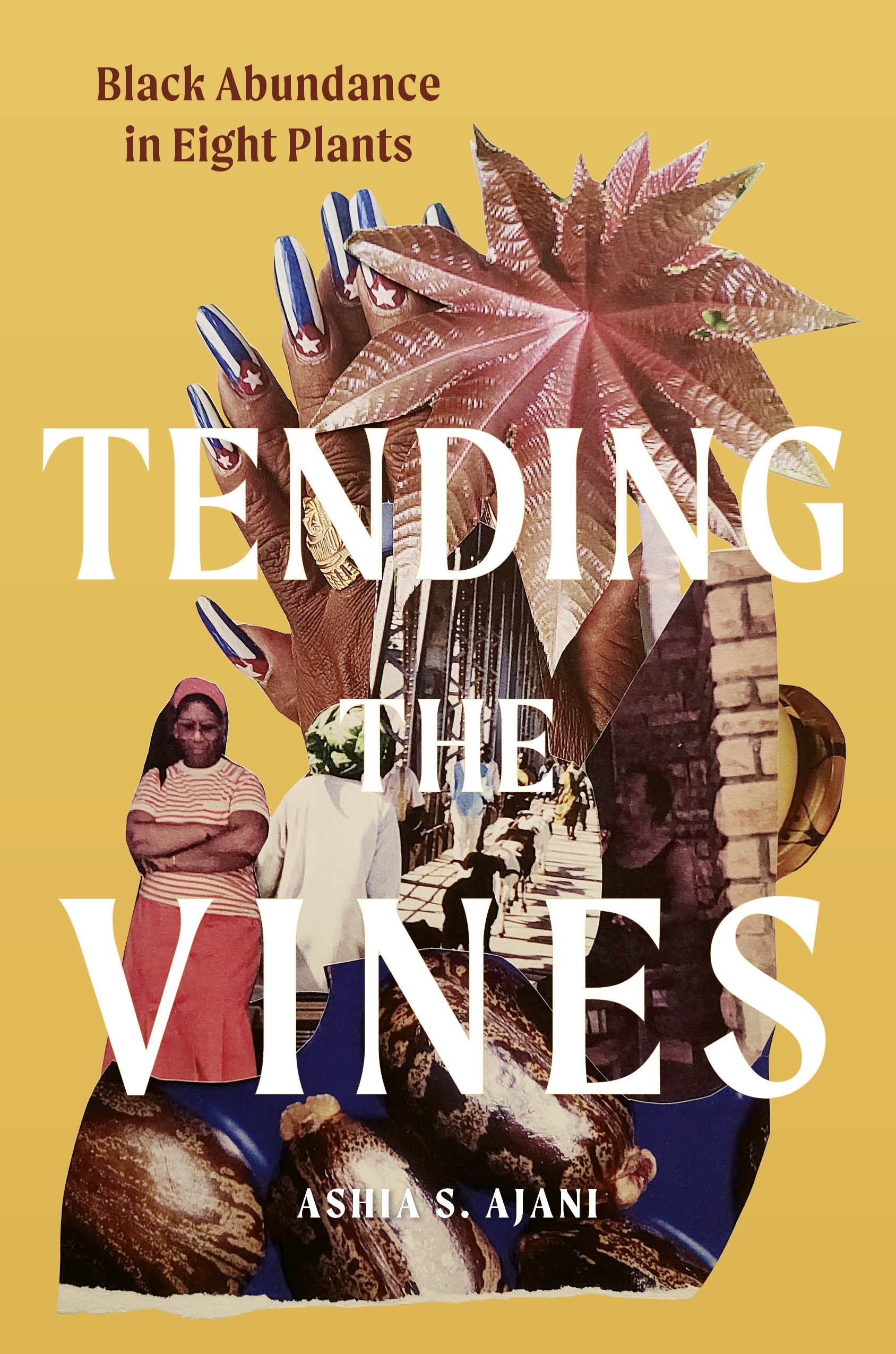
Author-researcher Ashia S. Ajani and community organizer Keala Uchôa discuss *Tending the Vines*, which unpacks the rhetorical and ethnobotanical lives of plants moved across the Western Hemisphere. The book examines how plants have served as metaphors for Black incursion and symbols for Black liberation, while complicating notions of "invasive" species and belonging. Ajani contextualizes plant migration through an eco-griot and abolitionist lens, while Uchôa brings her work at the intersection of abolition and environmental justice. A conversation on diasporic plant relatives and tender living amid the decline of empire.
Author Mary R. Thompson presents and reads from her work exploring the intersection of human language and natural world expression. The evening begins with a reception at 5:30 p.m., followed by the reading at 6:00 p.m. at Readers Books.
Join poet and bookseller Haley Hutchinson for a reading and conversation about her debut collection *Her Womanhood of Mine*, a lyric chronicle of girlhood, embodiment, and becoming. Rich with sensory detail and emotional nuance, the poems explore domestic life, relationships, and the raw grittiness of self-discovery. Hutchinson is a graduate of Middlebury College, editor at Gal Pal Media, and bookseller at Russian Hill Bookstore.
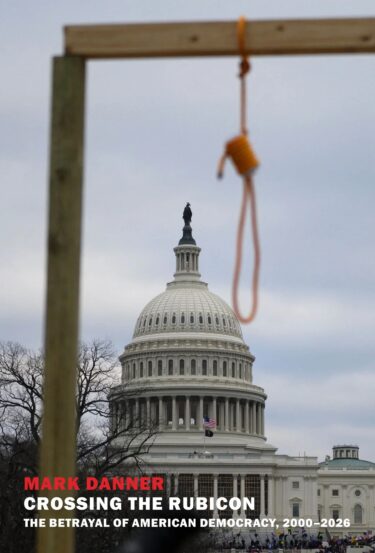
A discussion of Mark Danner's essay collection *Crossing the Rubicon*, which examines the erosion of American democratic institutions and the rise of authoritarianism from the 2000 election through 2026. Danner, a renowned political journalist and contributor to The New Yorker and The New York Review of Books, traces how the U.S. arrived at its current state of polarization, offering portraits of key figures like Dick Cheney and Donald Rumsfeld and critiquing mass media's role in politics. He is joined in conversation by Emeritus Professor Michael Pollan, followed by audience Q&A.
A screening and discussion of The Haunted Bay, an Amazon Prime documentary series exploring reported paranormal activity at Bay Area locations. Creator and producer Ying Liu discusses her investigations into historic San Francisco theaters, bars, the USS Hornet, and other sites, examining both rational explanations and unexplained occurrences while uncovering the history behind each location. Liu will take attendees behind the scenes of the documentary and share what goes into investigating a haunting, followed by audience Q&A. Part of Pub Scholar's lecture series at Bay Area bars.
A recurring philosophical salon exploring thought experiments and ethical arguments. This session focuses on objections to utilitarianism, with recommended readings on philosophical norms and counterarguments to utilitarian theory. Past discussions have ranged from personal identity and free will to animal ethics, artificial intelligence, and the nature of morality itself. Attendees engage in facilitated dialogue around philosophical questions in an intimate setting.
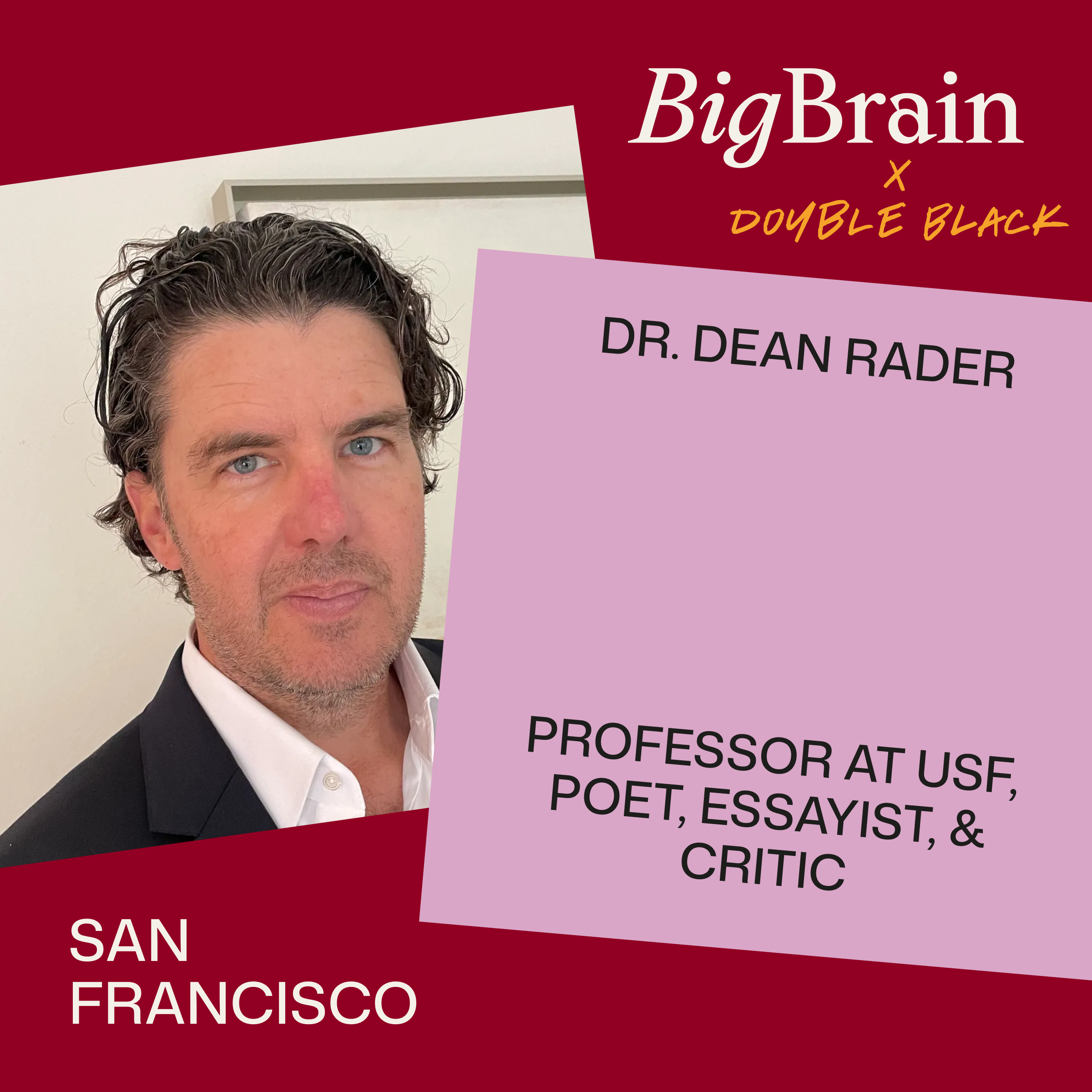
A lecture on how poetry teaches us to sit with life's biggest questions—love, grief, curiosity, doubt, belief, and awe. Poet and critic Dean Rader, a University of San Francisco professor and T.S. Eliot Prize winner, guides attendees through accessible 20th and 21st-century poems exploring what it means to be alive. No literary background required. Followed by Q&A.
Five published authors read from their latest work in horror, science fiction, and speculative fiction. Featured writers include Cynthia Gómez (The Nightmare Box and Other Stories), Loren Rhoads (In the Wake of the Templars, Unsafe Words), Sumiko Saulson (Happiness and Other Diseases, Black Magic Women editor), Kristina Ten (Tell Me Yours, I'll Tell You Mine), and Tamika Thompson (The Curse of Hester Gardens, 2024 Indie Book Award winner). Hosted by Telegraph Hill Arts and Literature at Telegraph Hill Books.
Parini Shroff, bestselling author of *The Bandit Queens*, discusses her new novel *Some People*, a witty and poignant story about a man on the brink of divorce forced to care for his injured future-ex-mother-in-law. Over seven days of recuperation, Nathan Whitlock navigates complex family dynamics, cultural misunderstandings, and unresolved tension with Malti Patel while her daughter is away. Shroff explores themes of love, forgiveness, and the search for understanding and acceptance amid personal upheaval.
A discussion of Rebekah Moyer's *Simple Kitchen Magic*, which offers whole-food recipes and home remedies for common ailments grounded in holistic nutrition. Moyer is a content creator and third-generation nutrition enthusiast who spent a decade pursuing self-directed study in holistic health, inspired by her family's food traditions and her kombucha-brewing mother. She shares accessible, nourishing meals using whole-food ingredients and practical remedies for everyday wellness.
The first of a four-part series of lectures on the origins of the Arts & Crafts Movement in 19th-century England, examining the philosophical and aesthetic contributions of John Ruskin and William Morris. The event explores how these influential figures shaped modern design and architecture through their critique of industrialization and promotion of craftsmanship.
Eric Beck Rubin discusses his fictional account of the final stages of pursuing the right to die. A deeply personal exploration of end-of-life autonomy and mortality through narrative.
Booker Prize-shortlisted author Andrew Miller discusses his novel *The Land in Winter*, a masterpiece set in December 1962 in the English countryside. The story follows two couples—doctor Eric and his pregnant wife Irene, and farmer Bill with his expectant wife Rita—whose quiet lives unravel when the mildest December gives way to the harshest winter in living memory, exposing secret resentments in both marriages. Miller, whose debut *Ingenious Pain* won the James Tait Black and International IMPAC Dublin Literary Award, has established himself as a chronicler of the human heart across 14 acclaimed novels, including *Pure* (Costa Book Award) and *Now We Shall Be Entirely Free*. *The Land in Winter* won the Winston Graham Historical Prize and the 2025 Walter Scott Prize for Historical Fiction. In conversation with Yangsze Choo at Kepler's Books.
Douglas Stuart celebrates his Booker Prize-longlisted novel *John of John*, a portrait of a young artist returning to his Hebridean island home and the tensions between duty, desire, and family secrets. Stuart, author of the Booker Prize-winning *Shuggie Bain*, is in conversation with Matthew Clark Davison, co-author of *The Lab: Experiments in Writing Across Genre* and creative writing educator at San Francisco State University.
Julie Orringer reads from and signs her new novel Luna, Phoenix, Queen, a multigenerational story spanning four decades and four thousand miles. The novel explores infidelity, artistic theft, and the power of storytelling through interwoven voices: a Midwestern couple—one a fiction writer, one a literature professor—whose marriage fractures as she secretly writes a novel and he steals and publishes it as his own after she develops early-onset Alzheimer's. Orringer, author of The Invisible Bridge and The Flight Portfolio (basis for Netflix's Transatlantic), teaches at NYU and Stanford.
Opening night celebration of Scaling Intelligence, an exhibition of 11 commissioned artworks exploring creative possibilities at the intersection of AI, machine learning, and artistic practice. Selected through a global open call, participating artists developed works with Modal cloud computing credits and support from Gray Area and Modal, investigating how different forms of intelligence might connect, interact, and sense the world. Projects range from satellite imagery and microbial visualization to neural network exploration and watershed mapping. Featured artists include Cezar Mocan, Colin O'Donnell & Justine Sun, Dela Cruz & Will Gardiner, Grayson Earle, Iana Chugunova, Ira Greenberg, Kristina Pulejkova, Miguel Novelo Cruz, Parag Mital, Rashed Haq, Sasha Sorokina, and Spencer Chang. The exhibition runs through November 1.
Ann Liang, New York Times bestselling author, reads from and discusses her lush historical fantasy *To Dream in Darkness*, set in ancient China where a Death God and a healing goddess strike a bargain with devastating cosmic consequences. The novel explores an unlikely alliance that blooms into romance while threatening to unravel the balance of the celestial realms. Event includes Q&A and signing; ticket includes admission and a copy of the book.
Angela Davis, activist, author, and cultural icon, reflects on Nina Simone's iconic song 'I Wish I Knew How It Would Feel to Be Free' in conversation with Poulomi Saha. The event explores the intersections of music, activism, and freedom through the lens of one of the Civil Rights era's most powerful artistic statements and its enduring cultural resonance.
A flavorful exploration of Taiwan through food, examining how the island's diverse history, cultures, and development have shaped its culinary traditions and how cuisine expresses national identity and serves as a tool of cultural diplomacy. Features David Chih-Hsiang Wu, Director General of the Taipei Economic and Cultural Office in San Francisco, in conversation hosted by the Center for Asia Pacific Studies at the University of San Francisco.
A discussion on manga as a form of conversation and cultural expression. Hanako Asakura from San Francisco State University explores how manga functions as a medium for dialogue and artistic communication.
A lecture examining how Belarusian, Polish, and Ukrainian scholars of the late 17th and early 18th centuries introduced classical culture into Orthodox Eastern Europe, despite initial religious skepticism toward pagan antiquity. Drawing on specific works by Simiaon Polacki, Jan Białobocki, and Teofan Prokopovych, the speaker traces how these authors navigated the tension between Orthodox tradition and classical learning, ultimately catalyzing the reception of ancient culture in Muscovy and the emergence of Neoclassicism in the Russian Empire. Part of The Other Europe Research Workshop, sponsored by the Stanford Humanities Center.
A lecture on the Sindbad and Seven Sages of Rome narrative tradition, one of the most widely transmitted premodern story cycles, told in at least 30 languages across more than 10 centuries from Persia to Iceland. The cycle centers on a medieval false rape accusation between a mute prince and his young stepmother, exploring themes of truth and justice in a royal court. Jutta Eming, professor of medieval German literature at Freie Universität Berlin, discusses why this enormously popular medieval and early modern tradition has received fragmentary scholarly attention, and presents new collaborative research and a comprehensive database of all known textual witnesses that enables renewed comparative philological, literary, and cultural analysis.
Four legal experts examine President Lincoln's extraordinary use of executive power during the Civil War and its parallels to contemporary presidential authority. Speakers include UC Berkeley Law Professors Daniel Barber (Co-Director of the Edley Center on Law & Democracy) and John Yoo (Faculty Director of the Public Law & Policy Program), alongside Steven Hayward (Pepperdine School of Public Policy) and Michael Paulsen (University of St. Thomas School of Law).
A lunchtime conversation with Professor Anna Spain Bradley, Distinguished MacArthur Foundation Chair in International Justice and Human Rights at UCLA School of Law, discussing her forthcoming book *Global Racism: A Challenge for the World* (Oxford University Press, October 2026). Bradley examines racism as a global phenomenon operating across continents and centuries, arguing it poses a serious threat to humanity and human rights. She draws on two decades of legal scholarship on peace, dignity, and human rights worldwide. Executive Director Savala Nolan moderates. Attendees enter a raffle for a signed copy.
A century after the University of California erroneously declared the Ohlone people extinct in 1925—leading to the loss of land rights for the Verona Band of Alameda County—UC Berkeley's 'ottoy Initiative (an Ohlone philosophy and practice of repair) is charting a new path forward. Vincent Medina and Louis Trevino, founders of the 'ottoy Initiative, discuss this historic institutional reckoning and how the campus is uplifting Ohlone culture and knowledge. First in a series on contemporary and historical issues impacting East Bay Ohlone communities.
How can data visualization deepen scientific investigation and communication? Eric Rodenbeck, founder of Stamen Design, discusses collaborations with UCSF scientists and researchers, including the Atlas of Emotions with Paul Ekman and the Dalai Lama, the UCSF Health Atlas with Dr. Debby Oh, and Brain Cartography with Dr. Edward Chang. He explores how maps, interfaces, and visual systems can reveal complex data, expose unexpected relationships, generate new questions, and help researchers and broader audiences understand science differently.
Mona Fawaz, professor of urban studies and planning at the American University of Beirut and co-founder of the Beirut Urban Lab, interrogates how participatory planning practices navigate fractured publics and rising populist politics. Drawing on a case study of co-designing public space in Beirut following the 2020 Port explosion, Fawaz examines tensions between expert knowledge, political conflict, and representation in a post-truth environment. She reflects on how planning theory's consensus-driven model breaks down when the state's legitimacy erodes and epistemic divisions deepen, and proposes pathways for reintegrating power and reimagining co-production within increasingly polarized cities. Part of UC Berkeley's Department of City & Regional Planning fall lecture series.
An open-class lecture featuring Yu Miri, the internationally acclaimed novelist and 2020 National Book Award winner, discussing her novel *Joban Line Yonomori Station*. The work traces a protagonist raised on a small island in the Seto Inland Sea who now works as a decontamination laborer in Fukushima, exploring themes of landscape, memory, and material traces in post-disaster Japan. Yu Miri will read passages from the novel, then discuss it in conversation with Junko Habu, the course instructor at UC Berkeley, followed by an audience Q&A.
A panel discussion on creating meaning and purpose in retirement, featuring three emeritus faculty members: Pedro Hernandez Ramos (Education), Nancy Unger (History), and Cynthia Mertens (Law). The panelists explore how retired scholars and professionals can build fulfilling lives beyond their careers.
A pop-up exhibition and lecture on Lauren Kroiz's new book *Living Power: Women's Suffrage and Modern American Art* (University of California Press, 2026). Drawing on materials ranging from book covers to photographs in the California wilderness, Kroiz traces a visual history of feminist art and inclusive political citizenship, expanding our understanding of how women's suffrage shaped modern American visual culture. The exhibition runs 4:00–5:00 p.m., with the lecture beginning at 5:30 p.m. Kroiz is an Associate Professor in the Department of History of Art at UC Berkeley.
In late Ming and early Qing China, a major Buddhist revival coincided with growing fascination for theater. Mengxiao Wang explores how performance became a vehicle for Buddhist philosophy and enlightenment, examining the intersection of religious practice and dramatic art in early modern China. Wang is a scholar of Chinese intellectual and cultural history with expertise in Buddhism, literature, and theater.
A conversation on the history of data and algorithms, tracing how data has been used as a tool and weapon—from the US Census and Victorian eugenics through facial recognition and AI systems today. Matthew L. Jones, Smith Family Professor of History at Princeton, discusses his book *How Data Happened: A History from the Age of Reason to the Age of Algorithms* (cowritten with Chris Wiggins), examining how technical capabilities shaped power relations among states, corporations, and people. Tom Mullaney, Stanford University, offers comments.
Janet Poole of the University of Toronto examines the life and work of modernist writer O Changhwan (also Ch'oe Myŏngik), a Pyongyang-based author whose fiction documented urban life and decolonization hopes in early 20th-century Korea. Poole, a specialist in Korean literary modernism and translator of mid-century Korean writers, contextualizes O's work within her broader research on Korean modernist responses to colonialism and the political division of Korea after 1945.
Amanda M. Smith, Associate Professor of Latin American Literature and Culture at UC Santa Cruz, discusses her forthcoming book *The Nature of Conflict: Rivers in the Wake of the Colombian Peace Accords*. Examining how rivers have participated in art and media addressing Colombia's internal conflict, Smith explores hydrofeminism and aqueous ecologies as frameworks for understanding water as a creative subject. She traces what she calls "ripple effects"—aesthetic decisions and procedures that register the material marks of watersheds in art-making—and argues that creative practice involving water transforms media into an archive of fluvial subjectivity, offering new approaches to understanding the more-than-human impacts of war.
Should universities remain institutionally neutral on political and social questions, or does neutrality itself represent a choice about universities' role in public life? Michael Roth, president of Wesleyan University and historian of higher education, explores institutional neutrality, academic freedom, and the responsibilities of university leaders in a polarized era. Drawing on his tenure at Wesleyan and scholarship including *Safe Enough Spaces* (2019), he discusses when institutions should speak, when they should listen, and how to protect open inquiry while engaging democracy's challenges. In conversation with UC Berkeley English faculty Stephen Best and Colleen Lye, leaders of the Townsend Center's yearlong Sawyer Seminar on Neutrality.
A recurring writers' group where participants share works in progress and receive peer critique from fellow writers and facilitator Michael Coffino, an author. Members read their work aloud (up to 1,500 words, double-spaced) and gather written and verbal feedback from the group. Submit pieces to jhooker@cityofmillvalley.gov at least one week before the meeting.
An inspiring guide to the art of letter writing as a tool for deepening connections and healing wounds. Frish Brandt, a beloved 'letter midwife,' shares prompts and exercises for exploring the transformative power of written correspondence. Ideal for anyone seeking to reconnect with others or process unfinished emotional business through the written word.
Explore how to have more productive conversations with AI tools by treating them as thought partners rather than vending machines. Facilitated by Chris Heuer, IBM futurist and author of *Conversations With My AI*, this workshop introduces a seven-part conversation framework, then guides participants through a real practice session with their own AI on something they're actually working on. You'll learn to ask better questions, provide necessary context, and leverage AI to think more clearly without outsourcing your own judgment. Bring a laptop or phone with access to ChatGPT, Claude, Gemini, or similar, and one real problem or creative project you're stuck on.
Elizabeth Dospěl Williams, Penny Vinik Chair of Fashion, Textiles and Jewelry at the Museum of Fine Arts Boston, explores late antique Egyptian textiles and the detection of imitation fabrics produced for the modern art market. Drawing on technical analysis, archival research, and visual sources, Williams examines how non-authentic works function as primary sources in the reception history and historiography of Coptic and Byzantine art, with particular attention to racialized depictions and the lasting impact of provenance issues on contemporary collecting and exhibition practices.
The Holloway Poetry Series presents a reading by poet Fady Joudah, co-sponsored by Palestinian & Arab Studies. Joudah is a physician, translator, and acclaimed poet whose work explores identity, displacement, and cross-cultural experience. Part of UC Berkeley's flagship poetry programming.
A screening of the acclaimed Off-Broadway one-man play Other, written and performed by Tony Award winner Ari'el Stachel. Directed by Tony Taconne, the dramedy follows Stachel's anxious search for belonging, drawing on voices from his past as he navigates identity, self-acceptance, and the pursuit of his dreams with humor and vulnerability. Stachel, known for originating the role of Haled in The Band's Visit on Broadway, brings his signature blend of hilarity and heart to this raw, relentlessly funny performance about anxiety, reinvention, and the art of belonging.
A four-week workshop led by Jenny Jedeikin, a former Rolling Stone journalist, humor writer, and comic strip artist, teaching students how to produce their own personal narrative graphic stories. Participants will learn techniques for translating life experiences into sequential art across four Thursday sessions.
Join SFMOMA's Works on Paper Book Club for a discussion of Carribean Fragoza's *Eat the Mouth That Feeds You* (City Lights), moderated by Assistant Curator of Photography Delphine Sims. Sims opens with a short talk connecting the book to SFMOMA's current exhibition *Graciela Iturbide: Between Two Worlds*, including how Iturbide's photograph appears on the book's cover. The group then discusses guided by Sims's own questions. Doors open at 5:30 p.m. for informal discussion among members. Partial reading is welcome.
Paul Rogat Loeb discusses his anthology *The Impossible Will Take a Little While*, which collects powerful voices from around the world to inspire ordinary citizens to keep working for change in an age of despair. The collection celebrates hope, courage, and sustained activism, offering readers inspiration and practical wisdom for long-term social engagement.
Followed by a post-screening Q&A with co-director Eric Daniel Metzgar. A screening of The Great Experiment, an epic documentary in black and white filmed across the US from 2017 to 2021, examining American democracy and national identity through observational storytelling. Rather than debate left-right ideology, the film weaves together diverse American experiences to hold contradictions in frame and ask whether the democratic experiment can survive.
A conversation with Deb Olin Unferth, 4-time Pushcart Prize winner and National Book Critics Circle Award finalist, on her latest novel *Earth 7*. Hosted at Mechanics' Institute, a trusted San Francisco civic institution.
A philosophical salon exploring the thought experiment of philosophical zombies—hypothetical beings that act human but experience no conscious sensations or emotions. What would it mean if such a being existed? If you discovered your best friend was a zombie in this sense, would you still value them? Led by Dr. Iris Oved, founder and director of The Paradox Lab, a San Francisco nonprofit bringing philosophical inquiry and critical thinking to all ages. Oved is an active researcher in philosophy and cognitive science who studies how explanation shapes human learning and category formation, testing her ideas through computational models.
Multidisciplinary artist Doug Aitken traces his three-decade career spanning film, video, sound, and performance. His practice centers on site-specific works that explore how we build landscapes, inhabit environments, and share experiences. Aitken discusses six projects anchored in film and video that reveal how his work continually reframes itself, including projects never before shown in San Francisco. Hosted at SFMOMA.
A screening of short films and archival footage exploring queer and trans domesticity and community space, presented in conjunction with the exhibition "Where We Made Room." The program opens with Jenni Olson's "575 Castro Street" (2008), a meditation on the Castro Camera Store and Harvey Milk's assassination-eve audio recordings, featuring his iconic message of hope and denunciation of anti-LGBTQ violence. Followed by a discussion between artist and curator Aleo Landeta and filmmaker Jenni Olson on queer spatial practice and their work.
Two Bay Area novelists discuss their new works. Tomas Moniz presents *The King of Aloe Vera*, a novel about the Mission, intergenerational friendship, and aging. Laleh Khadivi discusses *Female Life on Planet Earth*, exploring mothers, daughters, and family secrets. Khadivi chairs the creative writing MFA at USF and is author of *The Age of Orphans* and *A Good Country* (New York Times Editors' Choice); Moniz teaches at Berkeley City College, Antioch MFA, and USF, and his novel *All Friends Are Necessary* won the 2024 California Golden Poppy Award.
Filmmaker and human rights advocate Babak Payami examines how Iran's Woman, Life, Freedom uprising marked a fundamental rupture in decades of state-society relations. Drawing on his work with families of Flight PS752 victims, Payami traces the evolution of resistance language from cautious reform to direct moral and political rejection. He argues that their disciplined campaign for truth and accountability foreshadowed a broader transformation in Iranian civil society, as women, students, workers, and marginalized communities challenge both state authority and inherited political divisions. Digital media has rendered these struggles visible and connected across borders, creating new possibilities for democratic participation—though serious obstacles remain.
A book release event for Maya-Gawonii Shabazz-Saleh's debut novel *My Roommate Is Trying to Kill Me*, a queer horror romance about Hakeem Morales, a horror actor and aspiring screenwriter, and his suspiciously charming roommate Antonio. The novel blends dark humor with gothic tension and unexpected tenderness. Shabazz-Saleh is a critical essayist and author of essays in *Dead Pretty: Beauty in the Horror Genre* and *Echoes of the Earth: Black Voices Reclaiming Ecology and Justice*. She was recently awarded first runner-up for Red Hen Press' Quill Prose Award for her manuscript *Her Bite*, a Black Southern gothic sapphic vampire novella.
Three Bay Area writers read and discuss flash fiction and short stories. Claudia Monpere, Senior Lecturer at Santa Clara University, will read from her forthcoming collection *The Periodic Family* (Cowboy Jamboree, 2026). Kathryn Silver-Hajio, whose upcoming collection *Spinning* draws on years lived in Beirut, will share her work. Patricia Bidar, moderator and author of *Pardon Me for Moonwalking* (Unsolicited Press, 2025), a collection of short stories and flash fiction, will frame the conversation.
A Halloween-themed evening of horror stories and wine tastings hosted at the San Francisco Public Library. Justin, sommelier and owner of Ward Four Wines, will read a selection of classic and contemporary horror fiction interspersed with two guided wine tastings from sustainably sourced, family-owned vineyards. Costumes encouraged; the best costume wins a bottle of wine and a copy of this year's One City One Book selection. Ages 21+.
A screening of Bird of Four Hundred Voices, a documentary about Eugene Rodríguez and Los Cenzontles, the Bay Area organization that has preserved Mexican and Mexican American cultural traditions through music, dance, and storytelling for over 35 years. Directed by Bay Area filmmaker James Hall, the film features decades of archival footage, intimate interviews, and performances, with appearances by Linda Ronstadt, Los Lobos, Taj Mahal, Jackson Browne, Ry Cooder, and others. The screening begins with a live performance by Los Cenzontles, followed by a conversation with Hall and special guests on cultural preservation, intergenerational storytelling, and the arts as community catalyst.
An evening celebrating David Maisel's career survey *View from the Precipice*, a comprehensive monograph spanning forty years of photography, painting, and video. Maisel's aerial works address landscapes transformed by mineral extraction, resource reclamation, and military testing—sites rendered as destabilizing abstractions that use beauty to force attention on environmental catastrophe. His large-scale paintings respond to wildfire and flood; his immersive installations layer spatial ambiguity with human-altered geographies. Maisel will appear in conversation with art historian Alexander Nemerov (Carl and Marilynn Thoma Provostial Professor at Stanford, author of *Fierce Poise*) and Clio's founder Timothy Don to discuss the artist's practice and the monograph's development.
A screening of Wolven (1978), Michael Wadleigh's horror classic starring Albert Finney and Diane Venora, about a New York City detective investigating a series of gruesome deaths that may be connected to a mythical wolf-like creature. Introduced by Norman Zelaya. Popcorn provided.
A celebration of Daisy Fried's poetry collection *My Destination*, featuring Fried in conversation with Katie Peterson. Fried's poems explore grief, desire, motherhood, illness, and public anger with unflinching attention to bodies, objects, and moments where private life meets moral force. Peterson, professor of English at UC Davis and author of *Fog and Smoke*, brings her expertise as both a celebrated poet and editor of Robert Lowell's selected poems. The event includes a reading and discussion of Fried's work.
Douglas Stuart, Booker Prize–winning author of *Shuggie Bain* and *Young Mungo*, discusses his Booker Prize Longlisted novel *John of John*. Set in the remote Outer Hebrides, the novel follows John-Calum Macleod's return home after art school, navigating family secrets and fractured relationships with his father John, a sheep farmer and lay preacher, and his grandmother Ella. In conversation with fellow acclaimed author Karen Joy Fowler, Stuart explores this intensely character-driven story of impossible struggles and hidden truths unfolding across a single transformative season.
An illustrated graphic history examining ten major genocides across five centuries—from the mass slaughter of First Peoples in the Americas to the genocide in Gaza. Award-winning writer, artist, and genocide-survivor descendant Dana Moshoian Walrath reveals how dehumanization operates through violence and the political systems that enable it. Her interactive graphic narrative uses visual manipulation to mirror the mechanisms of dehumanization, then restores victims' humanity, making their suffering undeniable. Walrath's previous works include the graphic memoir *Aliceheimers* and the verse novel *Like Water on Stone* on the Armenian genocide.
A free monthly breakfast lecture series uniting Santa Cruz's creative community. Local innovators share creative insights while attendees connect over coffee and pastries. This month features Jeremy Stone, musician, producer, and founder of Sonivore listening lounge, who explores how art shapes community, identity, and place. Stone serves as a City Commissioner and trustee of the Santa Cruz Museum of Art & History and Kuumbwa Jazz Center. Open to anyone passionate about making something real.
A summit on belonging, identity, and America's future co-hosted by UC Berkeley's Goldman School of Public Policy, School of Law, Graduate School of Journalism, and the Othering and Belonging Institute. The event brings together scholars, policymakers, journalists, and community leaders to explore how Americans can reimagine national identity and strengthen social cohesion at a pivotal moment. Free to attend.
Serena Connolly, Professor and Chair of Classics at Rutgers University–New Brunswick, examines Emperor Hadrian's overlooked commitment to science and technology alongside his better-known philhellenism. Drawing on substantial evidence, she argues that Hadrian's intellectual interests in science and technology were shaped by personal inclination and imperial precedent stretching back to Augustus. Connolly's research spans Roman social and political history, women and non-elites in the Roman world, and the history of science and technology. She is the author of *Lives Behind the Laws* and *Wisdom from Rome*, and is completing *Learned Emperors: Science, Technology, and Power at the Roman Imperial Court*.
Mads Rosendahl Thomsen, professor of comparative literature at Aarhus University, Denmark, speaks as part of UC Berkeley's Cultural Analytics Series. Thomsen's work examines literature across national traditions and cultural contexts.
Mohammad Darawshe, Director of Strategy at Givat Haviva's Center for Shared Society, joins UC Berkeley's Yoni Furas to discuss the challenges facing Jewish and Arab communities in Israel working toward peaceful coexistence. Drawing on three years of escalating tensions and their impact on intergroup relations, the conversation explores both the obstacles to shared society and pathways forward at this critical moment. Darawshe has dedicated his career to building models of respectful and sustainable collaboration across communities.
A conference celebrating the academic legacy of David Hoy, Professor of Philosophy at UC Santa Cruz. The program features panels on his scholarly contributions, mentorship, leadership as department chair, and intellectual influence, with speakers including Christoph Cox (New School), Colin Koopman (University of Oregon), Martin Jay (UC Berkeley), James Clifford and Donna Haraway (UCSC), David Chalmers (NYU), and many of Hoy's former students and colleagues across philosophy, history, and the humanities.
A collaborative discussion with Mads Rosendahl Thomsen on cultural analytics and the quantitative study of culture. Thomsen is a scholar and researcher exploring how data and computational methods illuminate cultural patterns, texts, and digital phenomena.
A cultural history exploring humanity's widespread practice of wearing masks across time and society. Humanities West examines the psychology behind masking our personalities in public and traces the deep human affinity for physical masks as both cultural artifact and psychological tool. Hosted by Humanities West at The Commonwealth Club of California.
A screening of How to Divorce During the War, Lithuania's 2026 Academy Awards submission, with commentary from Maarja Merivoo-Parro, CEO of Vabamu Museum of Occupations and Freedom, and Gabrielius Landsbergis, visiting fellow and former Lithuanian Minister of Foreign Affairs. Director Andrius Blaževičius's family drama follows a couple navigating divorce as Russia's invasion of Ukraine begins, exploring how personal crisis intersects with historical upheaval.
Retired LAPD detective Harry Bosch returns in this thriller from #1 New York Times bestselling author Michael Connelly. Connelly will discuss The Hollow, which delves into the darkest chapter of his protagonist's past, with the author.
Adam Plantinga, author of the Kurt Argento thriller series and nonfiction books on crime and policing, discusses his latest novel *Dark Country*. The story follows Argento, a former Detroit cop living undercover in small-town South Dakota, who becomes entangled with a Syrian refugee teenager fleeing powerful pursuers. Plantinga, an investigator with the San Francisco Police Department's Internet Crimes Against Children unit, brings authenticity from his law-enforcement background to his crime fiction, which has earned Agatha and Macavity nominations and USA Today bestseller status.
Kirk Lombard celebrates the release of his book *The Shadow Stream* with an author talk, refreshments, and live music at The Dairy (Sports Basement Presidio). The event combines conversation around the book with music and community gathering.
An evening exploring horror, the Gothic, and why we return to things that frighten us. Professors Sara Hackenberg (San Francisco State University) and Renée Fox (UC Santa Cruz) discuss the enduring appeal of the Gothic and the evolution of vampire fiction. The evening concludes with a theatrical table read of J. R. Planché's *The Vampire; or, The Bride of the Isles* (1820) in Golden Gate Park at 8:30 PM. Participants may register for roles in the reading.
Pulitzer Prize finalist Michael Lewis discusses his new book *Blockers*, an inside account of Trump's Department of Government Efficiency and the public servants who resisted it. Lewis, author of *Flash Boys*, *Moneyball*, and *Going Infinite*, traces how individuals navigated a transformative government initiative. In conversation with Lara Bazelon, Professor of Law at the University of San Francisco and author of three books on criminal justice and racial equity, Lewis explores themes of institutional power, ethical resistance, and the human stories behind policy.
A one-day grammar and prose workshop led by Constance Hale, author of the bestselling *Sin and Syntax: How to Write Wicked Good Prose*. Through hilarious exercises and writing prompts, Hale guides writers of all genres through sentence dynamics, punctuation, voice, and common grammatical pitfalls—using her books *Sin and Syntax* and *Vex, Hex, Smash, Smooch* as texts. Participants will master subject-predicate structure, conquer the semicolon, avoid dangling participles, and explore how grammar shapes point of view and authorial voice. A former editor at Wired, Health, and the San Francisco Examiner, Hale has taught creative nonfiction at Harvard and UC Berkeley and published in *The Atlantic*, *The New York Times*, and *Smithsonian*. Six hours, includes bagels and a free book.
A four-week workshop exploring how descriptive writing in memoir reveals character and truth. Led by Connie Josefs, this course examines how sensory detail, imagery, and the craft of description transform personal narrative into compelling storytelling. Participants will study published memoir excerpts, practice descriptive techniques, and develop their own writing. Held at Book Passage Corte Madera, Saturdays October 31–November 21, 2026.
A four-week seminar on Dante's Inferno, exploring one of Western literature's greatest narrative poems and its continued relevance to contemporary crises of justice and human striving. Timothy Hampton, Aldo Scaglione and Marie M. Burns Distinguished Professor of Comparative Literature and French at UC Berkeley, will provide historical and philosophical context on Dante's medieval worldview before opening discussion of the text. Participants should read Robert Pinsky's English translation. Meeting Fridays, October 10–31, 11 a.m.–1 p.m. at Clio's Books.
Opening reception for Paul Harris: The Boy Sews Like An Angel, a retrospective of the artist and longtime Bolinas resident (1925–2018). The exhibition spans six decades of Harris's work, bringing together artworks and archival materials. Remarks at 1 PM.
A screening of Séance with director Vivian Kerr, who will participate in a post-screening Q&A. Set in 1892 California, the film follows novelist Emma Strand as she takes refuge from a storm at the mansion of her first husband George and his unstable new wife Lillian, who claims to be haunted by their dead child. Over the evening, Emma confronts her marital unhappiness, the temptation of adultery, and the disturbing possibility that the house is genuinely haunted.
Artist Steffani Jemison and choreographer Leslie Cuyjet perform a collaborative piece reflecting on the dynamic artistic relationship between Maren Hassinger and Senga Nengudi. The work explores the intense intimacy and attunement involved in longstanding artistic collaborations and the powerful intergenerational legacy of these artists' collective works.
Death Day is a half-day symposium exploring mortality, grief, and meaning-making through talks, storytelling, and conversation. Ecologist Kirra Swenerton discusses ecological grief as reverence for biodiversity loss; Maria Mangini traces the cultural history of mourning dress and bereavement customs from the Middle Ages to present; Tom Banger explores terminal diagnosis and proximity to death. Hosted by The Berkeley Alembic.
A staging of Annie Baker's *The Flick*, set in a failing movie theater in Central Massachusetts where three employees tend to the last remaining 35-mm film projector in the state. Their daily struggles and quiet heartbreaks explore themes of authenticity and human connection. Co-directed by Lina Valderrama and Felix Rae Whitehouse. Approximately three hours with a 15-minute intermission.
A screening of *Maxita* with director Mariana Machado, followed by panel discussion. The documentary follows Yanomami shaman Davi Kopenawa, a leading voice for Brazil's Indigenous peoples, as he travels from the Amazon to confront the mining industry destroying the forests. He reunites with activist Ailton Krenak to expose the devastation's global consequences. Part of Cine + Mas 18th Latino Film Festival and ¡VIVA! at the Library, a celebration of Latinx heritage and cultures.
Erika Krouse, the 2026 Joyce Carol Oates Prize winner, discusses her collection of short stories *Save Me, Stranger* (Flatiron Books), longlisted for The Story Prize. Krouse is a two-time Edgar Award winner and author of four books of fiction and nonfiction, including the memoir *Tell Me Everything: The Story of a Private Investigation*, a New York Times Editors' Choice. In conversation with Hannah Onstad, NewLit's Communication director.
Celebrate Diwali, the Festival of Lights marking the beginning of the new year in the Indian lunar calendar, with a full day of art activities, talks, tastings, and performances. Drop-in rangoli-making and henna-art workshops run 1–4 PM and are appropriate for all ages. Observed by millions across India and its diaspora, including Hindus, Jains, and Sikhs worldwide, Diwali is a jubilant holiday rich in cultural tradition and artistic expression.
Learn the principles and practice of Japanese tea ceremony in an immersive 75-minute workshop led by Harue Imaizumi, a certified Omotesenke tea instructor based in Berkeley. The session covers matcha and Japanese tea culture, wellness benefits, ceremony etiquette, and hands-on whisking technique. You'll prepare and enjoy your own bowl of matcha with traditional Japanese sweets, then receive practical guidance on brewing matcha at home from water temperature to storage. Tea sourced from ochamode, founded by Mayuka Inaba, featuring organic matcha from Shizuoka, Japan. Q&A with instructor and founder included.
Celebrate the opening of Vishnu's Cosmic Ocean, an exhibition featuring Southeast Asia's largest ancient bronze—a rare Reclining Vishnu sculpture on loan from Cambodia's National Museum. Asian Art Museum curators Natasha Reichle and Forrest McGill discuss the significance and history of this thousand-year-old Cambodian National Treasure in a double-feature talk.
Jacob Weisberg, editor of Slate and author of *Profiles in Cowardice*, examines the people and institutions that failed to resist Trump's agenda. Drawing on the book's devastating reckoning with political and moral capitulation, Weisberg explores how leaders across government, media, and business abandoned democratic principles when it mattered most. A sharp inquiry into institutional failure and the cost of silence.
Followed by a post-screening Q&A with director Habiba Nosheen, moderated by Jenni Olson. A screening of The Gymnasts of Fisherman Colony, an intimate coming-of-age documentary by 3X Emmy Award-winning filmmaker Habiba Nosheen that follows three teenage girls in Pakistan as they pursue gymnastics in a society where girls and sport rarely coexist. The film explores themes of girlhood, joy, and quiet rebellion as these young athletes navigate deeply rooted cultural expectations about what is possible for them.
Julianna Glasse, a former Christian pop star, discusses her memoir about how reading transformed her life and enabled self-actualization. Her story traces an empowering journey of personal discovery through literature, offering insight for women navigating identity and transformation.
A guided walking tour of four historic cemeteries in Colma where notable San Franciscans are buried: Woodlawn, Home of Peace, Hills of Eternity, and Cypress Lawn, with a visit to Holy Cross. The tour concludes with a group return to Colma or South San Francisco BART. Hosted by Shaping San Francisco.
A staging of Annie Baker's *The Flick*, set in a failing movie theater in Central Massachusetts where three employees tend the last remaining 35-mm film projector in the state. The play explores their daily struggles and quiet heartbreaks in the search for connection. Co-directed by Lina Valderrama and Felix Rae Whitehouse. Approximately 3 hours with a 15-minute intermission.
A somatic movement workshop led by interdisciplinary artist Steffani Jemison, an Associate Professor at Rutgers University and exhibiting artist whose work spans mark-making, gesture, projection, and movement. Drawing on the children's game 'Marco Polo,' participants will explore orientation, perspective, and relation through guided improvisation, playful prompts, and contact improvisation. The workshop integrates theory, fiction, and poetry—referencing Dionne Brand, Tyrone S. Palmer, and Quincy Troupe—and is adaptable to all bodies and physical capacities. No prior movement experience required.
A behind-the-scenes factory tour of Quarry House, considered the finest stone fabricator in North America. Attendees will see full-scale mockups, rare imported stone blocks, and the largest CNC stone-carving machine in North America mid-fabrication. Meet founder and CEO Edward Westbrook, whose 30+ years managing stone masonry and hardscape projects has earned him collaborations with legendary landscape architect Lawrence Halprin and leading architects and designers. Lunch included. Organized by the Center for Architecture + Design.
How did Taiwan transform from an agricultural colony into an economic power in half a century, and how did it export that success globally? This talk traces the history and impact of the 'Taiwan model' of agrarian development—the land reforms, farmers associations, and improved crop varieties that Taiwan's authoritarian government promoted at home and throughout Africa and Southeast Asia during the Cold War. Drawing from Chapter 4 on Taiwan's agricultural missions to the Republic of Vietnam, the speaker explores how Taiwanese agricultural technicians and scientists framed their practices as proof of the Republic of China's modernity while seeking to maintain its contested international legitimacy and domestic martial-law rule.
Sharan Grewal, Associate Professor of Government at American University and Nonresident Senior Fellow at the Brookings Institution, discusses his forthcoming book examining Tunisia's democratic transition and collapse. Drawing on interviews with senior officials and three nationally representative surveys, Grewal argues that while power-sharing institutions can stabilize early transitions, extending them too long frustrates voters and enables populists and extremists to gain traction. The book explores this dynamic through Tunisia's own trajectory after the Arab Spring and tests the theory quantitatively across all democratic transitions from 1942–2020, revealing how consensus-focused governance can paradoxically undermine democracy.
A poetry writing workshop led by writer and educator Darius Simpson, exploring vulnerability and creative expression through verse as a form of resistance. The workshop welcomes all experience levels and draws on traditions of the Black Arts Movement and spoken word circles, fostering peer dialogue and collective learning. Simpson is a New Afrikan writer, farmer, and recipient of fellowships from the Poetry Foundation and National Endowment for the Arts; his collection Never Catch Me is recently published.
How should democracies deal with an unreliable superpower? Former Canadian Deputy Prime Minister Chrystia Freeland discusses her new book examining power inside government, the intersection of trade, security and democracy, and how democracies might resist authoritarian states and oligarchs. Drawing on her careers as a foreign correspondent covering Russia's oligarchs and as a senior Canadian official who renegotiated the USMCA, Freeland offers insights into international political economy and democratic resilience. Moderated by Kathryn Stoner, Freeman Spogli Institute Senior Fellow and Director of CDDRL, with audience Q&A to follow.
R. Aída Hernández Castillo discusses her forthcoming book *Digging for Hope: A Feminist Ethnography in the Land of Mass Graves* (University of Arizona Press, 2026), an ethnographic study of women-led search collectives in Mexico who exhume and memorialize disappeared loved ones. Drawing on a decade of fieldwork, Hernández Castillo explores how these women enact what she calls a "pedagogy of love"—rooted in care, solidarity, and refusal to forget—to reclaim dignity for the dead and resist normalized violence. In conversation with Diana Negrin (UC Berkeley geographer) and Omar Gómez Trejo (human rights attorney and former lead prosecutor of the Ayotzinapa case), Hernández Castillo examines the gendered dimensions of violence and the grassroots movements that challenge it through emotional community-building and new languages of justice.
An artist talk and screening featuring Tanya Lukin Linklater, a dance artist and filmmaker exploring indigenous technologies, knowledge systems, and creative practice. The event includes both a public talk/screening and a separate workshop component. Hosted by UC Berkeley at Grimes Engineering Center.
A conversation on California's newly signed SB 1387, which allows Jews to identify as Jewish on government forms asking about ethnicity. Panelists explore implications for Jews in California and beyond, including potential unintended consequences and community concerns about state categorization. Featuring David Bocarsly (Jewish California coalition leader), Aliya Saperstein (Stanford sociologist studying census questions and racial categorization), Keith Feldman (UC Berkeley), Ari Y. Kelman (Stanford), and Rabbi Tarlan Rabizadeh (American Jewish University), moderated by Asaf Elia-Shalev of J. The Jewish News of Northern California.
Julianna Glasse, founder and CEO of This Is What Happens When Women Read, discusses her memoir about leaving a life as a Christian pop star and MLB wife to pursue education and autonomy. The book traces her transformation after discovering forbidden literature—works by de Beauvoir, Dickinson, Emerson, and others—that challenged her faith and marriage. Glasse holds a master's from Oxford and now runs a global organization providing scholarships to women leaving restrictive religious communities.
The Short Plays Festival returns with new work from Playwrights Lab writers exploring AI, neighborhood etiquette, a dog aspiring to sing opera, a grandmother's sex advice to her granddaughter, and a king's quest to secure his legacy. Performed by Bay Area actors and directors. In collaboration with the Playwrights Lab.
Khir Johari discusses his multi-award-winning book *The Food of Singapore Malays: Gastronomic Travels Through the Archipelago*, which explores the cultural anthropology of Malay food and its role in shaping Singapore's Malay culture. The result of 11 years of research spanning from the 7th-century Srivijaya Empire to the present, the book combines historical anecdotes with rich photography. It won Best of the Best in Food Culture at the 2025 Gourmand World Food Awards. Johari has since founded Dialogues by Khir Johari, a platform dedicated to exploring Nusantara's food, culture, and history.
A screening of the documentary Traces, which centers Ukrainian women survivors of wartime sexual violence and torture resulting from Russia's invasion. Director Alisa Kovalenko and producer Natalia Libet (co-founder, 2Brave Productions) discuss the film's testimony and documentation work, with moderation by Steven Saum of Saint Mary's College.
Historian and curator Gregory Dreicer examines the grand narratives and building processes that shaped the construction of the modern nation during the 19th century. How did America's physical infrastructure reflect and enable the idea of a unified nation?
How has Russia sustained its confrontation with the West since 2022, and at what cost? Hanna Notte, Director of the Eurasia Nonproliferation Program at the James Martin Center for Nonproliferation Studies, examines Russia's adaptation after the invasion—working around sanctions, building new partnerships, cultivating support across the Global South, and deepening divisions within Western democracies. Her account combines policy analysis with field reporting from more than a dozen countries and interviews with officials and ordinary people. She also explores domestic consequences: Putin's focus on confrontation has distorted Russia's economy and moved the country toward full authoritarianism. Moderated by Kathryn Stoner, FSI Satre Family Senior Fellow and Mosbacher Director of CDDRL, with audience Q&A.
Learn to tell compelling stories across any medium with writer and filmmaker David Feather. This hands-on workshop explores story structure using popular media, examines storytelling techniques from cultures around the world, and includes collaborative writing and feedback on participant ideas. Designed for teens, tweens, and young adults. Part of Literally How, a monthly life literacy series at Berkeley Public Library's North Branch offering hands-on skill-building workshops.
How did coal materially produce and sustain patriarchal gender orders in Upper Silesia? Anna Seidel, Associate Professor at the University of Vienna, traces the entanglement of coal, masculinity, and heteronormativity through Upper Silesian literature, film, and performance from the early twentieth century to today. Drawing on energy humanities and feminist resource theory, she shows how coal-based patriarchy—men as underground miners, women confined to domestic roles—was consolidated through cultural production, persisted through socialist realism and postsocialist transition, and only began to destabilize as mines closed during Poland's and the Czech Republic's energy transitions. Contemporary works like the Netflix series Królowa and drag performances by Śląsk Przegięty recast coal and queerness as entangled rather than opposed, revealing how cultural representation becomes the space where coal's gender legacies are contested and reimagined.
A panel discussion on feminist approaches to death, mourning, and memorialization in South Asia, examining how gender shapes experiences of loss across the region. Speakers include Fawzia Afzal-Khan (Montclair State University / Princeton University), Angana P. Chatterji (UC Berkeley Center for Race and Gender), Jyoti Puri (Boston University), and Ather Zia (University of Northern Colorado), with panel chair Leti Volpp (UC Berkeley School of Law). Hosted by UC Berkeley's Political Conflict, Gender, and People's Rights Initiative and the Institute for South Asia Studies.
A roundtable discussion with CFGNY, a New York-based artist collective investigating racialization, subjectivity, and the concept of 'vaguely Asian' through image making, installation, sculpture, garment making, and performance. The collective, founded in 2016 and composed of Daniel Chew, Ten Izu, and Tin Nguyen, uses materials including porcelain, photography, and corrugated cardboard to explore mass production and fetishistic desire. The conversation is moderated by artist Vincent Chong, an MFA candidate at Stanford working in calligraphy, seal carving, and performance. CFGNY has recently exhibited at the Whitney Biennial, Hammer Museum, and Cooper Hewitt Smithsonian Design Museum.
Tommy Orange, author of *There There*, discusses the new Indigenous horror anthology *Back for Blood: Never Whistle at Night Part II* with co-editor Shane Hawk. This collection features 21 stories by established and emerging Native and First Nations writers—including Stephen Graham Jones—drawing on Indigenous experiences, histories, and traditions to showcase horror as a vehicle for survival and transformation. The editors describe the work as 'sustained dread, sustained appetite, sustained consequence.'
On election night, physicist and author Sky Nelson-Isaac guides an interactive workshop on staying grounded when politics divides us. Drawing on his forthcoming book *The Synchronicity Path* and years of seeking out people with different worldviews, Nelson-Isaac introduces SEW (Style, Emotions, Wholeness)—a simple framework for staying curious rather than taking sides. The event combines real conversation, wine, and collective inquiry into the deeper questions beneath recurring arguments.
A public talk by Martin Strauss exploring curious corners of history. Hosted by Curiosity Guild, a community of storytellers investigating the wonderfully weird through nearly-monthly 21+ talks that celebrate historical oddities and overlooked narratives.
Kristen Naiman, Chief Brand Officer at The RealReal and co-author of Real Style, discusses her book, which reframes style beyond traditional fashion guides to explore personal expression, sustainability, and intentional consumption in the age of resale and circular fashion.
Frish Brandt, a letter-writing teacher at Stanford Medical School, discusses her book *Unfinished Business: Writing the Five Essential Letters of Your Life* — a guide to crafting five essential letters: thank you, I'm sorry, I miss you, I love you, and goodbye. Drawing on her experience teaching at Stanford, Harvard Divinity School, and in workshops across the country, Brandt weaves practical writing prompts with reflections on grief, connection, forgiveness, and closure. In conversation with Roberta Katz, PhD in anthropology and former Associate Vice President for Strategic Planning at Stanford.
A recurring cognitive science reading group for Bay Area enthusiasts. Members vote on and collectively read papers or books related to cognitive science, then gather to discuss. Hosted at Frontier Tower, open to anyone interested in the field.
Art historian Atreyee Gupta examines modernism in India through the lens of decolonization and the Non-Aligned Movement. Gupta traces how Indian artists engaged with the Third World project and anti-colonial politics in the mid-twentieth century, revealing modernism not as a Western export but as a site of postcolonial resistance and nation-building. A lecture on art history, political struggle, and cultural sovereignty in the postwar era.
Historian Timothy Stewart-Winter (Rutgers University) discusses his book *Outed: LBJ's Confidant and the Arrest That Transformed a Presidency*, exploring how the exposure of a close adviser's homosexuality became a turning point in both LGBTQ history and American presidential politics during the Johnson administration.
Carolina Valdivia, Assistant Professor of Criminology, Law and Society at UC Irvine, discusses her book *Sanctuary Making: Immigrant Families Reshaping Geographies of Deportability*. As U.S. immigration enforcement expands into neighborhoods, workplaces, hospitals, and homes, undocumented and mixed-status families employ strategies to shield themselves from deportation. Valdivia explores the emotional and material labor of young adults who take on parental responsibilities, broker legal processes, and provide emotional support while navigating these terrains of enforcement. The talk examines how policymakers, organizers, educators, and communities can better support these young people in creating sanctuary for their families.
Emmy Award–winning investigative journalists Michael Rey and Oriana Zill de Granados of 60 Minutes discuss their book investigating the Havana Syndrome attacks that have wounded hundreds of U.S. intelligence officers, diplomats, and special operators. Drawing on nearly a decade of reporting, more than 70 victim interviews, and evidence of Russian intelligence operations, the authors reveal whether a mysterious energy weapon was deployed or whether the U.S. government has covered up a multi-year mystery. A tour de force of investigative journalism examining how government prioritizes its own interests over those who serve the country.
Daniele Valisena, Visiting Fellow at the German Historical Institute, UC Berkeley, discusses his book *Italian Lives, Belgian Coal*, which examines the 1946 'men in exchange for coal' agreement between Italy and Belgium. Drawing on archival documents, primary sources, and oral histories, Valisena traces how labor migration, coal extraction, and environmental transformation intersected in the Belgian Walloon coalfields, exploring the agency of states, industry, miners, and ecosystems. The book reveals the environmental and corporeal injustice inflicted by capitalist institutions on workers' health, society, and nature.
A lecture examining how data are constructed rather than discovered—exploring the philosophical, methodological, and political dimensions of data creation in research and society. Hosted by UC Berkeley.
What more-than-human modes of knowing and world-making can guide ecological thought and practice in an era of ecological crisis? This panel brings together art, science, and environmental philosophy to explore field-based knowledge, speculative science, and critical aesthetics beyond human exceptionalism. Dimitris Papadopoulos (UC Santa Cruz, History of Consciousness) and María Puig de la Bellacasa (UC Santa Cruz, environmental humanities and science studies) lead the conversation, joined by philosopher and artist Mark Nash discussing Felix Guattari's ecosophy and art as singularization, alongside Donna Haraway, Karolina Karlic, and Kriti Sharma. Field Notes emphasizes place-based observation, relationality, and post-Anthropocene ecological thinking.
A conversation on Israeli theatre's role in contested political speech. Theatre director Ronnie Brodetzky discusses her bold reinterpretations of canonical plays and experimental works drawing from digital media — including *Typing…*, created from WhatsApp conversations, and *How to Get Up from a Chair*, inspired by YouTube tutorials — and what live performance reveals about contemporary Israeli society. Hosted by Helen Diller Institute for the Study of Jewish Texts, Culture, and Intellectual Life at UC Berkeley.
A discussion of photographer Norma Ibarra's work documenting Indigenous skateboarders and the decolonial potential of skateboarding as a challenge to settler-colonial property regimes. Ibarra's photographs from the Museum of Vancouver's 2021–22 exhibition *Skate for Change* capture self-fashioned Indigenous skaters, exploring how her collaborative practice reveals skateboarding's cultural resistance to imposed spatial discipline. The presentation examines tensions between skateboarding's liberatory practice and photography's settler-colonial legacy, articulating possibilities for decolonial praxis. Presented by Miguel Fernandez, Ph.D. student in History of Art/Visual Culture at UC Santa Cruz and 2025 Lionel Cantú Memorial Awardee.
A panel discussion on craft, materiality, and digital technology in the age of computation. MacArthur Fellows Katherine Behar, Nick Benson, Hideo Mabuchi, and Camille Utterback—artists and technologists working at the intersection of making, robotics, and digital systems—explore what traditional craft offers in a moment of paradigm-shifting technological change, and what is gained or lost when embodied creative practice meets machine intelligence. Moderated by Vanessa Chang. Part of the MacArthur Fellows at 45 series.
Rebecca Tarlau, Associate Professor of Education at Stanford University, discusses her ethnographic research on teacher organizing strategies across Brazil, Mexico, and the United States. Drawing from her book *Occupying School, Occupying Land*, Tarlau examines why teachers' unions in São Paulo, Oaxaca, and New York have pursued radically different approaches—leftist party politics, autonomist politics, and rank-and-file caucuses—and what these divergent strategies reveal about transforming institutions for educational and social justice. The talk explores how teachers' political choices shape both schools and society, offering lessons for scholars and activists working toward more equitable education systems.
A screening of the documentary 'Jesus was a Migrant' examining the contradiction at the heart of American Christianity — how the same faith compels some to welcome migrants while others oppose immigration. The film follows NYT bestselling author and historian Dr. Jemar Tisby to the U.S.-Mexico border. The screening will be followed by a conversation with Dr. Roberto Mata and Dr. Jaime Wright from Santa Clara University's Department of Religious Studies.
Richard Louv, author of the influential *Last Child in the Woods*, discusses his new book *Noticing: Intimate Encounters with the Natural World*. Louv explores how paying attention to nature restores focus, reduces stress, and deepens our connection to the living world—a counterpoint to the nature-deficit disorder he documented in his earlier work. Drawing on research and personal observation, he reflects on the power of noticing as a practice and a path to well-being.
A comparative literature talk examining how Natsume Sōseki drew on Murasaki Shikibu's *The Tale of Genji* despite claiming indifference to the work. Keith Vincent traces echoes of the Genji in Sōseki's *Sanshiro*, *The Gate*, *Kokoro*, and *Light and Dark*, arguing that Sōseki learned from Lady Murasaki about how fiction illuminates the emotional depths of human experience. Vincent is Associate Professor of World Languages & Literatures at Boston University and directs the MFA Program in Literary Translation; he will be in conversation with Alan Tansman, Professor of East Asian Languages and Cultures at UC Berkeley.
A lecture on the paradox of Tunisia's democratic collapse following its post-Arab Spring success. Sharan Grewal, Associate Professor of Government at American University and author of *The Rise and Fall of Tunisian Democracy*, examines how an overemphasis on power-sharing and consensus institutions—designed to ensure inclusion—ultimately frustrated voters and enabled the rise of populists, leading to democratic breakdown in 2021. Drawing on interviews with senior Tunisian officials and nationally representative surveys, Grewal tests his theory against all democratic transitions from 1942–2020, revealing the dark side of compromise and offering new insights into the causes of populism and polarization.
Naomi Caffee of Reed College explores how Indigenous diplomacy functioned as cultural work during the Cold War and its aftermath, examining the politics of recognition and representation across this historical period.
A tribute to Milorad Drašković, the Hoover Institution's librarian and archivist for a decade who shaped its collections and strengthened connections between Serbian, Yugoslav, and international scholarly communities. The event marks the thirtieth anniversary of his passing and features remarks by Dennis Bark, Hoover emeritus senior fellow and historian of European-American relations, and Jasmina Bojić, lecturer in Stanford's International Relations program and founder of the UN Association Film Festival. Attendees will have exclusive access to the newly reopened Polich Library, renamed to honor Todor and Andja Polich and dedicated to the study of Yugoslav history.
A live demonstration of dong-ahn (youthful) makeup technique with Aurelia Kim, founder and makeup artist of Aube Hair & Makeup. Kim will showcase Korean beauty's foundation method on a live model, exploring how subtle changes in placement, texture, and balance shape facial contours and create polished, natural looks. The event examines the artistry and intricacies of K-Beauty and how intentional details transform overall appearance. Hosted by the Center for Asia Pacific Studies at University of San Francisco.
A book launch celebrating Stanford in Haus Cramer: A Berlin Microhistory, which documents the 50th anniversary of the Stanford Berlin Bing Overseas Studies Program. The book examines the history of Haus Cramer as a witness to Berlin modernity, Jewish-German life between the wars, and as a refuge for residents, faculty, and students. Featuring presentations from editors Karen Ruoff Kramer and Cheryce von Xylander, and Faculty Emeritus Larry Friedlander, with reception to follow.
Aryeh Green, who has lived in Israel for over 40 years, explores themes of peace and place in an intimate setting at Book Passage. The event features Green discussing his experience and insights on life in Israel.
A hands-on workshop exploring how biological signals can be translated into robotic movement and synthesized sound. Artists Scott Kildall and Kal Spelletich—collaborating with over 50 years of combined experience in experimental art and technology—will demonstrate their bio-art practices: Kildall transforms environmental data and fungal signals into sculptural sound installations, while Spelletich creates interactive robotic sound machines from plants. Participants will engage with working prototypes, learn electronics and data harvesting techniques, and develop strategies for their own bio-related art projects. No technical prerequisites required. Part of Gray Area's Patch Bay weekly series for media artists and creative technologists.
Join Kristen Naiman, Chief Brand Officer at The RealReal and co-author of *Real Style*, for a discussion of her book. Rather than a traditional style guide, *Real Style* reimagines how we think about fashion and personal expression in the contemporary moment.
Julie Riley, inaugural Creedon Fellow at UC Berkeley's Department of Architecture, discusses her design research examining materials, production tools, and historical narratives. Riley is a designer and educator whose work bridges contemporary design methods with critical historical inquiry, informed by her experience as a project designer at Welcome Projects and d.esk, and her teaching at Woodbury University. The lecture explores how designers can engage materially driven and research-oriented approaches to architecture and design practice.
A screening of the first two episodes of Millennial Punk – Eine Subkultur in Zeiten der Digitalisierung, a four-part documentary exploring the punk scene of the 1990s and early 2000s through the voices of musicians, journalists, and activists who lived it. The series examines punk's lasting ties to anti-discrimination, anti-fascism, and diversity, and asks what sustains punk's ethos in an increasingly digital world. Following the screening, writer Diana Ringelsiep and director Felix Bundschuh join for a conversation and Q&A.
Mark Danner, one of America's foremost political thinkers and author of *Crossing the Rubicon*, discusses essays spanning fascism, the war on terror, Abu Ghraib, Dick Cheney, the Iraq War, and the Bush-Gore and Trump elections. A wide-ranging exploration of power, democracy, and the defining crises of the post-9/11 era from a leading voice in political journalism and analysis.
A 90-minute survey of 400 years of operatic history, from Dafne (1597) through A Streetcar Named Desire (1998). The presentation introduces key terms, concepts, and celebrated performers through recordings and live discussion, designed for both opera newcomers and experienced enthusiasts seeking deeper knowledge of the form's evolution and major works.
An intimate evening with chef and food writer Rachel Gurjar celebrating her debut cookbook, East to East: Recipes and Stories from Mumbai to New York. A Culinary Institute of America graduate who cooked at New York's ABC Kitchen and served as food editor at Bon Appétit, Gurjar brings a produce-forward, market-driven sensibility to 101 Indian-inspired recipes that fuse Mumbai and New York pantries—Caesar salad meets chicken kebab marinade, shrimp biryani finished with pineapple raita. Part cookbook, part memoir, East to East tells stories of leaving home and building a life between two cultures.
The San Francisco Neo-Futurists discuss how they operate as a non-hierarchical, consensus-based collective to produce 100 shows annually, write and direct the acclaimed *Infinite Wrench*, and manage their performance space, committees, budget, and fundraising. Learn their process for developing new material with rotating casts, their anti-oppression practices, and how they balance artistic creation with collective business operations. The Neos are a prolific experimental theater group known for immediate, ephemeral, accessible performance that positions the audience as active creative participants.
A presentation and panel discussion on how artists and institutions are evolving archives to center marginalized stories, histories, and perspectives. Participants will explore projects that reimagine engagement with public spaces and memory-work practices for preserving and transmitting culture. This final installment of the Power & Public Memory: Shaping Legacy Program Series — a San Francisco Arts Commission initiative examining the city's Civic Art Collection and supporting artist-led reimaginings of monuments and memorials — brings together community voices historically excluded from these conversations.
Historian Kelly Lytle Hernández discusses her book *Racist by Design: Two Centuries of U.S. Immigration Control*, which traces how the United States has systematically used immigration law and enforcement as a tool of racial subordination from the early 19th century to the present. The conversation examines the legal and policy architecture that has shaped immigration control as a fundamentally racialized practice. Lytle Hernández is a UCLA professor and author of multiple works on US immigration and racial history.
A signature reading series featuring four Northern California fiction authors sharing work from their debut and latest titles. The evening includes a reception with authors at 6:00 PM, followed by readings, discussion, and Q&A, concluding with a book signing at 7:30 PM.
A screening of Jane Schoenbrun's film Public Access Afterworld followed by an author talk. Schoenbrun, filmmaker and author, explores the mysterious realm on the other side of our screens and the dark forces that inhabit it. The event takes place at the Roxie Theater in collaboration with Book Passage.
A screening of Runa Simi with director Augusto Zegarra. The film follows Fernando Valencia, a 29-year-old Quechua voice artist and Indigenous activist from Cusco, Peru, as he pursues an ambitious dream: dubbing Disney's The Lion King into Quechua (Runa Simi), the ancestral Incan language. Starting with his viral Quechua Clips project—which reimagined iconic animated scenes in Quechua for millions of hungry speakers—Fernando embarks on this quixotic quest with his eight-year-old son Dylan, a homemade studio, and relentless resolve. The film documents his navigation of rejection, setbacks, and self-doubt, ultimately becoming a powerful statement on language justice and cultural reclamation.
Explore practical steps for planning ahead, including creating an advance health care directive and communicating your wishes with loved ones. Learn how advance care planning helps you make informed decisions about future care and ensures your preferences are understood and respected. Led by Heart Bridge Care, a San Francisco Bay Area nonprofit founded and directed by hospice nurses that provides end-of-life care navigation, holistic support, and community education.
A 200-year history of Mill Valley's baylands, from Miwok settlement through agricultural and post-war residential transformation. Curt Oldenburg, a Lawrence Berkeley National Laboratory scientist and long-time Mill Valley resident, traces how the Sycamore area between Locust and Camino Alto evolved from tidal marshland to farmland to suburban community, examining the creeks, sloughs, and human communities that shaped the landscape.
An evening of fiction, nonfiction, and poetry by USF MFA student writers. Discover new voices and celebrate the literary community in San Francisco with the USF MFA program.
A salon discussion on cause prioritization within effective altruism: how do we compare and weigh competing global problems — from global health interventions and family planning to animal welfare, insect sentience, and AI ethics — when resources are limited? Hosted by Effective Altruism San Francisco, the group will explore disagreements with frameworks like 80,000 Hours' list of pressing problems, tensions between personal values and comparative advantage, and tools like the Moral Parliament framework for deliberating across moral worldviews.
A recurring salon exploring speculative short fiction and alternative worlds through structured discussion. Sessions feature canonical science fiction and philosophical stories by authors including Ted Chiang, Ursula K Le Guin, Greg Egan, Octavia Butler, and others, with a focus on futurism, social commentary, and philosophical questions. Attendees read assigned stories in advance and gather for laid-back yet substantive conversation. Hosted at The Commons SF.
A lecture on how cinema portrays the paranormal compared to actual reported paranormal experiences. Loyd Auerbach, a parapsychologist, paranormal investigator, and author who appeared in Netflix's Surviving Death, draws on decades of research investigating paranormal claims to unpack Hollywood's ghost-story tropes, myths, and cinematic liberties. He'll explore where films take creative license, where portrayals may align with reported experiences, and why the reality of the paranormal is often more complex than movies suggest. Includes audience Q&A.
A 60-minute culinary demonstration and book signing featuring Chef Eric Bédiat, Head Cuisine Chef at Le Cordon Bleu London. Bédiat brings decades of experience from Michelin-starred restaurants across France and the UK, having worked alongside renowned chefs including Michel Roux at the three-Michelin-starred Waterside Inn and Guy Martin at Le Grand Véfour in Paris. He will introduce the groundbreaking seven-volume Le Cordon Bleu Culinary Arts School cookbook collection and demonstrate signature techniques including Beef Tartare. A rare opportunity to learn directly from one of Le Cordon Bleu's most respected chef educators and ambassadors.
An intimate fireside conversation with Melissa Gonzalez, entrepreneur and author of *The Purpose Pivot*, exploring what it means to pivot toward purpose after life's pivotal moments. Hosted by Grace Kraaijvanger, the evening features honest discussion about fear, grief, clarity, and the courage required to rebuild around what matters most, followed by a live reflection workshop exercise designed to help attendees get clear on their own crossroads and next steps. Light bites from 6:30 PM, conversation at 7 PM.
Law professor and civil rights activist Robin Knauer Maril discusses her book *A Queer Guide to Saving American Democracy*, which examines the assault on LGBTQ rights as a symptom of broader democratic crisis and fascism in America. Drawing on her decade in the LGBTQ civil rights movement, including her work as Associate Legal Director at the Human Rights Campaign, Maril argues that queer and trans people are at the frontlines of defending democratic institutions. The event centers queer and trans voices leading resistance movements and explores pro-democracy frameworks rooted in queer resilience and joy. Hosted by City Lights Bookstore and Cambridge University Press.
A screening of The Eyes of Ghana, a documentary directed by Ben Proudfoot and executive produced by Barack and Michelle Obama, following Chris Hesse, the personal cinematographer to Ghana's first president Kwame Nkrumah. After the film, producer Nana Adwoa Frimpong discusses the archive of over 1,000 rolls of film Hesse preserved and the political power of cinema in Africa's liberation movement, facilitated by Stanford professor Aaron Van Jordan.
A launch celebration and conversation with Bay Area poet and writer Truong Tran discussing his memoir *How to Exi(s)t*, in conversation with Esmé Weijun Wang.
Priyanka Mattoo, author of *Bird Milk & Mosquito Bones* and contributor to The New York Times, The New Yorker, and Vulture, reads from and signs her memoir *How to Be Less Useful: The Joy of Inefficiency*. Mattoo explores how American culture has become obsessed with optimization and efficiency, especially in work, parenting, and self-care, and investigates why pleasure gets pushed aside as we age. With humor and insight, she examines what we systematically cut out—solo travel, dessert, dancing, unhurried time with friends—and shows how to reclaim joy, authenticity, and ease. A reading and signing.
The second of a four-part series of lectures on the origins of the Arts & Crafts movement in England, examining the influence of John Ruskin and William Morris on design philosophy, craft practice, and the reaction against industrial production.
An artist talk with Jess Sabogal, a queer Colombian-American muralist and printmaker from San Francisco, mapping two decades of creative evolution from large-scale public murals to intimate self-portraiture and sculpture. Sabogal examines lineage, radical representation, and the artist's responsibility to communities at risk of erasure, discussing how they have reinvented muralism as a medium for social change, empowerment, and action. Hosted by Chicana/o-Latina/o Studies and El Centro Chicano at Stanford University.
Rachel Gabara, Nancy Gillespie Brinning Professor in French at the University of Georgia, discusses her new book *Documentary Objectives: Filming Africa from Colonialism to Independence*. Over a century of documentary filmmaking in West and Central Africa reveals how colonial-era European films gave way to African directors reclaiming their cinematic image after independence. Gabara traces how African documentarists challenged outsider narratives of authenticity and developed new models for nonfiction, demonstrating how this region's filmmakers remade a global art form rooted in oppression and exoticization.
A guided tour of California Current: Art and Histories from the Bay Area, led by Aleesa Pitchamarn Alexander, Robert M. and Ruth L. Halperin Associate Curator of Modern and Contemporary Art at Stanford's Cantor Arts Center. The exhibition brings together over 60 works—paintings, sculptures, photographs, and time-based media—by Bay Area artists from the twentieth century to the present, exploring interconnected currents (ecological, infrastructural, technological, political, and creative) that have shaped Northern California. The show traces how communities and artistic practices take root and persist in a constantly changing region, pairing historical works with contemporary pieces to ask what draws people to the Bay Area and what keeps them connected despite its contradictions and pressures.
Stephanie Young reads from her work as part of Lunch Poems, UC Berkeley's renowned noontime poetry series founded by Robert Hass. Young is an author of five poetry and prose collections including *Pet Sounds* (Lambda Literary Award winner) and the forthcoming *Crowd Control: The Racial Ordering of Literary Reward* (with Claire Grossman and Juliana Spahr, Columbia University Press). She directs the creative writing program at Mills College at Northeastern University, serves as an editor at Krupskaya Books, and co-curated the 2026 *Poetics and Plant Medicine* reading series at UC Berkeley.
An informal gathering exploring solarpunk, regenerative futures, and systems change through radical collaboration. Hosted by Bobby Fishkin and Andres Acosta, this open-space conversation invites systems-change agents, community builders, artists, and innovators to explore themes including regenerative knowledge systems, collective entanglement, and micro-moments of care. Attendees can arrive anytime between 2–5 PM for relaxed connection and collaborative dreaming at an indoor public open space, with the option to join a nearby block party at 5 PM.
A professional development workshop for K–12 and college educators on US involvement in fascism from the Spanish Civil War through the Nuremberg trials and beyond. Sebastiaan Faber of the Abraham Lincoln Brigades Archives and Oberlin College explores how American citizens, policy, and institutions responded to the rise of fascism in Europe and its legacies. Designed for teachers and students seeking historical context and pedagogical approaches to this period.
Meet graphic novelist Judd Winick, creator of the New York Times bestselling Hilo series, at a special event celebrating the first-ever Hilo Holiday Special. In this graphic novel, Hilo and friends must solve the mystery of a giant, grumpy snowman crashing their holiday celebration. Winick is also the author of the acclaimed graphic memoir Pedro and Me and the spinoff series The Mighty. Perfect for families and fans of action-packed, heartfelt storytelling.
Historian Kelly Lytle Hernández, Thomas E. Lifka Endowed Chair in History at UCLA and MacArthur Fellow, presents her forthcoming book *Racist by Design: Two Centuries of U.S. Immigration Control*. Hernández reveals how U.S. lawmakers and law enforcers systematically built the immigration system to welcome white migrants while targeting nonwhite immigrants for exclusion, punishment, and removal—creating a permanent caste of criminalized undocumented workers for cheap labor. Drawing on her earlier works *Migra!*, *City of Inmates*, and *Bad Mexicans*, she examines the explicit racist architecture of American immigration control and charts a path toward dismantling it.
How did postwar American social scientists use Japan to think through modern democracy's central problem: balancing individual freedom with social solidarity? Anthropologist Amy Borovoy (Princeton) examines three influential studies—Ruth Benedict's *The Chrysanthemum and the Sword* (1946), Ezra Vogel's *Japan's New Middle Class* (1963), and Thomas Rohlen's *For Harmony and Strength* (1974)—to show how Japan functioned as an archive for understanding social reproduction, welfare, and collective purpose in democratic life. Borovoy explores how these texts grappled with modernization theory's prediction that industrialization would dissolve kinship, community, and hierarchy—yet Japan's persistent village, family, and corporate structures challenged that narrative.
A screening of No Ideas But in Things, an art film directed by Lan A. Li and produced by Peter N. Miller, followed by a discussion with the filmmakers. The film explores what can be learned through touch, making, and the body, drawing on footage from the Material Intelligence seminar at the American Academy in Rome where scientists, makers, and humanists investigated how to engage with materials in an age of words and algorithms. Using Rome as an object of inquiry and conversation as a research instrument, the film reimagines scholarly output beyond traditional formats.
A work-in-progress seminar on fascism in the era of post-Fordism and immaterial labor. Drawing on Paolo Virno's account of cognitive and affective exploitation, the seminar asks how the capacities that promise liberation have become sites of extraction and abandonment, especially for Black communities. By bringing Virno into dialogue with Ruth Wilson Gilmore and Black studies scholarship, Lorenzo Fabbri (McKnight Land-Grant Associate Professor of French and Italian, University of Minnesota Twin Cities, author of *Cinema is the Strongest Weapon: Race-Making and Resistance in Fascist Italy*) proposes a new diagnosis of fascism grounded in freedom and deregulation rather than discipline. The seminar concludes by exploring what infrastructures of care and sociality might sustain good lives as labor transforms.
A lecture on how international observers and global media covered the 1948 Arab-Israeli War, examining geopolitical perspectives from major powers and international publics. Derek Penslar of Harvard University explores how different nations and press outlets framed this pivotal conflict and its diplomatic dimensions. Part of UC Berkeley's annual Diller Lecture series, hosted at the Magnes Collection of Jewish Art and Life.
A debut coffee table book of photography documenting San Francisco's evolving spirit, self-expression, activism, and community from the early 1970s onward. Photographer Greg Gaar discusses his visual chronicle of the city's cultural life alongside Jay Blakesberg.
Dr. Bryant Lin, a primary care physician and cancer researcher living with terminal cancer, shares a personal reflection on serious illness, hope, and living fully amid uncertainty in 'My Cancer Journey: Happiness and Sadness, Hope and Fear.' In conversation with Dr. Shoshana Ungerleider, a physician, journalist, and leading voice in patient-centered care, they explore the emotional and practical dimensions of cancer diagnosis—fear, purpose, relationships, and navigating life-limiting illness with honesty. Dr. Lin's new book, *Sunshine: An Exploration of Living When You Are Dying*, launches November 10; signed copies available for purchase to in-person attendees. Hors d'oeuvres and refreshments served after the talk.
Taiwanese-American writers Shawna Yang Ryan and Grace Loh Prasad discuss Ryan's novel Anatomy, a formally inventive meditation on an unnamed Asian American performance artist's journey toward female consciousness, desire, and autonomy across the Clinton and Trump eras. The conversation explores Asian American fiction, the writing life, and the intersections of race, gender, politics, and embodiment. Ryan is author of Anatomy, Green Island (a Boston Globe Pick of the Week and Amazon Best Book of the Month), and Water Ghosts (a San Francisco Chronicle bestseller), and recipient of an American Book Award. Prasad is author of The Translator's Daughter, a memoir finalist for the Northern California Book Award, and her essay won the inaugural 2025 Panorama Prize.
Harry Tanner, Classics PhD from the University of Galway, discusses his book *The Queer Thing About Sin* (Bloomsbury 2025), which traces the ancient origins of homophobia from Greek and Roman legal systems through biblical law. Tanner explores why homosexuality became condemned by the 5th century BCE and what those historical patterns reveal today. He will also discuss his path from PhD research to trade publishing, the role of AI in adapting scholarly work for general audiences, and how his own experience with conversion therapy shaped his research in Classics. His book was shortlisted for Book of the Year by Foyles UK.
A screening of Frontline's award-winning documentary One in a Million, which follows Israa's 10-year journey from Syria through Turkey and Eastern Europe to Germany, and her return to Aleppo after the fall of the Assad regime. The film documents her family's navigation of war, exile, and integration challenges as Western culture clashes with Syrian traditions. After the screening, Frontline Editor-In-Chief Rainey Aronson-Rath will discuss the film with Berkeley Journalism's Jason Spingarn-Coff and take audience questions. Sundance winner for Audience Award: World Cinema Documentary and World Cinema Documentary Directing Award.
A panel discussion on how light, sound, and color shape human experience in buildings and landscapes. Panelists including Bill Hynes, PLA, LEED AP and other leaders in architecture, landscape, interiors, and lighting design will examine multisensory design through built work across residences, cultural, civic, and commercial spaces. The conversation explores how design decisions—in lighting, materials, and technology—affect how people feel in physical spaces, and how digital expectations are reshaping architectural design.
What does it mean to truly notice the natural world in an age of distraction and climate anxiety? Author Richard Louv explores how slowing down and opening our senses to the living world around us can reconnect us to nature and inspire action. In conversation with Jenny Park, Executive Director of Climate One, Louv discusses his book *Noticing: Intimate Encounters with the Natural World* and the power of attention as a path to hope and environmental engagement.
A screening of the 2025 documentary 'Remaining Native', directed by Paige Bethmann, a coming-of-age feature exploring Native American identity and experience. Hosted by the Native American Health Alliance, a registered UCSF campus organization, in community conversation.
Two poets explore how ordinary moments—conversations, gardens, kitchen tables—reveal extraordinary belonging. Prartho Sereno, Poet Laureate Emerita of Marin County and author of *Starfall in the Temple*, *Indian Rope Trick*, and *Causing a Stir*, draws on 4 years in an Indian ashram and her work as a counseling psychologist and poet-in-schools educator. Michelle Latvala brings her own lyric exploration of domestic rhythms and spiritual practice. Together they read and discuss how poetry transforms the familiar into invitations to wonder, finding wisdom in the everyday patterns that shape us.
A screening of *One Fighting Irishman*, a 30-minute documentary by Sharon Yamato and Evan Kodani narrated by George Takei, followed by a panel discussion on immigrant rights, Japanese American history, and allyship. The film tells the story of Wayne M. Collins, the San Francisco civil rights attorney who prevented the deportation of more than 5,500 Japanese Americans imprisoned at Tule Lake Segregation Center during WWII. The panel features filmmaker Sharon Yamato, Justice Tracie Brown (California Court of Appeal), and civil rights advocates, moderated by Justice Brown. Light refreshments provided.
James Beard award-winning chef, author, and television personality Melissa King discusses her intimate memoir about family, food, and discovering her voice as a queer Chinese American chef. King explores how embracing her love of cooking empowered her to embrace all dimensions of her identity—her Chinese heritage, American upbringing, and the parts of herself that felt both too much and not enough. A powerful story of self-acceptance and finding freedom.
A conversation on food, drink, and cultural memory across the Caribbean diaspora, inspired by the exhibition 'After the Island: Ornament and Ceramic Practice in the Jamaican Diaspora.' Chef and cocktail creator Nelson German, James Beard Award–winning culinary anthropologist Andréa Lawson Gray, and moderator Nigel Jones explore how ingredients like rum, sugarcane, citrus, and botanicals carry histories of trade, labor, and resistance—and how creative practices preserve lineage while embracing reinvention. Drawing from German's forthcoming book *Caribbean Cocktails: Drinks & Bites from the Afro-Latino Diaspora*, the panel considers the Caribbean as a site of circulation where African, Indigenous, and European influences collided to produce new aesthetic and culinary languages. Drinks and food samples follow the conversation.
Jonathan Weber discusses City on the Edge, his account of San Francisco's tech boom and near-collapse, tracing the intersection of technology, politics, and urban identity. Moderated by Jeanne Carstensen. Hosted at the Mechanics' Institute, a trusted civic institution.
Electric Contrasts Study Evening explores how photography revolutionized art history in the late 19th and early 20th centuries, using Kenneth Clark's landmark 1938 book 'One Hundred Details from Pictures in the National Gallery' as a lens. The event features speakers Geraldine Johnson (University of Oxford) discussing Italian sculptor-photographer Medardo Rosso and his innovative use of photographic details, and Alexander Nemerov on André Malraux's 'The Voices of Silence,' moderated by curator Altair Brandon-Salmon. The evening includes a tour of the Electric Contrasts exhibition at Bowes Art and Architecture Library, followed by talks and audience Q&A.
A public launch of Reckoning with Redress, a cinematic digital history project, alongside the 45th-anniversary Peggy Downes Baskin Ethics Lecture. Donald Tamaki, Senior Counsel at Minami Tamaki LLP and former pro bono counsel on the Korematsu coram nobis case, will deliver "A Debt Owed—Korematsu, Reparations, and the Ever-Recycling Racial Pathology of 1619." Tamaki helped overturn Fred Korematsu's 1944 conviction after uncovering suppressed government evidence proving the incarceration's false justification. He served on California's Reparations Task Force. The event marks the 45th anniversary of the 1981 Commission on Wartime Relocation and Internment of Civilians hearings that catalyzed major U.S. reparations efforts.
Chad Harbach, bestselling author of *The Art of Fielding*, discusses his new novel *The Brightness*, an urgent story of friendship, art, love, and grief following two young women navigating transformative life moments.
A screening of Episodes 3 & 4 of Millennial Punk – Eine Subkultur in Zeiten der Digitalisierung, a four-part documentary series by Diana Ringelsiep and Felix Bundschuh (2024) exploring the punk scene of the 1990s and early 2000s. Musicians, journalists, and activists from the era reflect on punk's evolution and enduring commitment to anti-discrimination, anti-fascism, and diversity in an increasingly digital world. Episodes 1 and 2, followed by a conversation with the filmmakers, screen on November 4.
A staged reading of *How to Live in a House on Fire*, a new play by Kari Barclay that uses queer history as a lens to understand climate grief. The play follows two men—Benny and Jeremy—across fifty years, from a gay commune in 1970s Berkeley to the same house during the 2020 California wildfires, asking how we care for each other in moments of crisis. The reading, presented for the first time in the Bay Area where the story takes place, is followed by a talkback with playwright and performance scholar Kari Barclay and director M. Graham Smith, offering audience members a chance to share feedback and participate in the play's development.
Stacey Gordon discusses her debut novel *The Pearl Farm*, a multigenerational family saga about three estranged sisters navigating the collapse of their freshwater pearl farm in rural Tennessee while reckoning with family secrets and inherited legacies. Gordon, who grew up in Appalachian Ohio and spent her early career as a trade journalist covering the cultured pearl industry before transitioning to Silicon Valley tech, brings both intimate family insight and industry knowledge to this exploration of love, loss, ambition, and resilience. In conversation with Bronwyn Emery.
A recurring philosophical discussion group exploring fundamental questions about human life, meaning, and the explanatory concepts underlying civilization. The group welcomes those interested in philosophical, scientific, and religious theories alongside psychological insights into the human condition—topics often dismissed as impractical but essential to understanding how we pursue happiness and navigate existence.
A screening of the documentary *Closure* with filmmaker Michał Marczak. After his teenage son Chris disappears in Warsaw, a father launches an obsessive search of the Vistula River using self-built boats, drones, and underwater cameras. As his family grapples with uncertainty, he begins helping other families locate missing loved ones, exploring themes of grief, closure, and the human need for answers.
Rachel Gurjar, chef and food writer, discusses her memoir-cookbook *East to East: Recipes and Stories from Mumbai to New York*, which traces her culinary journey from Mumbai to Brooklyn. Gurjar has worked at acclaimed NYC restaurants including ABC Kitchen and served as food editor at Bon Appétit; her writing appears regularly in Food52, The Kitchn, and Forbes. In conversation with Hetal Vasavada, cookbook author and creator of the popular Milk & Cardamom platform, who brings her innovative approach to Indian-inspired desserts and Western techniques. Vasavada's cookbooks *Milk & Cardamom* and *Desi Bakes* have been praised by The New York Times and Bon Appétit.
Kanaka Maoli scholar, poet, and organizer Jamaica Heolimeleikalani Osorio reflects on Indigeneity, political struggle, and collective well-being in a world structured by colonialism, militarism, and racial capitalism. Drawing from indigenous epistemologies, abolitionist traditions, and Kanaka Maoli moʻolelo, she challenges liberal democracy's political horizons. Moving between lecture, poetry, and storytelling, Osorio considers narrative as a practice of political survival and collective possibility—recovering radical traditions and knowledges through which her people have imagined and built otherwise. Osorio is an Associate Professor of Indigenous and Native Hawaiian Politics at the University of Hawaiʻi, internationally recognized poet, and author of *Remembering our Intimacies: Moʻolelo, Aloha ʻĀina, and Ea*.
A monthly poetry reading series featuring two poets with new collections: Angie Minkin (Lineage Songs) and Heather Saunders Estes (Crosswinds). After the featured readings, the community is invited to share their own poems during an open mic. Hosted by Michael Koch and Jerry Ferraz. No charge to attend or read; donations support the featured poets.
Lisa Hanawalt discusses her memoir *I Can't Stop Thinking About Horses and Sex*, a candid, humorous exploration of sexuality, relationships, and self-discovery. In conversation with cartoonist and author Julia Wertz. Hanawalt is the cartoonist behind Netflix's *BoJack Horseman* and *Tuca & Bertie*.
An evening discussion on *The Havana Syndrome*, the investigative book by Emmy-award-winning 60 Minutes producers Michael Rey and Oriana Zill de Granados, in conversation with Pulitzer Prize–winning journalist Lowell Bergman. Rey and Zill de Granados recount their decade-long investigation into a mysterious weapon that has targeted U.S. diplomats, intelligence officials, and military personnel from Havana to Vienna. They discuss how they interviewed victims, uncovered suppressed government documents, and identified evidence of a highly specialized technology—all while the U.S. government denied the attacks. Bergman, a legendary investigative journalist and professor of journalism at UC Berkeley, will explore their groundbreaking reporting and the obstacles they faced breaking through classified material and institutional resistance.
A reading and conversation about Tricyclist, Joon Oluchi Lee's debut novel set in early-2000s San Francisco. The book follows Howie Song, a former ballet dancer navigating romantic entanglements, creative ambition, and identity across decades and cultural shifts. Lee's prose is poetic, sensual, and formally inventive—an exploration of queer desire, artistic failure, and the unexpected grace of being the "third wheel." Lee is a writer and performer whose work blends fiction, criticism, and performance art.
Oakland librarian and public historian Dorothy Lazard discusses her memoir *Behind the Desk at Main: A Librarian's Memoir*, an insider's account of modern American library work. Through personal stories spanning decades at the Oakland Public Library's flagship branch, Lazard reveals how libraries serve as vital civic hubs defending knowledge, connection, and community life. Drawing on her experience as keeper of Oakland's public history archives, she shares the joys and dilemmas of serving one of the nation's most diverse cities.
The Believer magazine celebrates its fall issue with a conversation between managing editor Ginger Greene and author Katherine Cusumano about Cusumano's feature essay on the indie professional wrestling circuit of the Pacific Northwest. Cusumano is a reporter and essayist whose work has appeared in The New York Times Magazine, Orion, and Longreads; she holds an MFA from Oregon State University and received an Oregon Literary Fellowship in 2025. The Believer, a fifteen-time National Magazine Award finalist, is a quarterly journal of literature, arts, and culture featuring criticism, literary nonfiction, immersive reportage, journalism, interviews, comics, and poetry.
Film historian and collector Dwight Cleveland presents an illustrated lecture on women directors, writers, and producers of the silent era whose contributions to cinema have been largely overlooked. Drawing on his decades-long collection of film posters and lobby cards, Cleveland traces how women shaped early Hollywood's development and cultural landscape. He will discuss his extensive research into over 1,000 silent-era women filmmakers, with particular focus on figures like Anna May Wong and María Félix. Cleveland is the author of *Cinema on Paper: The Graphic Genius of Movie Posters* and has exhibited his collection at major institutions including the Library of Congress, the Academy Museum, and Poster House in New York. Limited copies of his book available for purchase and signing.
An interactive salon exploring systems thinking, values-centered design, and the human capacities needed to navigate technological change. Participants will engage in collective dialogue and inquiry into what it means to design AI with care, intention, wisdom, and responsibility—and how our values shape the systems we build. Hosted by Social Impact SF at Trellis Coworking & Events, limited to 25 participants.
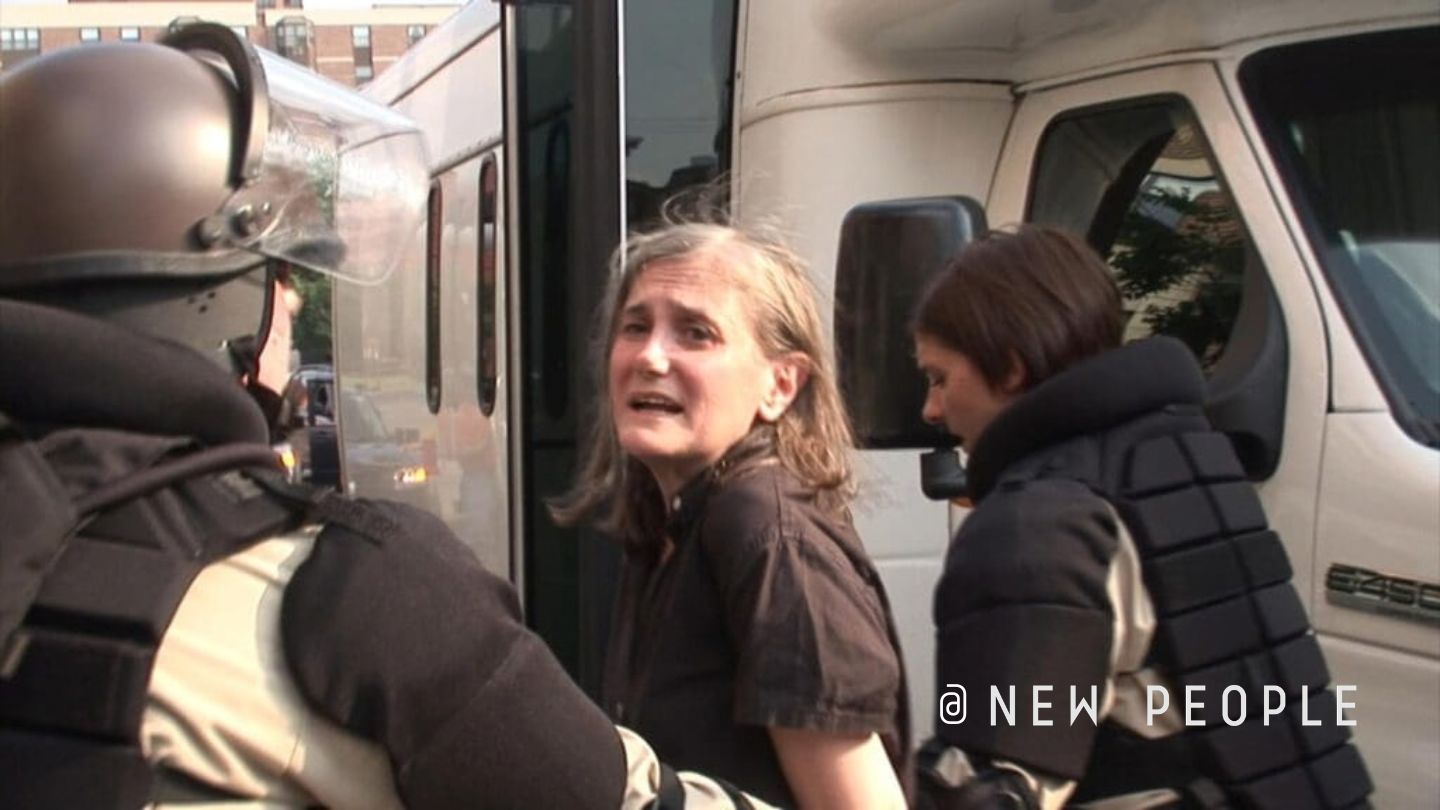
Explore the art of Yiddish 'song smuggling' — how songs cross borders between languages, cultures, and musical traditions — in this hands-on workshop led by Daniel Kahn, a Detroit-born, Hamburg-based troubadour and multi-instrumentalist. The workshop focuses on polyglot performance, tradaptation (translation plus adaptation), musical mixology, and other modes of border-crossing in modern Yiddish song work. Participants should bring their voice, languages, and willingness to experiment. For singers, musicians, and the polyglot-curious; advance registration required.
This talk examines the 2019 assassination of Paweł Adamowicz, Mayor of Gdańsk, as a turning point in Poland's political trajectory—revealing how anti-immigrant rhetoric can harden into violence. The speaker explores Adamowicz's vision of urban democracy rooted in civic openness rather than ethnonationalism, grounded in Christian social teaching and aligned with Benjamin Barber's argument that cities function as democratic bulwarks dependent on newcomer vitality. The talk also addresses Adamowicz's championing of LGBTQ+ inclusion through initiatives like the Model for Equal Treatment and his public support for Gdańsk's Equality March, set against rising illiberal currents in Poland and attacks from figures like Karol Nawrocki.
An introductory tour of Letterform Archive's collections led by Melissa Lee. Letterform Archive preserves and presents typography, lettering, calligraphy, and related design materials spanning centuries of written communication.
A two-part workshop exploring movement building rooted in deep relationships and collective responsibility. Part One uses guided poetry and storytelling to explore kuleana—our responsibilities to ourselves, families, lands, and communities—through hands-on writing exercises. Part Two, facilitated by SOUL, RUKUS Society, and the Huli Movement, covers campaign strategy, organizing tactics, targets, messaging, and security culture for building sustainable movements. Led by Dr. Jamaica Heolimeleikalani Osorio, a Kanaka Maoli organizer, scholar, and Associate Professor of Indigenous and Native Hawaiian Politics at the University of Hawaiʻi at Mānoa.
A book launch and guided reflection evening with Wall Street Journal bestselling author Tiago Forte, creator of the Building a Second Brain methodology. Forte will lead a live guided journaling, meditation, and visualization exercise attendees can practice annually, followed by a Q&A on reflection, planning, and building a purposeful life, and a book signing. His new book, Life in Perspective, distills two decades of personal practice into the ARC Method—Appreciate the Past, Reflect on the Present, Create the Future—offering a framework for annual life review in an era of constant digital distraction. Every attendee receives a hardcover copy as part of their ticket.
Haera Shin, author of *Korean Cocktails: From Traditional Spirits to Modern Drinks*, explores the evolving world of Korean drinking culture—from traditional sool to modern cocktails and Korean pantry ingredients. She discusses the distinctive flavors of Korean spirits, their reimagining in contemporary cocktails, and how ingredients from the Korean kitchen shaped beverage programs she developed during seven years as Momofuku's beverage director. In conversation with Tess Anne Sawyer, a hospitality industry veteran with two decades of experience in brand advocacy and beverage programming, and a personal connection to Korean culinary traditions through her grandmother.
A screening of Forbidden (1932) with film curator Lara Gabrielle. Part of the Mechanics' Institute's Movies at Mechanics' series, featuring discussion and fresh popcorn.
Kirk Lombard, author of the award-winning *Sea Forager's Guide to the Northern California Coast*, reads from his new children's novel *The Shadow Stream*, an epic family adventure following Gabriel, a boy in juvenile detention, and a cast of talking animals who must save their river from being dammed. Lombard is an angler, sustainable fishmonger, tuba player, and former juvenile rehabilitation counselor whose work has been praised by NPR for its poetic approach to nature.
A listening night celebrating 1966 music and memories, hosted at Mill Valley Public Library with Gary Scheuenstuhl of Mill Valley Music and DJ Jim Welte. Bring your favorite song from that year on vinyl or choose from the library's collection to play for the group, then share the song's meaning to you. Doors open at 6pm; dancing, drinks, and snacks included.
Nicholas Epley, John Templeton Keller Distinguished Service Professor of Behavior Science at Chicago Booth School of Business, discusses his new book *A Little More Social*, which explores the paradox at the heart of human life: we are a deeply social species equipped to connect, yet we habitually avoid opportunities to do so. Epley examines why we skip conversations with strangers, hesitate to express gratitude, and miss daily moments of connection—and how small, approachable practices can unlock the happiness and health benefits of a more social life. His research on decision-making and human behavior has been widely featured in the New York Times, Wall Street Journal, CNN, NPR, and other major outlets.
A screening of Safar (Journey), a film by Priyanka Suryaneni tracing South Asian histories at Angel Island, followed by a post-film discussion and program with the filmmaker. Hosted by EastSide Arts Alliance.
A conversation celebrating Rosanne Annoni's debut memoir *Unfolding the Heart*, which explores spiritual practice and personal transformation through the lens of psychotherapy and contemplative practice. Annoni, a psychotherapist and spiritual teacher, discusses her journey with Sandra Maitri, bringing together insights from both the therapeutic and wisdom traditions. Hosted at Copperfield's Books in Petaluma.
Comedian Nigel Ng, known globally as Uncle Roger for his viral food critiques and defense of authentic Asian cooking, appears in conversation with Chef Martin Yan to discuss his comedy, food culture, and culinary authenticity. Ng has built a massive following through razor-sharp humor and fiercely opinionated takes on cooking technique and cultural representation in food media.
City Arts & Lectures presents Lindy West discussing her memoir *Adult Braces: Driving Myself Sane*. West, a longtime essayist and cultural critic known for her work on internet culture, identity, and personal narrative, reads from and discusses her latest book. A trusted City Arts & Lectures public event.
A guided history walk through Sutro Heights Park led by John Martini, a retired National Park Service ranger and San Francisco historian. The tour explores Adolph Sutro's 19th-century "Pleasure Grounds," including the Cliff House, Sutro Baths ruins, the Merrie Way midway, and Sutro's formal estate. Limited to 30 people. Organized by Western Neighborhoods Project, a nonprofit preserving San Francisco's west-side history.
A six-hour intensive workshop on grammar, syntax, and prose style led by Constance Hale, author of *Sin and Syntax* and former editor at Wired and the San Francisco Examiner. Through exercises, prompts, and guided practice, participants will master sentence structure, punctuation, voice, and common grammatical pitfalls—exploring how to exploit grammar as a tool for powerful writing rather than a set of rules to fear. Open to writers of all genres and experience levels. Includes book, bagels, and instruction on building writer's voice.
A hands-on writing workshop exploring how to unlock and share the stories of your life. Britta Stromeyer guides participants through exercises designed to help you move from idea to page, drawing inspiration from Maya Angelou's insight that untold stories carry a unique burden. Ideal for writers at any stage seeking to translate lived experience into narrative.
A series of beginner-friendly sessions exploring the artists, histories, and ideas behind the RM x SFMOMA exhibit. Sturdy Bridge Art Skool creates accessible entry points into the exhibition, grounded in the spirit of RM's vision of building 'a small but sturdy bridge for many.' The program, presented by the Namjooning Collective, welcomes fans and curious learners to approach contemporary art with curiosity, context, and care. Part of the Library's Weaving Stories celebration of Asian American, Native Hawaiian, and Pacific Islander heritage.
A screening of Stacey Gordon's multigenerational novel *The Pearl Farmers*, which follows three sisters upholding their family's Tennessee pearl farm legacy. Gordon explores themes of family history, inheritance, and resilience through the symbolism of pearls—beauty born from struggle.
A full-day film and dialogue event exploring the Ecosex Movement—a practice that reimagines Earth as lover rather than resource, blending environmental activism, art, and sensuality. Founders Beth Stephens and Annie Sprinkle present three documentary films spanning their work from Appalachian mountaintop removal protest (Goodbye Gauley Mountain, 2013) to California water politics (Water Makes Us Wet, 2017) to wildfire aftermath (Playing with Fire, 2025). Each screening includes a Q&A with the directors. The day also features an interactive Ecosex Bingo game, book signings for Assuming the Ecosexual Position, tabling, and community conversation. Doors open 11:30 AM; programming runs through 8 PM.
A guided walk exploring the Tenderloin's hidden urban green spaces, from street interventions and community gardens to redwoods and nature-based public art. Led by Shaping San Francisco, an organization dedicated to understanding and reshaping the city's public realm.
A gallery walkthrough exploring BeHere/1942: A New Lens on the Japanese American Incarceration, an exhibition featuring enlarged and recontextualized photographs by Dorothea Lange and Russell Lee, activated with augmented reality. Museum educator Margaret Yee examines media representation and the language used to describe forced incarceration, examining the power dynamics between photographers and subjects. The session concludes with a poetry exercise centered on Mitsuye Yamada's 'Evacuation,' encouraging visitors to look beyond the images to the emotional and historical dimensions of this moment.
A special double-feature film premiere presented by the Manilatown Heritage Foundation, SOMA Pilipinas, and SFMOMA. The Fall of the I-Hotel (restored 2K edition) is Curtis Choy's landmark 1983 documentary chronicling the decade-long fight to save San Francisco's International Hotel and prevent the eviction of its elderly Filipino and Chinese tenants—a defining moment in the struggle for affordable housing and community self-determination. The screening of Manilatown Manang follows. Both films are paired with community conversations featuring Curtis Choy, Jeanette Lazam, and producers, moderated by Caroline Ocampo. The I-Hotel restoration was completed by the Manilatown Heritage Foundation in collaboration with the UCLA Asian American Studies Center and FotoKem.
Kirk Lombard discusses his epic children's novel *The Shadow Stream*, a throwback to family reads of yesteryear following a troubled boy and a host of hilariously vexed animals who must save a river before it's dammed—and save themselves.
Opening celebration for two Visualizing Abolition exhibitions at Santa Cruz Barrios Unidos: Visions From Within: Women of Resilience, featuring newly commissioned work by people incarcerated in California women's facilities, co-curated by Elizabeth Lozano and Anthony Alejandrez; and Elevar la Cultura, a 22-foot sculptural installation by artist Victor 'Marka27' Quiñonez exploring immigrant labor and creativity. The event includes panel discussions with currently and formerly incarcerated artists and organizers, remarks by Quiñonez, live entertainment, and food. Elevar la Cultura will remain on view through March 7, 2027.
A workshop exploring hybrid, small press, university, and self-publishing paths with author and publisher Albert Flynn DeSilver. Participants will analyze case studies, complete writing exercises, and learn strategies for navigating the modern publishing landscape beyond traditional routes.
A screening of the documentary *Wood Street*, which follows a year in Oakland's largest unhoused encampment as residents face eviction and organize to stay—centering on John and LaMonté as mounting pressure tests their friendship and personal struggles. Filmed using cinéma vérité, the 105-minute film (2026, NR) is followed by a moderated Q&A exploring the making of the film, the Wood Street community, and broader Bay Area issues of housing, displacement, and homelessness. Closed captions in English.
Author and historian Asya Pereltsvaig discusses her novel *Murder in Petrograd*, a historical thriller set in Imperial Russia's final years. The story follows a young Oxford graduate working for British Intelligence tasked with stopping Rasputin—and eliminating him if necessary. Pereltsvaig, a native of Saint Petersburg with a doctorate in Linguistics and teaching experience at Cornell and Stanford, blends archival research with espionage, romance, and moral suspense to explore the people behind one of history's most infamous murders and the ethical questions surrounding political assassination.
A screening of The Dalai Lama: My Religion is Kindness with director Babeth Mondini-VanLoo and special guest, followed by a Q&A moderated by Gaetano Kazuo Maid, Executive Director of the Buddhist Film Foundation. The film offers an intimate portrait of the 14th Dalai Lama through his longterm engagement with the Dutch people, including members of the royal family, artists, and intellectuals. It explores his message of inner peace, planetary concern, and universal connectedness as responses to contemporary polarization and conflict.
The 27th Annual Potrero Hill & Dogpatch History Night celebrates the neighborhood's rich past with local storytelling, archival photographs, and community connection. This year's program explores Jackson Park's history, marks the Potrero Boosters Neighborhood Association's 100th anniversary, and documents the waterfront's transformation over time. Hosted by Pier 70 Time Machine and Avenue Greenlight at Pier 70's historic Building 12, with doors at 5:30 PM and the program beginning at 7:00 PM. Live music and refreshments in the atrium.
A staged reading of *How to Live in a House on Fire*, a new play by performance scholar Kari Barclay exploring queer history and climate grief. Set in a gay commune in 1970s Berkeley and the same house during 2020 California wildfires, the play follows Benny and Jeremy across fifty years, asking how we care for each other in crisis and what histories to preserve. After the performance, a talkback with the creative team and director M. Graham Smith invites audience feedback on the work in development. Hosted by the GLBT Historical Society and Crowded Fire Theater.
A conversation with Greg Sarris (Federated Indians of Graton Rancheria) and Jennifer Foerster (Muscogee/Creek Nation) celebrating Natalie Miller's (Chickasaw) debut poetry collection *Radiant Connection*. The event brings together three Native American voices to discuss contemporary indigenous literature and artistic practice.
Explore Fairyland's 75-year history and cultural impact on Oakland through a curated exhibition at OMCA. The show features a timeline of the beloved amusement park's journey, before-and-now photographs of iconic attractions, miniatures by local artists, vintage Magic Keys, and one of Fairyland's original Jolly Trolly cars for visitors to explore. This celebration of Fairyland's legacy runs through the feature's closing.
A hands-on workshop for families inspired by South African artist William Kentridge's stop-motion charcoal drawings. Participants use a variety of materials to create their own animated drawings. The event includes a talk by Kentridge at 2 p.m. in Phillis Wattis Theater. No museum admission required for the workshop.
A hands-on workshop exploring the experimental materials and processes of Korean-American artist Ha Chong-Hyun. Inspired by the Asian Art Museum's retrospective of his work, participants squish, cut, press, and manipulate materials to explore texture and discover unexpected creative possibilities. Your contributions become part of a collaborative community art project, with all participants credited. Perfect for anyone curious about contemporary art and material experimentation.
A walking tour of downtown San Francisco and SOMA exploring the places, histories, and cityscapes that inspired Susanna Kwan's novel *Awake in the Floating City*. Led by Shaping San Francisco, the tour moves from high rises and Chinatown streets to rooftop outlooks, memorials, and other elevated sites, inviting participants to imagine the city across time. The tour is just under two miles with a couple of steep slopes and a staircase. Rain or shine. Part of the San Francisco Public Library's One City One Book program.
Educator, anthropologist, and community organizer Isa Prieto leads a discussion and collective mapmaking activity exploring utopianism and the fragments of utopia already present in Bay Area neighborhoods. Participants will engage in hands-on mapping as both an intellectual and creative practice, examining how communities envision and build alternative futures. Hosted at BAMPFA (Berkeley Art Museum and Pacific Film Archive).
Three She Writes Press memoirists—Robin Rosenbluth, Rosanne Annoni, and Georgine Hodgkinson—discuss reckoning with the past and self-discovery through memoir writing. The panel explores how writers transform formative relationships with mothers and daughters into narrative, navigating memory, family dynamics, and personal truth.
A screening of a documentary exploring the lived experiences and cultural continuity of Indigenous peoples across California's South Coast Range, featuring intimate interviews with members of the Association of Ramaytush Ohlone, Confederated Villages of Lisjan, Muwekma Ohlone Tribe, Tamien Nation, Amah Mutsun Tribal Band, Esselen Tribe, and Salinan Tribe communities. Following the screening, filmmaker and photographer Kirti Bassendine joins tribal representatives Gregg Castro (T'rowt'raahl Salinan / Rumsien-Ramaytush Ohlone) and Corrina Gould (Confederated Villages of Lisjan, tribal spokesperson) for a panel discussion on cultural resilience, the continuing Indigenous presence in California, and the importance of protecting and amplifying Indigenous voices and knowledge.
Prize-winning historian Kevin Waite presents the first book-length biography of Biddy Mason, an enslaved woman who escaped the cotton South and built a remarkable life of freedom, wealth, and social activism in California. Waite's narrative traces Mason's extraordinary journey from bondage through the Civil War era to her emergence as a pioneering entrepreneur and community leader in Los Angeles. A significant contribution to African American history and the untold stories of Black achievement in the American West.
William Kentridge, one of the most influential contemporary artists, discusses his creative process and the philosophical foundations of his interdisciplinary practice spanning drawing, film, sculpture, theatre, and opera. Kentridge explores the conceptual and working methods behind his opera *The Head & the Load* (2018), which examines history, language, and political movements through layered performance. Drawing on his experience growing up in apartheid-era Johannesburg, Kentridge reveals how erasure, movement, and revision shape his approach to art as a cultural catalyst, addressing themes of historical rupture, ethical unease, and provisional meaning across his career.
New York Times bestselling author Lucy Foley returns to Sonoma County for the kickoff event of her first U.S. book tour, joined by author Amy Meyerson for conversation. Foley's appearance follows a sold-out 2024 event. Hosted by Copperfields Books at Sebastopol Community Cultural Center.
Artist and bestselling author Lea Redmond explores gift-giving as an act of relational care and human connection. Rather than reducing gifts to consumer products, Redmond proposes that thoughtful gift-giving honors the spaces between us and practices our best humanity. She shares her vision from *This Is for You*, her latest book, and leads an interactive workshop with practical gift ideas ahead of the holiday season. Redmond is author of *Knit the Sky*, *Wonder Hunt*, *Paint Chip Poetry*, and the bestselling *Letters to My…* keepsake journal series, and runs the World's Smallest Post Service.
Listen to Native stories and traditional music with Paul Steward, a tribal member of Elem Indian Colony of Pomo Indians and lecturer of Native American/American Indian Studies at CSU. Steward specializes in California and Bay Area history, drawing on his upbringing on the reservation and knowledge passed down by his father and grandparents. Part of the Library's celebration of Indigenous voices and cultures.
Jennifer Liss discusses her middle-grade novel Wide Eye, a heartwarming adventure about a 10-year-old girl spending summer at her grandfather's quirky monster museum on Wide Eye Lake, where she uncovers a long-buried family secret while navigating friendship and the power of imagination. Liss is an educational publishing veteran and regional coordinator for the Society for Children's Book Writers and Illustrators. Wide Eye was a London Times Children's Book of the Week.
A panel discussion with artists from the exhibition Silica / SiO2: Northern California Ceramics, moderated by ceramicists Carlos Dye and Iver Hennig. The artists discuss their work and practice in contemporary ceramics.
An open mic night for original spoken word, music, and cover songs hosted by poet and organizer Aya De Leon. Singing and dancing are optional; the evening centers on community performance and connection. Representatives from California Working Families Party and Bay Resistance will be on hand for attendees interested in political organizing.
Four authors—Samina Ali (*Pieces You'll Never Get Back*), Diana Kapp (*The Last Free Women*), Jason Roberts (*Every Living Thing: The Great and Deadly Race to Know All Life*), and Parini Shroff (*Some People*)—discuss strategies for overcoming writer's block and creative obstacles. Moderated by Page Street founder and author Janis Cooke Newman (*A Master Plan for Rescue*). Complimentary wine and non-alcoholic drinks served.
A reading and generative workshop celebrating Emilie Lygren's anthology *How to Get Home in the Dark: Poems on Mental Health and Healing*. Lygren reads alongside poets Alegria Barclay, Zeina Hashem Beck, Melissa Fowlks, and Antwan Linton Penn, followed by a brief panel discussion. Attendees then write their own pieces in conversation with the anthology—paper, pens, and journal space provided. A space for poetry, reflection, and shared creative practice around healing and mental health.
A screening of The Big Whoop, a dark indie comedy about three desperately out-of-work birthday party clowns who go on the run with an accidentally-stolen artifact, pursued by a ruthless thief and crossing paths with comedy legends including Sandra Oh and Penn Jillette. In the spirit of classic slapstick farces like The Pink Panther and The In-Laws. Director Lisa Satriano has 30 years of experience in studio features and premium television; cast members Jim Turner (HBO's ARLI$$, MTV's Randee of the Redwoods), Mark Fite, and Dave Gruber Allen will participate in a post-screening discussion with writer Steven Banks (SpongeBob SquarePants Emmy-nominated head writer).
A screening of the documentary *Hold On to Your Music: A Mother's Legacy*, directed by Academy Award nominee Josh Aronson and Emmy winner Adam R. Wood, telling the true story of 14-year-old piano prodigy Lisa Jura, who was sent alone on the Kindertransport from 1938 Vienna to wartime London carrying only her music and her mother's parting words: "Hold on to your music." The film features rare archival footage, newly restored recordings, and live performances by Jura's daughter, internationally acclaimed pianist Mona Golabek. Following the screening, Golabek joins co-director Aronson and producer Susan Solomon Libitzky in conversation with Dr. Anita Friedman. Based on Golabek's bestselling memoir and acclaimed stage production *The Pianist of Willesden Lane*.
How do we recognize history while we are still living through it? Journalist and political thinker Mark Danner traces twenty-six years of American political life from the disputed 2000 election through the rise and return of Donald Trump, examining how democratic institutions have been tested and transformed. In conversation with sociologist Arlie Russell Hochschild, author of *Strangers in Their Own Land* and *Stolen Pride*, they explore both the political forces shaping the nation and the human lives shaped by those forces. Hochschild's work, selected by Barack Obama as a favorite book of 2024, examines the emotions and identities beneath America's political divisions. Anthropologist Cari Borja, Clio's founding member, opens the evening, contextualizing the conversation within the history of ideas. $10.
Two-Way Mirror books celebrates the release of two new works: Danny Rosen's *A Love Poem Called War* and J Grabowski's *POMPEI: or The Notes Are In The World*, with live music by Starry Skemes (featuring J Lee on modular synthesis and vocals). Rosen, founder of Lithic Press and Lithic Bookstore, is a poet, geologist, and former astronomical observatory director whose recent collections include *Suspended Erosion* (2024) and *The Tuscan Journals & Other Poems* (2022). Grabowski is a New York–based multimedia artist and co-founder of PUSH Press and Turtle Records. Publisher Marina Lazzara hosts.
A member-led mystery book group meeting on the second Monday of each month at the Mechanics' Institute Library. Open to readers interested in discussing mystery fiction.
Part of UC Berkeley's Cultural Analytics Series. Speakers Meredith Martin and Wouter Haverals discuss computational approaches to analyzing culture, literature, and society. Cultural analytics combines data science, computational methods, and humanistic inquiry to uncover patterns and meaning in large-scale cultural datasets.
What does citizenship mean for those legally ineligible to claim it? Juman Kim, Associate Professor of Political Science and Director of the Program in Law and American Civilization at Towson University, explores how marginalized groups exercise interpretive agency and prefigurative citizenship despite exclusion from formal political status. A CSLS Speaker Series event.
How did Cuban photojournalism of the 1960s–70s reshape decolonial struggle across the Global South? Dr. Jessica Stites Mor of the University of British Columbia explores how Cuban revolutionary imagery functioned as infrastructure for tricontinental solidarity, forging new anti-imperial vocabularies and mobilization strategies during the height of the Cold War. Part of the Sovereignty & Solidarity Fall Speaker Series, hosted by UC Santa Cruz's Huerta Center.
A collaborative deep dive on cultural analytics with Mads Rosendahl Thomsen, Cultural Analytics speaker. Meredith Martin and Wouter Haverals join for an in-person discussion exploring how computational and quantitative methods illuminate cultural phenomena, bridging digital humanities, literature, and data science.
A screening of The Last Dance (2024), Anselm Chan's acclaimed Hong Kong drama about a wedding planner who reinvents himself in the funeral industry and forms an unexpected partnership with a Taoist priest. The film explores love, loss, family, and renewal through the collision of two different worlds. Part of the inaugural Hong Kong Films in Focus Series, presented by the Center for Asia Pacific Studies in collaboration with the Hong Kong Economic and Trade Office in San Francisco, offering audiences insight into how contemporary Hong Kong cinema captures the city's distinctive culture, humor, and everyday life.
Postdoctoral scholar Zoé Samudzi (Ohio State University, Department of African American and Africana Studies) presents archival research tracing uranium extraction, colonialism, and nuclear warfare across the twentieth century. Drawing on photographs from the Belgian Congo (c. 1929–30) held at Photo Elysée in Lausanne, Samudzi constructs a visual forensic connecting Leopold's colonial exploitation and Katangese uranium mines to the Trinity test, Operation Crossroads in the Marshall Islands, and the atomic bombings of Hiroshima and Nagasaki. She employs the "black planetary" as a conceptual and geographic frame to illuminate the entangled histories of imperialism, genocide, and nuclear afterlives. Part of the Art, Technology & Culture Colloquium.
An Arts, Technology, and Culture Colloquium presentation examining genocide studies through the lens of digitality, viewership, and practices of witnessing in the digital age. Speaker Zoé Samudzi explores how technology mediates our encounter with atrocity and the ethical dimensions of digital spectatorship. Hosted by UC Berkeley's Berkeley Center for New Media.
A leading cancer researcher and patient advocate shares lessons for living learned through his dual perspective as a doctor and as someone navigating terminal illness. Bryant Lin distills wisdom on meaning, resilience, and the practice of living fully when facing mortality.
A discussion of investigative journalist Melanie D.G. Kaplan's book *Lab Dog*, which traces her adopted beagle Hammy's mysterious past and explores the ethics and realities of laboratory animal research. Kaplan joins USF law professor Matthew Liebman to discuss how her dog's story became a window into the complex world of animal research, institutional practices, and the animals behind scientific discovery.
A panel conversation on war, sanctions, and intimacy in the Iranian diaspora. Negar Mottahedeh, Professor of Literature and Middle Eastern Studies at Duke University, reads from 'How My Instagram Hacker Changed My Life,' tracing an unlikely friendship born from digital theft and shaped by revolution, state power, and censorship. Salar Mameni reads from daily notes written since February 28, 2026, reflecting on witnessing war from exile, diaspora divisions, and connectivity amid internet blackouts. The conversation explores how revolution, loss, and aggression reshape intimacy and community across geographies.
An anchor event for Oakland is a Reading Town, a campaign celebrating local literacy and community belonging. Panelists include librarians Denise Ngnan (Roosevelt Middle School) and Sam Soloman (Calvin Simmons Library), YA/kids author Maggie Tokuda-Hall, and graphic novelists Thien Pham and Wahab Algarmi discussing storytelling and the role of libraries in building community. The event includes a button-making station.
A book launch and illustrated lecture on how emerging technologies are reshaping architectural imagination and the material world. Katherine Lambert and Christiane Robbins, founders of MAP Studio, examine the relationship between technological systems, architectural speculation, and environmental inquiry—exploring what technology allows architecture to imagine, what it obscures, and what it ultimately builds. Following the presentation, they join Keith Krumwiede, Dean of Architecture at California College of the Arts, for a conversation on implications for architectural practice and education. Copies available for purchase through William Stout Architectural Books.
A design workshop exploring music hardware as fashion. Nick Susi and artist VÉRITÉ trace the evolution from the Walkman to AirPods, sharing design references and historical context on how musicians make their sonic worlds tangible through wearable devices. Attendees then sketch their own wearable music-inspired device and share the creative story behind it, gaining insight into the emerging intersection of music, fashion, and technology.
A conversation about *With Tea: Culture, Accoutrements, and Rituals*, Maria Geyman's debut exploring tea's health benefits and the rituals of a new generation of tea drinkers. Geyman is a naturopathic doctor and writer whose work has appeared in the New York Times, Vogue, and Goop. She is joined by Lauren Haynes, an herbalist, writer, and founder of Wooden Spoon Herbs whose work on medicinal plants has been featured in Bon Appétit, the New York Times, and Vogue. The book combines detailed recipes, tea wisdom, and visually stunning photography and watercolor illustrations.
Local author Katherine McCarty signs copies of her debut LGBTQ+ romance novel *Conversing with Cardinals*, a multigenerational story set in a small North Carolina town where a young woman named Camella experiences mysterious visions of a boy from the 1930s while navigating her grandfather's wisdom, a midnight musician, and her town's resistance to corporate development. McCarty holds degrees in Literature and Chiropractic, and has built a chiropractic practice, nonprofit organization, and writing career since moving to San Francisco.
How do we understand AI beyond the simplistic frames of savior or monster? Professor Kevin Volkan explores AI as a symbolic and transitional medium that reflects longstanding human desires to summon and control powerful forces we don't fully understand. Drawing on psychoanalytic theory, he examines how AI inherits distinctly human patterns of reasoning, conflict, and distortion—and how people form attachments and transference relationships with machine systems. Volkan is a clinical psychologist and founder of California State University Channel Islands who teaches in psychoanalytic studies programs at Roma Tre University and Pacifica Graduate Institute; his forthcoming book is *Artificial Intelligence and Our Ghosts in the Machine*.
A reading and conversation with graphic novelist Emil Wilson about his debut graphic novel *The Nightingales*, hosted by graphic novelist Sophie Yanow. The story follows Lou Miller in spring 1985 as her family takes in Jim, a recently evicted coworker, and his two dogs. As Jim's arrival disrupts their small-town Oregon household, Lou discovers an unlikely bond with him while her mother grows uneasy. A tender exploration of compassion, resilience, and how one person's life can alter another's.
Swiss author Nelio Biedermann discusses his debut novel *Lázár*, a sweeping historical family saga that drew comparisons to Thomas Mann and landed on German bestseller lists before the author turned 25. The English translation by Jamie Bulloch earned a New York Times feature and a Publishers Weekly starred review calling it "a marvel." Biedermann speaks in conversation with Blaise Zerega of Alta.
A reading and discussion of *The Flying Death*, historian Matt O'Hara's account of 1930s explorers racing to harvest curare from the Amazon—a poisonous vine used by Indigenous tribes that became foundational to modern medicine and surgery. The book traces Richard Gill's obsessive quest to broker deals between Indigenous poison masters and American pharmaceutical companies, his competition with rival Boris Krukoff, and the human cost of their success: curare became central to shock therapy and surgical innovation, eventually earning a Nobel Prize, yet the story raises urgent questions about who profits from discovery and who bears the price. O'Hara is a professor of history at UC Santa Cruz and author of *The History of the Future in Colonial Mexico* and *A Flock Divided*.
Zyzzyva Magazine celebrates its 133rd issue with an evening of readings and conversation. Founded in 1985 in San Francisco, Zyzzyva publishes poetry, fiction, and essays by West Coast writers and artists, many previously overlooked by mainstream publications. The celebration will be MC'd by Zyzzyva Managing Editor Oscar Villalon, with guest appearances by Allie Coon and Cristina Fries.
Will generative AI and automated text summaries transform how we read, write, and think? Dr. Maryanne Wolf, director of the Center for Dyslexia, Diverse Learners, and Social Justice at UCLA and author of *Proust and the Squid* and *Reader, Come Home*, explores whether outsourcing language tasks to AI agents risks diminishing the deep cognitive processes that enable critical thought. In conversation with Kirsten Read, Associate Professor of Psychology at Santa Clara University and director of the Language Learning Lab, which studies how children develop language fluency through early literacy experiences.
An evening exploring how artist and activist Harry Belafonte used fame as a force for political change. Geographer and writer Joshua Jelly-Schapiro discusses his book *Daylight Come: Harry Belafonte and the World He Made*, tracing Belafonte's pivotal role in the civil rights movement, his friendship with Sidney Poitier and Martin Luther King Jr., and how he brought Caribbean music into American consciousness. UC Berkeley English professor Nadia Ellis, author of *Territories of the Soul: Queered Belonging in the Black Diaspora*, joins the conversation alongside cultural anthropologist and Clio's founding member Cari Borja, who brings her own fieldwork from Jamaica. Together they explore the intersections of music, migration, race, and activism, asking what it means when an artist becomes a force capable of changing the world.
Jeff and Molly celebrate the release of *The Land*, a memoir documenting a decade-long journey building cabins, tree decks, and community on a small plot in the Northern California redwoods. After a wildfire destroyed their initial structures, they rebuilt with a more intentional approach, chronicling lessons in hands-on learning, DIY adventure, and the surprising power of rallying friends to create something together. Part cabin-building guide for the non-builder and part community chronicle, *The Land* is a scrapbook of experiments in approachability and shared growth.
What does democratic recovery look like after years of authoritarian backsliding? Tom Ginsburg, Leo Spitz Distinguished Service Professor of International Law at the University of Chicago, examines Hungary's recent transition away from Viktor Orbán's 16-year rule and its broader implications for constitutional democracy. Drawing on comparative analysis across multiple countries, Ginsburg argues that today's democratic transitions face distinct challenges from the Cold War–era democratizations of 35 years ago, requiring different tools for institutional redesign and constitutional reconstruction. He is co-author of *How to Save a Constitutional Democracy* and Faculty Director of the Forum on Free Inquiry and Expression at the University of Chicago.
Selin Bengi Gümrükçü, political scientist at Rutgers University, discusses her book *Protest and Politics in Turkey in the 1970s: Echoes of Dissent*, the first comprehensive study of Turkey's protest cycle during the decade. Drawing on original data, the work examines how leftist, nationalist, and Islamist movements developed amid state repression, and how the 1980 military coup suppressed organized political activity and reshaped the political arena, contributing to the rise of political Islam and rightward political shift. The book connects 1970s struggles to contemporary debates on authoritarianism, democracy, and protest.
L. Maria Bo examines Cold War-era literary translations as sites of ideological struggle and diaspora formation. Drawing on her book *Writing on Water*, Bo argues that English-Chinese literary translations mobilized by U.S. and Chinese governments to win over ethnic Chinese communities worldwide became fluid exchanges that undid strict ideological equivalence. By tracing how these texts traveled through multiple languages—English, Mandarin, Cantonese, and local patois—across East Asia, Southeast Asia, and the U.S., she uncovers how translation created ideologically diverse diasporic reading publics. Bo teaches Asian, American, and Asian American literature at Stanford and specializes in 20th/21st-century transpacific literature and multilingual diaspora.
Rock historian Richie Unterberger presents a film-based exploration of Cream, the legendary late-1960s supergroup featuring Eric Clapton (guitar), Jack Bruce (bass, vocals), and Ginger Baker (drums). Unterberger, author of *Do What You Fear Most: The History of the Velvet Underground* and numerous rock history volumes, discusses the band's brief but massively influential career, iconic hits like "Sunshine of Your Love" and "White Room," and the musical groups its members were part of before and after Cream. A look at how British blues-rock virtuosity shaped hard rock.
A screening of The 100th: Seeds of Aloha, a documentary honoring Hawaiʻi's legendary 100th Infantry Battalion and 442nd Regimental Combat Team—Nisei soldiers whose heroism during WWII reshaped Japanese American history. As a test screening, attendees will experience the film while it is still being refined and provide feedback to the production team. The program includes a special acoustic performance by Harold Payne, the film's music director, followed by a Q&A with Producer/Director Steve Sue. Part of the library's Weaving Stories celebration of Asian American, Native Hawaiian, and Pacific Islander heritage.
Dr. Arash Davari examines representations of Iran through the lens of colonialism and imperialism, asking how Western encounters with Iran in the 19th and 20th centuries—when Iran remained semi-colonial but unconquered—illuminate contemporary geopolitical debates. Drawing on René Magritte's concept of the image versus reality, Davari diagnoses assumptions that obscure understanding of Iran's revolutionary history and current political strategies, particularly among those opposing US imperial ambitions in the Middle East. Co-hosted by CMENA and the Asian American/Pacific Islander Resource Center at UC Santa Cruz.
Five talks from designers, artists, researchers, and technologists exploring how aesthetic judgment shapes technology culture. Speakers include Soleio on design philosophy, Nick Susi and VÉRITÉ on artist-made hardware, Dylan Abruscato and Andrew McClintock on taste formation, Tyler Mincey and Toby Shorin on feeling AGI, and Eugenia Kuyda on machine beauty. The evening includes conversation, a "Taste Gallery" edible installation, and drinks. Hosted by tiat and supported by the Department of Anthropology and Culture Forward grant from the Svane Family Foundation.
A Hearst Award ceremony honoring Camille Zapata, Governor Gavin Newsom's Director of Digital Strategy, for her achievements in First Amendment advocacy and her influential role in reshaping the media landscape. Zapata will deliver an award address reflecting on digital strategy, cultural voice, and the responsibilities of communicating in public — examining how communication shapes democratic dialogue and holds power accountable. Food available at 4:00 p.m.; ceremony begins at 4:30 p.m.
Ilyas Chattha, Associate Professor of History at LUMS, discusses his new book Citizens to Traitors: Bengali Internment in Pakistan, 1971–1974 (Cambridge University Press, 2025). Drawing on previously untapped sources, the book reconstructs Pakistan's mass internment of thousands of Bengalis after the 1971 war and explains why this history has been erased from the historical record. Chattha traces how Bengalis in West Pakistan were stripped of citizenship and recast as "traitors" in the conflict's aftermath. Sadia Saeed, Associate Professor of Sociology at USF, serves as discussant, moderated by Elora Shehabuddin, Professor of Gender & Women's Studies and Global Studies at UC Berkeley. A livestream link will be available.
Filmmaker and artist Kahlil Joseph discusses the representation of space in his work, particularly the construction of Black space in his feature film BLKNWS: Terms and Conditions. The conversation explores how these cinematic ideas extend beyond the screen through the Underground Museum, the Los Angeles cultural institution Joseph co-founded in 2012 with Noah Davis and sculptor Karon Davis, dedicated to Black art, thought, and creative expression. Part of Stanford's Art and Art History course "An Architectural Imagination" taught by Christian Ho.
A conversation with journalist Jordan Ritter Conn about his New York Times Editors' Choice book *American Men*, a narrative nonfiction work exploring what it means to be a man in America through the intimate stories of four diverse men navigating identity, heritage, and modern masculinity. Conn, a Senior Staff Writer at The Ringer and host of narrative podcasts including *What If? The Len Bias Story*, spent five years reporting on men across institutions of power and precarity. In conversation with Jennifer Kahn, staff writer for the New York Times Magazine and lecturer in UC Berkeley's Magazine Program.
Four authors share their publishing journeys—covering both traditional and self-publishing paths—and offer insider tips on getting books to market. Kier Holmes and guests answer audience questions about the routes, timelines, and strategies behind successful publication.
Explore best practices for handling, storing, and framing photographs to preserve these complex historic materials. Learn about photographic techniques across the decades and how different photographic processes affect care and preservation. Part of SFPL's One City One Book programming, presented by world-class experts in photography and conservation.
Join Book Society's Romantasy Fan Book Club for discussion of *The Knight and the Moth* by Rachel Gillig, a gothic fantasy romance set in the kingdom of Traum. The group explores Gillig's moody narrative of Sybil Delling, a Diviner whose nine years of service at Aisling Cathedral are disrupted by a heretical knight and the mysterious disappearance of her fellow Diviners. This recurring book club gathers to read and discuss speculative fiction with romance elements in an intimate, participatory setting.
A playful writing workshop exploring the many forms of love in ancient Greek philosophy—Eros, Philia, Storge, and Agape. Led by Katherine Okpara, participants will write poems, stories, or songs inspired by these concepts, experimenting with literary techniques like alliteration and sensory detail. Newcomers can riff on famous love stories, adding new stanzas, chapters, or alternate endings. $5 ticket includes a drink or purchase credit.
A conversation on how ideas become ventures and how entrepreneurial ecosystems shape innovation. Mike Alvarez Cohen, UC Berkeley's Director of Innovation Ecosystem Development and author of *Startup Campus*, discusses Berkeley's rise as a global center for entrepreneurship alongside Darren Cooke, Chief Innovation & Entrepreneurship Officer, and Laura Hassner, Executive Director of the Office of Innovation & Entrepreneurship. Moderated by Missy Martin, founder of Cat Eye Collective. The evening opens with cultural anthropologist Cari Borja exploring how ideas move between people and what kinds of places enable that movement—examining not just what gets built, but what happens between the people doing the building.
A debut novel exploring reinvention, trauma, and redemption. Luke Griffin, a former reality-TV contestant whose football career ended in a car accident, returns to the competition show Endeavor a decade later as a father and husband to a U.S. senator—only to confront the betrayals and guilt he spent ten years trying to escape. Blending the drama of The Traitors with the physical stakes of The Challenge, the novel examines what it costs to rebuild your life when your past is permanently recorded. Lovell Holder reads and discusses his work at Fabulosa Books.
An open mic poetry night at Noe Valley Books where community members share original work. All levels welcome; each poet has a 5-minute slot and may read multiple pieces. Sign up as a poet or attendee.
Scott Lambridis reads from and discusses his debut novel *St. Ulphia's Dead*, a psychological mystery about a disgraced medical researcher and his supervisor investigating an outbreak of mass psychosis on a remote island where villagers claim to be possessed by a cannibalistic demon. The novel explores how trauma warps truth, how isolation breeds belief, and the line between fact and folklore. Lambridis holds a degree in neurobiology from the University of Virginia and an MFA from San Francisco State University.
International Booker Prize-winning translator Jennifer Croft celebrates her debut memoir, *Notes on Postcards*, a collection of personal essays exploring wanderlust, love, and motherhood through a lifelong archive of postcards. The event is presented by Litquake's AfterShocks series at City Lights Bookstore. Free to attend; seating is first-come, first-served.
Oakland author and librarian Dorothy Lazard discusses her work in conversation with Jeneé Darden, Sights & Sounds host and author at KALW. Lazard shares insights into her career at Oakland's main library and her writing on the Bay Area literary and library landscape.
An evening of poetry featuring Avia Tadmor, author of *Song in Tammuz* (Tupelo Press, 2026), winner of the International Berkshire Prize, and Clinical Associate Professor at NYU; and Keetje Kuipers, author of four poetry collections from BOA Editions and Editor-in-Chief of *Poetry Northwest*. Kuipers' *Lonely Women Make Good Lovers* won the Isabella Gardner Poetry Award, and her work has appeared in *The New York Times Magazine*, *POETRY*, and *American Poetry Review*. A rare shared reading from two acclaimed contemporary poets.
An intimate evening with Joyce Maynard, author of seventeen books including the novel *To Die For* and the bestselling memoir *At Home in the World*. Maynard, who captured national attention at 18 with a New York Times cover story, discusses her decades-long career as a journalist, NPR contributor, Moth storyteller, and novelist. She will reflect on the art of storytelling, her novels and memoirs, and her latest book, *In Wonderland*.
Leading cancer researcher and physician Bryant Lin discusses his memoir *Sunshine*, which explores living with terminal illness from both a doctor's and patient's perspective. After his own lung cancer diagnosis, Lin created a Stanford Medical School course called "From Diagnosis to Dialog: A Doctor's Real-Time Battle with Cancer," which gained international attention. In conversation with Laurel Braitman, Lin offers philosophical and scientifically grounded insights into navigating medical crises, finding hope and resilience, and making meaning in life's most challenging moments.
Acclaimed sports journalist Marcus Thompson II presents Game Changers, exploring the unique players who transformed basketball and sparked endless GOAT debates. Thompson examines the statistical and cultural impact of these game-changing figures on the sport's evolution.
Behind-the-scenes look at cookbook publishing and creation, exploring what it takes to bring culinary books to market. Speakers include Maria Zizka, James Beard Award–nominated cookbook author and editor (six of her own, 50+ with chefs like Yotam Ottolenghi and Suzanne Goin); Joyce Tang, who left tech for culinary school and co-wrote her debut cookbook *Bake Sum* with Soleil Ho; and Aya Brackett, Oakland photographer whose work appears in cookbooks by Maria, Joyce, and Samin Nosrat. Hosted by Margarita Florez Vasconcelos (founder of Showoff) with conversation, Q&A, and light snacks.
Paul Wagner, author of the mystery novel *A Murderous Vintage*, discusses his latest book set in Napa Valley. When a winemaker is found dead in a tank of fermenting Pinot Noir, a local newspaper editor becomes entangled in a dangerous investigation that threatens both his life and livelihood. Wagner, who taught viticulture and enology at Napa Valley College for over thirty years, brings authentic wine-country expertise to this page-turner filled with quirky characters and intriguing riddles.
A screening of experimental films by Rock Ross, a legendary Bay Area filmmaker, with the artist present for a post-screening Q&A. The program surveys 20 years of Ross's work, featuring seven shorts from 1982–1999 on 16mm film, including Sosueme, Till My Head Caves In, Baglight, Autumnal Diptych, Go Like This, Vespucciland the Great and Free, Charcoal Narcissus, and Just Another Girl. Ross, who studied at the San Francisco Art Institute and has worked as a film inspector, title designer, and founding projectionist of the No Nothing Cinema and New Nothing Cinema, brings decades of experimental filmmaking and community organizing to Bay Area cinema.
Santiago Lastra, chef and author of *Mexican Soul*, discusses his debut book exploring Mexican culinary traditions and contemporary cooking. Lastra, who trained at Michelin-starred establishments including Mugaritz and noma, opened KOL in London to international acclaim before launching Fonda in 2024. His philosophy centers on celebrating Mexico's rich cultural tastes, aromas, and textures through meticulously sourced seasonal ingredients. The event takes place at Omnivore Books on Food.
A poetry reading celebrating Kelly Grace Thomas's debut collection *Future Tense*, a memoir-in-verse reckoning with infertility, adoption, and love under pressure. Thomas spent three years struggling to conceive while her mother died of Stage IV cancer—a collision of desire and loss she transforms into intimate, unflinching poems about womanhood, motherhood, and meaning-making in grief. Featuring Kim Addonizio (author of *Exit Opera*, NEA and Guggenheim fellow), Tracey Knapp (poet of *Swerve*), and Yaccaira Salvatierra (author of *Sons of Salt*, named one of the New York Public Library's Best Books for Adults 2024).
What happens when the desire to know becomes inseparable from the desire for something to be true? Scott Lambridis and Yance Wyatt, authors of the debut novels *St. Ulphia's Dead* and *The Watersmith*, explore how grief, love, memory, and loss complicate the boundaries between evidence, belief, obsession, and hope. Their conversation moves between psychology, science, faith, and mythology to ask what makes a belief reasonable, where skepticism becomes its own certainty, and whether emotion distorts inquiry or gives it urgency. At stake: when ordinary explanations fail us, what are we willing to believe in order to keep making sense of the world?
Andy Richter presents his oral history of the beloved holiday film Elf, drawing on his firsthand experience on set. Richter shares behind-the-scenes stories and anecdotes from the making of the movie, offering fans an intimate look at the film's production and the on-set dynamics that shaped this cultural touchstone.
The third lecture in a four-part series on the origins of the Arts and Crafts movement in 19th-century England, tracing the ideas and influence of John Ruskin and William Morris. The movement emerged as a reaction against industrial manufacture and advocated for handcrafted beauty, ethical labor, and the integration of art into everyday life.
An introduction to the Enneagram as a framework for understanding personality types, motivations, and interpersonal connection. Sheena Symone Blackwell, a PsyD student with six years of Enneagram study and emphasis on community-based behavioral health, will guide an engaging lesson and interactive exercise on how recognizing our own patterns can deepen intimacy and foster stronger relationships. The event includes a Q&A and time to mingle.
SRI International celebrates its 80th anniversary at the Computer History Museum, reflecting on transformative inventions—from foundational computing technologies to modern applications used globally—and exploring the organization's future research directions. The event showcases how SRI-developed technologies have shaped contemporary life across computing, communications, and related fields.
Santa Clara University's celebration of World Philosophy Day features a full day of talks, panels, and performances exploring philosophical questions. The schedule includes keynote addresses from philosophy faculty and alumni, including Dr. Meilin Chinn on 'Singing in a Thicket of Questions,' panels with SCU alumni and department faculty (Drs. Justin Clardy and Scott LaBarge), student lightning talks, and the university's Ethics Bowl Team. The event combines formal presentations with social time, meals, and community engagement.
Susan Stryker, professor emerita of gender and women's studies at the University of Arizona and distinguished visitor at Stanford's Clayman Institute for Gender Research, discusses her latest book Changing Gender. Stryker traces the gender concept from its grammatical roots through the culture wars, exploring surprising historical moments—from "Yankee Doodle" to 19th-century phrenology to present-day anti-trans conspiracy theories. Drawing on her lifetime as a historian, filmmaker, activist, and founding figure of transgender studies, Stryker argues that to change gender is to change what it means to be human. The book exposes limiting assumptions about gender across the political spectrum and imagines possibilities beyond them.
A lecture on German genocide denialism and museum institutional power. Dr. Zoé Samudzi, a Provost's Fellow to Faculty scholar in African American and Africana Studies at UC Berkeley (on leave from Ohio State), examines a conflict at the Staatlichen Kunstsammlungen Dresden over an exhibition addressing Germany's colonial genocide against the Ovaherero and Nama peoples in Namibia. Samudzi explores how the museum's resistance to recognizing this genocide reflects broader state disciplining of Black scholarship and memory work, and considers withdrawal as an ethical response to institutional anti-Black power. Moderated by Akasemi Newsome, IES Associate Director.
A test screening of The 100th: Seeds of Aloha, a feature-length documentary honoring Hawaiʻi's legendary 100th Infantry Battalion and 442nd Regimental Combat Team — the extraordinary Nisei heroes of WWII. The program includes a special acoustic performance by Harold Payne, Music Director, and an audience Q&A with Producer/Director Steve Sue. Attendees' feedback directly shapes the film as it moves toward final release and festival presentations. 110 minutes. (CC not provided.)
A lecture on the hidden feminist genealogy of Egypt's 2011 revolution. Dr. Lucia Sorbera, Associate Professor at the University of Sydney and author of *Biography of a Revolution: The Feminist Roots of Human Rights in Egypt* (UC Press, 2025), argues that the revolution was not a sudden rupture but the culmination of a century of women's organizing across nationalist, labor, student, and democratic movements. She reflects on how testimony, intimacy, and relationality—informed by decolonial and indigenous feminist epistemologies—offer a methodological alternative to event-based narratives and Western-centric periodization of Middle Eastern political history, and discusses new research agendas for studying movements that persist and transform rather than simply end.
Dr. Zeynep Gursel discusses her photographic work examining displacement, migration, and belonging across international borders. Gursel is a scholar and photographer whose work centers on how visual narratives reveal experiences of statelessness, asylum, and exclusion in the contemporary world.
A conversation on how sacred spaces, art, and spirituality shape the experience of living with cancer. David S. Zucker, M.D., PhD, Emeritus Founding Medical Director of Cancer Rehabilitation Services at Providence-Swedish Cancer Institute, discusses the body's capacity to heal while living with serious illness. Kathryn Barush, founding director of the Berkeley Art and Interreligious Pilgrimage Project and author of *Imaging Pilgrimage: Art as Embodied Experience*, explores how the arts shape belief and ritual. Of particular interest to pre-health students and those in the Medical and Health Humanities Program.
Shaun Ossei-Owusu, a legal scholar and insider to the American justice system, examines how the law often fails to deliver the equality it promises. Drawing on his perspective as both a practitioner and critic, Ossei-Owusu recounts encounters with institutional inequality and explores what transformation of the legal field might require. A conversation on law, race, and systemic change.
Elizabeth Nugent, Assistant Professor of Politics at Princeton University, presents research from her forthcoming book on activism among political exiles and opposition movements abroad. Nugent studies authoritarianism, political psychology, and religion in the Middle East, and is author of *After Repression: How Polarization Derails Democratic Transition* (Princeton University Press, 2020). Her work appears in top journals including the American Journal of Political Science and Comparative Political Studies. She holds a PhD and MA in politics from Princeton, studied Arabic and Arab Studies at Georgetown, and held fellowships at Harvard Kennedy School and Yale.
A lecture with Dr. Lucia Sorbera hosted by UC Berkeley's Center for Middle Eastern Studies. [Note: The source provides no information about the topic, Sorbera's institutional affiliation, or the substantive focus of the discussion — a reader cannot determine what this event is about from the available description.]
Historian Matt O'Hara traces the true story of American explorer Richard Gill's 1938 quest to extract curare from the Amazon, believing the Indigenous poison held pharmaceutical promise. Gill's obsessive race against Russian rival Boris Krukoff to broker deals with Indigenous poison masters and U.S. pharmaceutical companies transformed surgery globally and led to a Nobel Prize — but at what cost? O'Hara examines who benefits from scientific discovery, whose knowledge is exploited, and what price is paid for progress, weaving together Indigenous expertise, colonial ambition, corporate competition, and the ethics of medical innovation.
Carmen Argote, a contemporary artist known for her interdisciplinary practice exploring identity, labor, and community, presents a lecture as part of UC Berkeley's Visiting Artist Lecture Series. The Department of Art Practice hosts this free public talk in the Anthropology and Art Practice Building.
Hannah Shepherd discusses her new book *The Narrowing Sea*, which uses three historical portraits to examine the imperial region that developed across the Tsushima Strait—the maritime boundary between Japan and Korea. Through vignettes spanning the region's complex past, Shepherd explores how this geographical and political space shaped East Asian imperial politics and cultural exchange. A talk grounded in regional history and transnational perspective.
How do we prepare ourselves and our children for fulfilling careers when the nature of work itself is changing rapidly and opaquely? Roboticist and author Illah Nourbakhsh discusses his book *Crunch Time*, examining the future of labor, education, and opportunity in a shifting economy. A conversation on work, meaning, and adaptation in an uncertain technological landscape.
An immersive exploration of fungi where ecology, culture, and cuisine intersect. Participants taste and experience mushrooms through a curated wild-grazing board in an approachable, sensory-forward format. No named speaker or educational framework specified.
Join artist-naturalist Laura Cunningham for a reading and presentation on the reissue of her natural history masterpiece *A State of Change: California's Forgotten Landscape*. Cunningham, who studied paleontology and biology at UC Berkeley and has worked field biology jobs for the California Department of Fish and Game and USGS, presents illustrated scientific detail of California's precolonial ecology and historical biodiversity. This fully redesigned edition features new material on wolf reintroduction, regenerative agriculture, and traditional Indigenous uses of fire. A book signing follows. Hosted at the Santa Cruz Museum of Natural History.
Kate Doerge presents her guide Reimagining Grief, which reframes the traditional stages of grief into five actionable healing practices. Drawing on personal experience, Doerge offers a compassionate roadmap for navigating loss and finding meaning in the aftermath of darkness.
A generative writing workshop led by poet Jennifer Barone, author of Sirenland. Participants explore siren mythology of the Bay of Naples through photographs, ancient artifacts, and archaeological discoveries, engaging themes of death, transcendence, sensuality, longing, and transformation. The workshop uses guided writing prompts to awaken creativity and invite attendees into their own creative territory. Open to writers of all genres; no previous experience necessary. Limited to 15 participants.
Peabody winner Daniel Handler and Pulitzer winner Andrew Sean Greer discuss their favorite literary passages in a deep dive into the craft and power of written language. Two acclaimed authors in conversation about what moves them on the page.
A reflective poetry workshop led by poet, author, filmmaker, and educator Amber Allen-Peirson, drawing from her collection *The Unrooted Bloom*. Participants explore identity, belonging, and the conditions that allow authentic self-expression through guided writing prompts and introspection. Topics include where you feel seen and safe, how you adapt to belong, what you've inherited, and what parts of yourself are ready to emerge. No prior poetry or writing experience required; all are invited to write honestly and share only what they choose.
Renowned sculptor Charles Ray discusses his five-decade practice exploring how spatial transformation shapes perception of objects, reflecting on works including his 1996 film Fashions, currently exhibited in Solid Pictures. Ray appears in conversation with Patrick R. Crowley, Associate Curator of European Art at the Cantor, to explore connections between Ray's work and the exhibition's investigation of three-dimensionality, consumerism, and the perceptual role of clothing and fashion. The Solid Pictures exhibition, curated by Crowley, is the first major show of François Willème's 1859 photosculptures—pioneering experiments translating photographs into three-dimensional figures that laid the foundation for modern 3D scanning and printing.
David D. Schmidt discusses his California Book Award–winning environmental history of the San Francisco Bay Area, tracing how natural forces and human choices have shaped the region's landscape over thousands of years. Schmidt will present his research with particular focus on Oakland and the East Bay, followed by audience Q&A and book signing.
San Francisco Poet Laureate emerita Kim Shuck and special guests celebrate This Music, a memoir in prose poems by the late Native poet and essayist Janice Gould. Part of SFPL's Monthly poetry reading series, the event honors Indigenous voices and artistic expression. Shuck, the city's seventh Poet Laureate, draws on her Polish and Cherokee heritage in her own work, including her 2024 poetry collection Pick a Garnet to Sleep In and her 2022 essay collection Noodle, Rant, Tangent. During her tenure, she launched major citywide initiatives to honor Native American and Indigenous Peoples' heritage in partnership with the San Francisco Arts Commission.
A writing workshop on embodying memoir, led by Savala Nolan, author of *Good Woman: A Reckoning* and *Don't Let It Get You Down: Essays on Race, Gender, and the Body*. Nolan explores how writers draw from and contend with the body to craft honest, fresh memoir — what our bodies can tell us that minds cannot, how to work with embodiment when we live in a society hostile to our bodies, and concrete approaches to honest representation. The session includes examples of embodied writing from celebrated authors and a skills-building exercise. Bring pen, notebook, or laptop.
SRI International celebrates 80 years of technological innovation with a public event at the Computer History Museum. Speakers will reflect on SRI's foundational contributions to computing, robotics, weather satellites, artificial intelligence, medicine, and personal computing — technologies that shaped the modern world. The evening features current SRI researchers and leaders discussing the institute's past achievements and ongoing work, with additional speakers to be announced.
Journalist Alexis Madrigal discusses his work in craft, career, and culture in conversation with Adrian Daub, J.E. Wallace Sterling Professor in the Humanities at Stanford. Madrigal is co-host of KQED's Forum, creator of the podcast Containers, author of The Oakland Garden Club newsletter, and co-founder of The COVID Tracking Project at The Atlantic. His book The Pacific Circuit explores how Oakland's logistical revolution reshaped American cities. He also runs Local Economy, a community space in Oakland. Book signing and selling to follow.
Journalist and activist George M. Johnson discusses their adult memoir *And If I Die Before I Wake*, which recounts 15 transformative years navigating an HIV diagnosis, alcoholism, grief, and the fight against book banning. Johnson's previous work, *All Boys Aren't Blue*, remains a frequent target of censorship despite critical acclaim. In conversation with Maggie Tokuda-Hall, children's and YA author and co-founder of Authors Against Book Bans. Doors at 6 p.m.
A screening of Little Forest with director Yim Soon-Rye in conversation. The filmmaker discusses this delightful foodie film exploring food, community, and everyday life. Presented in partnership with the Korean Cultural Center, Los Angeles.
A panel discussion on Mother Jones magazine's 50-year history as an investigative news organization founded in San Francisco in 1976. Speakers include Clara Jeffery, editor-in-chief of Mother Jones; Adam Hochschild, co-founder and historian; and moderator Jamil Smith, faculty lecturer at UC Berkeley's Graduate School of Journalism. Topics include the magazine's origins and influential investigations, its defense of press freedom (including a lawsuit against OpenAI), its approach to confronting disinformation, and the sustainability of the nonprofit news model for outlets nationwide. The panel will also analyze recent election coverage and media performance.
A monthly romance book club for readers of all subgenres—historical, paranormal, enemies-to-lovers, fake dating, and more. This month discusses *The Isle in the Silver Sea* by Tasha Suri. The club meets the second Thursday of each month in person at Mill Valley Library. Audiobook and Large Print editions available upon request.
A reading and signing featuring three acclaimed poets and fiction writers published by Black Lawrence Press. Taayba Kanwal reads from *Talking with Boys*, a collection of linked stories exploring the Pakistani diaspora in Houston, Dubai, and Lahore. James Cagney presents *Ghetto Koans: A Personal Archive*, poems capturing Bay Area urban life through monologue and documentary narrative. Tureeda Mikell shares work from *The Body Oracle of Memory*, visceral poems of healing and ancestral connection. All three authors will be available to sign copies of their latest collections.
A screening of the documentary short Judges Under Fire, examining the vital role of U.S. District Court judges in upholding constitutional limits, judicial independence, and the rule of law. Co-directors and producers Abby Ginzberg and Ken Schneider discuss the film with Judge Suzanne Ramos Bolanos, co-chair of the Retired Judges Initiative, moderated by Eva Paterson, co-founder of the Equal Justice Society. Hosted by Commonwealth Club, a trusted nonpartisan civic institution.
Journalist and NYU professor Rachel L. Swarns discusses her award-winning book *The 272*, which examines the history of American slavery and its ongoing impact on institutions today. Swarns investigates how slavery shaped American society and institutions, and how we reckon with this legacy in the present. The talk, honoring Black Catholic History Month, will be followed by a reception and book signing.
An evening with three authors exploring weird science, strange beliefs, and the impossible. Scott Lambridis, Martha Conway, and Yance Wyatt discuss their work and ideas around the unexplained and unconventional.
A storytelling event celebrating the connections between people and handmade objects. Bay Area artists, makers, and community voices each share a personal object of significance and reveal the stories behind it, exploring how craft intersects with memory, identity, creativity, and belonging. Presented by the American Craft Council, a national nonprofit dedicated to building a world where objects matter, makers thrive, and craft connects.
Celebrated political journalist Mark Danner discusses his new essay collection *Crossing the Rubicon: The Betrayal of American Democracy, 2000–2026*, published by NYRB. Drawing on three decades reporting on foreign wars and American politics, Danner traces the erosion of democratic institutions and rise of authoritarianism from the Bush–Gore election through Trump, offering portraits of key architects like Cheney and Rumsfeld alongside critiques of mass media's role in politics. Danner is Class of 1961 Distinguished Chair in Undergraduate Education at UC Berkeley and has received a MacArthur Fellowship, Guggenheim, National Magazine Award, and three Overseas Press Awards.
Two debut novelists longlisted for the Center for Fiction First Novel Prize discuss their publication journeys with independent presses. Devon Halliday, author of *To Stay, To Stay, To Stay* (McSweeney's 2026) and a former literary agent, and Rebecca Handler, author of *Edie Richter Is Not Alone* (Unnamed Press) and *In the Round* (McSweeney's 2026), explore the long, meandering path to getting a book into the world. In partnership with Same Page SF.
Bing Gordon, legendary video game industry strategist, and his daughter Chloe discuss *Everybody Wins*, their guide to applying game design psychology to product development and customer engagement. Drawing on four decades shaping companies like EA Sports, Amazon Prime, Spotify, and Duolingo, Gordon presents his "Gamification Checklist"—eight core principles including Wow Moments, Social Integration, Retention Hacking, and Game Loops—with Paul Saffo moderating. The event explores how the psychological drivers that make games irresistible can unlock better business strategy and user experience across industries.
A book talk with Spencer R. Scott, biologist and cofounder of Solar Punk Farms, celebrating his new memoir *As If We Were Staying*. Weaving personal narrative with scientific inquiry, Scott explores how we might reimagine our relationship to capitalism and ecology, drawing on his experience building a queer regenerative community. The book bridges science and lived experience to ask: how do we live on this planet as if we were staying? Event at The Booksmith, San Francisco's independent Haight Ashbury bookstore. Seats guaranteed with book purchase or $3 sliding-scale donation; first-come, first-served thereafter. Check-in begins 6:45 PM.
The West Coast premiere of William Kentridge's seminal multimedia work chronicling the untold history of over two million Africans who labored, fought, and died during World War I. Through dance, projection, shadow play, song, and costume, Kentridge weaves together texts by anticolonial authors and Dada poets in multiple languages with original music by Philip Miller and Thuthuka Sibisi, blending traditional African songs with quotes from WWI-era European composers. The production takes its name from a Ghanaian proverb, "The head and the load are the troubles of the neck," continuing Kentridge's exploration of history, language, and political movements. Concept and direction by Kentridge; choreography by Gregory Maqoma; music direction by Thuthuka Sibisi.
An evening celebrating Netflix's limited series adaptation of John Steinbeck's classic novel, with co-showrunner, writer, and executive producer Zoe Kazan and star Florence Pugh. The event will include a presentation of the John Steinbeck Award to both Kazan and Pugh by the Martha Heasley Cox Center for Steinbeck Studies at San Jose State University, honoring their fresh perspective on Steinbeck's 74-year-old masterpiece. The series reimagines the multigenerational saga through the lens of its antihero, Cathy Ames, and features Christopher Abbott, Mike Faist, Hoon Lee, Tracy Letts, and Ciarán Hinds.
A screening of La Haine (1995), Mathieu Kassovitz's landmark film about three young men navigating racism, marginalization, and police violence in Paris's low-income banlieue districts. The screening is followed by a moderated panel discussion with The 418 Project board member Amber Wyld and special guests addressing the film's themes: racism and identity, economic hardship, alienation, and state violence against immigrant communities. The film explores the simmering resentment of France's Jewish, African, and Arab populations confronting systemic exclusion.
The Computer History Museum and IEEE honor SRI International's significant technical achievements with the unveiling of two new IEEE Milestones. The event celebrates SRI's history of innovation in computing and related fields.
A symposium honoring film theorist Mary Ann Doane, featuring scholars across three thematic sessions: Technology/Epistemology (Wendy Hui Kyong Chun on LLMs and archives, Nico Baumbach on cinema, Kristen Whissel on 3D film and doubling, Yuriko Furuhata on climate and deep time); Mediating Time (Althea Wasow on cinema and racialization, Pooja Rangan and Joshua Guilford on politics and avant-garde form, Rosalind Galt on anticolonial feminism); and Desire and the Politics of Form (Maggie Hennefeld, Karl Schoonover, Erika Balsom on voyeurism and feminist film theory, Marc Steinberg on Japanese cinema). Facilitated by Kristen Whissel and Damon Young of UC Berkeley.
How have European countries navigated industrial capitalism and superpower competition since 1945? Laurent Warlouzet, historian of European integration and capitalism, examines the political and economic strategies European nations adopted to manage capitalism while building supranational institutions. A lecture exploring the deep history of the EU as a response to Cold War geopolitics and economic transformation.
A conversation with filmmaker and graphic novelist James Spooner about his graphic novel *It Starts with Anger: A Punk Beginning. An AFROPUNK Ending*, which traces the origin of the multi-million-dollar AFROPUNK festival from a mixed-race teenager's search for belonging in the nineties New York City punk scene. Moderated by cartoonist Johnny Damm. The event includes a book signing by Spooner, and local author and punk historian John Malkin will also sign his new book *Punk Spirit! – An Oral History of Punk Rock, Spirituality, and Liberation*, with Damm's latest comic *I'm a Cop: Real Life Horror Comics No. 3* available.
Devon Halliday discusses *To Stay, To Stay, To Stay*, exploring love's central contradiction—how it generates both bewilderment and clarity simultaneously. The book examines how love ultimately transcends this paradox through hard-earned understanding.
A screening of Baby Face (1933) with film curator Lara Gabrielle, who leads discussion after the film. Part of Movies at Mechanics', a series pairing classic cinema with expert context and audience conversation.
William Kentridge's West Coast premiere of *The Head & the Load*, a visionary multimedia work that chronicles the untold history of more than two million Africans who labored, fought, and died during World War I. Through dance, projection, speech, song, shadow play, and costume, Kentridge—concept and director—weaves together texts by anticolonial authors and Dada poets with original music by composer Philip Miller and choreography by Gregory Maqoma. The production features co-composer and music director Thuthuka Sibisi, blending traditional African songs with WWI-era European compositions. Presented by Cal Performances at UC Berkeley.
A student-directed production of playwright Gillian O'Leary's original play about friendship, apocalypse, and the interior of a sperm whale's stomach. Directed by UCSC student Britney Johnson, the show features quick-witted dialogue and implausible storylines exploring the complexities of young adult relationships. Running approximately 60 minutes with no intermission. Contains loud noises, violence, adult language, and mature themes.
An exploration of the craft of children's picture book writing with Monica Wesolowska. The session examines the structural and stylistic conventions that govern picture books and how creative constraint can actually fuel imaginative storytelling. Learn both the established rules and the strategies for breaking them effectively.
A conversation on staying present through the holiday season's overwhelm. Cecily Mak, author of *Undimmed: The Eight Awarenesses for Freedom from Unwanted Habits*, and Libby Stockstill, integrated life and leadership coach and author, discuss how intuition helps us recognize early signs of distraction and busyness, and how to return to what matters most when the calendar fills and our minds drift to tomorrow's agenda.
A talk on digital safety and privacy strategies for political artists and activist creators. Gray Area / Grand Theater is a bar and event venue in San Francisco.
Spurred by Christopher Nolan's film *Oppenheimer*, Phil Cousineau explores Homer's *Odyssey* as a timeless meditation on heroism, journey, and homecoming. Drawing on classical scholarship, film, and contemporary resonance, Cousineau illuminates how ancient epic speaks to modern questions of purpose and transformation. A talk for anyone drawn to literature, mythology, and the enduring power of storytelling.
A monthly moderated discussion salon for people seeking to think more clearly and live more deliberately. Led by Abraxas Adams, each session centers on a carefully researched theme drawn from philosophy, spirituality, and science, grounded in real questions people actually wrestle with. Participants receive a printed handout with context, evidence, and discussion prompts, then share perspectives in turn—no one required to speak, no one dominates. The format prioritizes genuine dialogue, humor, and curiosity over consensus. Disagreement welcome; disrespect not. Held at Manny's, a San Francisco bar, every second Saturday, 10:30 AM–12:00 PM. Commitment expected.
The Sogdians were Iranian-speaking merchants from Samarkand and Bukhara who dominated Silk Road trade between the 4th and 8th centuries CE, serving as cultural brokers who spread Buddhism, Manichaeism, Christianity, and Zoroastrianism across Eurasia. Dr. Sanjyot Mehendale, an archaeologist at UC Berkeley specializing in Silk Road trade and mobility networks, explores how the Sogdians shaped artistic traditions, technologies, and urban life across Central Asia to China. A full-day study group featuring morning and afternoon sessions at the Asian Art Museum.
A hands-on cooking workshop led by chef and educator JiYoung Park, founder of Parks Kitchen in San Francisco. Participants will prepare sujebi (hand-torn dough soup) and baechujeon (Korean cabbage pancakes) — two dishes featured in Yim Soon-rye's 2018 film Little Forest — while learning about the cultural significance of Korean cuisine, how recipes evolve through families, and Park's own journey reinterpreting Korean food heritage. All materials provided; dishes prepared and enjoyed fresh after cooking.
A lecture-recital exploring how Eastern and Western composers interpret the seasons across musical traditions. Pianist Yinxuan Long, music faculty at Chabot College and Grammy-featured artist, examines Vivaldi's storms, Tchaikovsky's winter scenes, and jazz standards alongside classical Chinese repertoire rooted in the pentatonic scale and the aesthetic philosophy of Yijing (意境). The program reveals how different musical philosophies—Western narrative imagery versus Eastern contemplative reflection—translate nature into sound and deepen understanding of memory, place, and artistic expression across cultures.
EastSide Arts Alliance's Community Archival Resource Project (CARP) invites Black, Brown, and Indigenous musicians, dancers, theater artists, and cultural educators to share stories and materials for archival preservation at a community archival day. Bring posters, photos, letters, ephemera, and other documents to be digitized and preserved. Digitization services, participation stipends, and archival storage are provided. LGBTQ+ artists are especially encouraged to attend. Lyft travel vouchers available by request.
A launch celebration for *Mukja: Let's Eat!*, a cookbook pairing fan-favorite Korean dishes inspired by K-dramas, movies, and K-pop with vibrant full-color illustrations. Written by chef Judy Joo and illustrated by Asia Kang, the book features kimbap, ramyeon, snacks, sweets, and drinks. Asia Kang will be present to sign copies and discuss bringing iconic food moments to the page. The event includes treats from Atoi Bakes and merchandise from Chonky Wontons.
A celebration of Venezuelan-American singer-songwriter, visual artist, and poet Devendra Banhart around his poetry collection *Four Nose Jobs a Day*. Like his music and visual art, Banhart's poetry converges experimental form with intimate observation. Meet the artist at Book Passage Ferry Building.
Tom Singer, a Jungian analyst, psychiatrist, and author, reflects on a lifetime of writing, scholarship, and creative exploration in psychology, myth, and culture. He traces the emergence of "recombinant visionary mythology"—a creative practice of discovering new meaning through the continual recombination of experience, symbol, and story. Singer, a 2023 Milley Award recipient, has published more than a dozen books and spent decades illuminating how stories, symbols, and imagination shape both inner life and contemporary culture. Part of the Creative Practice Series, featuring Mill Valley Milley Award recipients exploring creativity across the arts.
A joint lecture on a recently acquired carved limewood panel by celebrated 17th-century English Baroque woodcarver Grinling Gibbons—one of only three works by Gibbons in an American museum collection. David Oakey, curator in charge of European decorative arts and sculpture at FAMSF, and Linda Lin, objects conservator, discuss discoveries and conservation insights from two years of ongoing investigation and research. Part of the "A Closer Look" curatorial lecture series exploring collection development and art historical significance.
Isabel Allende, New York Times-bestselling author, discusses her children's book *Perla and the Princess*, the third in her series about Perla the mighty dog. The story follows Perla as she saves her human brother Nico Rico and his friend from danger.
Emory Douglas and William Rhodes discuss their collaborative piece *Revolution in Our Lifetime*, featured in *Some Particular Heaven* at BAMPFA. The artists explore how visual work fosters solidarity, reimagines collective power, and opens new political possibilities. Douglas, the Black Panther Party's legendary minister of culture, and Rhodes, a contemporary artist and activist, reflect on art's role in social transformation and resistance.
A celebration of Hardly Strictly Bluegrass at 25 featuring *The Big Twang!*, a collection of photos and essays about the iconic festival. Author and journalist Gina Arnold discusses the book with producers and HSB insiders Tricia Hellman Gibbs, Sarah Davis, and Avery Hellman. The panel is followed by a live performance from Crying Uncle Bluegrass Band.
Join artist Dorian Reid for an afternoon of art making and collective action celebrating the Black Cat Revolution. Inspired by her Emerging Artist Program exhibition *Calling All Cats*, Reid connects Black history, civil rights, animal welfare, and the superstitions surrounding black cats—drawing parallels between how black cats and Black people have been treated with fear and prejudice. Participants will create hand-painted protest signs, then march with Reid around the museum while joining in protest songs and chants rooted in civil rights movements. Reid, a Berkeley native and daughter of historian Betty Reid Soskin, channels her family's legacy of activism and community into this joyous call for liberation, justice, and care for all.
Learn about the real-life and on-stage opera characters audiences have come to love and hate — gods, goddesses, countesses, and courtesans — and how opera divas command attention and captivate with their vocal artistry. Cole Thomason-Redus, Educational Content Curator at SF Opera, illustrates the history and cultural power of the operatic diva, accompanied by recordings from celebrated opera stars.
A two-hour memoir workshop led by Katharine Harer, a poet and creative writing instructor. Participants will excavate and write personal memories—sights, sounds, feelings, smells, tastes—and learn techniques for crafting vivid, emotionally resonant stories from lived experience. Harer has taught memoir and creative writing at the San Francisco Writing Salon for eight years and previously taught English at Skyline College. She is the author of seven poetry collections, including *Deconfliction* (2020) and *Jazz & Other Hot Subjects* (2016), with work published widely in literary journals, newspapers, magazines, and anthologies.
Japanese contemporary artist Ōki Toshie, winner of the 2026 Coffland Grand Prize in the New Generation Bamboo Art Prize competition, discusses her innovative bamboo sculptures and site-specific installations. Toshie will share insights into her creative process, influences, and artistic vision during this rare presentation timed to coincide with the exhibition of this year's prizewinners in the Henri and Tomoye Takahashi Gallery.
Seth Fleisher discusses his sweeping novel *The Farther Shore*, a story about fathers and sons, memory, and race inspired by the true story of Eugene Marais, one of history's most extraordinary figures. The novel explores the dangerous fictions that shape us across generations.
A workshop and book signing with Alejandra Siroka on using language intentionally to deepen relationships and cultivate authenticity. Siroka explores how the words we choose shape our emotional connections and communication patterns, offering practical tools for more peaceful and genuine interactions. Book signing and refreshments provided.
A conversation celebrating Jae Nichelle's poetic musical collection *Grownfolk Blues: A Musical in Poems*, a cross-genre work blending narrative verse with musical theater. Nichelle discusses this dynamic experiment in form and the queer Southern blues influences that inspired it, in conversation with local literary icon KB Brookins.
A opening reception for two Bay Area visual artists. Mariela de la Paz, a Chilean-born painter, draws on Tibetan Buddhist iconography, Mapuche tradition, and sacred plant medicine in her four-decade oil-painting practice. Vibrata Chromodoris creates geometrically patterned abstract paintings and sculptures exploring rhythm, reflection, and perceptual distortion through immersive digital and traditional techniques. Artist talk at 7pm.
Sara Calvosa Olson and Crystal Wahpepah discuss *Radiant Connection* by Natalie Miller (Chickasaw). An event centered on contemporary indigenous voices and literature.
Copperfield's Books welcomes local author Teri Roche Drobnick to discuss her memoir *Our Long Goodbye: A Daughter, a Father, a Best Friend*, a deeply moving exploration of family and loss.
Poet and author Diego Perez (Yung Pueblo) discusses his new book *Journey: The Year That Changes Everything*, a year-long guide to building self-awareness, emotional maturity, and inner peace through daily reflections and intentional habit change. In conversation with Elena Brower, author of *Hold Nothing* and *Art of Attention*, both will explore how short reflections, practices, and mindset shifts cultivate healthier relationships with oneself and others. Brower brings nearly three decades of experience shaping modern yoga and meditation practice.
An illustrated lecture on how to evaluate artificial intelligence through the lens of human flourishing—considering authenticity, embodiment, agency, relationship, community, and responsibility. Sam Stern, Senior Content Creator at Esalen Institute and host of the podcast Voices of Esalen, draws from the human potential movement to examine AI's capacity for assistance and expression alongside its risks of extraction, dependency, and control.
David Sedaris celebrates his new essay collection *The Land and Its People* in conversation with author Susan Orlean. Sedaris, the acclaimed humorist and radio contributor, reflects on home, family, and the natural world in this new collection. Orlean, known for her narrative journalism and books including *The Wager* and *Rin Tin Tin*, joins him for what promises to be a lively and intimate discussion.
A creative problem-solving session where kids offer advice to adult artists seeking inspiration and direction. Danielle Krysa, the Jealous Curator, opens by reading from her book *How to Spot an Artist*, then moderates a Q&A where children help adults reconnect with their creative practice. Paper and drawing materials provided for brainstorming.
A conversation with three writers and artists exploring how creativity responds to attacks on land, memory, and cultural ecosystems. Robert Liu-Trujillo (illustrator of I Am Sausal Creek), Umi Vaughan (author of Rebel Dance, Renegade Stance and Carlos Aldama's Life in Batá), and Tiffany Yap (conservation scientist and urban wildlands science director at the Center for Biological Diversity) discuss crafting inclusive work that holds history, ecology, and lived experience simultaneously. The event concludes with a closing performance by SambaFunk.
A program exploring Japanese American legacies of resistance through OMCA's exhibition BeHere / 1942: A New Lens on the Japanese American Incarceration. OMCA Executive Director Lori Fogarty will open remarks, followed by Satsuki Ina and Miya Sommers—both with personal or familial ties to wartime incarceration—in conversation with host Joemy Ito-Gates about anti-imperialist organizing, solidarity, and healing work amid ongoing racial injustice. Taiko Peace will close with an interactive performance of "Ei Ja Nai Ka" honoring Japanese American immigrant ancestors and their resistance through taiko, dance, and song. A post-program Call to Action gathering and interactive protest art activities by Japanese American Families for Justice, Nikkei Resisters, and Tsuru for Solidarity will follow.
At its heart, The Wild Scribe invites us to open a dialogue with the more-than-human world. Blending the beauty of nature writing with the immediacy of guided practice, this book speaks to anyone w...
Author and artist Danielle Krysa, creator of The Jealous Curator, discusses her new book *Real Artists Wear Black* in a myth-busting conversation about building a creative life. Krysa will read from her work, then explore the myths that obstruct artists' careers and strategies for moving past them. The event includes a Q&A where attendees—from emerging to established Bay Area artists—can share their own experiences and questions in a welcoming, participatory space. Recommended for ages 16+.
A reading by LeeAnn Pickrell from her novel Tsunami, exploring the natural disaster through narrative. Organized by the Left Coast Writers and hosted by Book Passage.
An open mic poetry event celebrating local poets of all ages and cultural backgrounds. The afternoon includes a free writing workshop (2:30 PM), open sign-ups (3:30 PM), and an open mic (4:00 PM) featuring four-minute performances, followed by a featured poet at 5:00 PM. Host and featured artist Chris "L7" Cuadrado, a cultural worker from Inglewood committed to amplifying the voices and struggles of colonized and oppressed communities, will provide vinyl house music throughout. Hosted by Santa Cruz Museum of Art & History.
A fireside conversation with celebrated actress and author Denise Nicholas, moderated by Tayler Crenshaw, exploring her memoir *Finding Home* and her remarkable career spanning groundbreaking television roles in *Room 222* and *In the Heat of the Night* to film appearances including *Let's Do It Again*. Nicholas reflects on her journey redefining the representation of Black women in American entertainment, her personal experiences, creative evolution, and the people and places that shaped her extraordinary life. Through candid storytelling, she shares what it means to find one's voice, embrace one's history, and discover a sense of home—a celebration of personal discovery and the enduring power of lived experience.
A reading and book signing celebrating the launch of *Kind Little Bao*, a children's picture book about a dumpling seeking recognition during Lunar New Year. Illustrator and writer Camey Yeh, a San Francisco-based Taiwanese American artist, shares the story of Bao, a middle child who discovers his own special gifts while helping his neighbors. The book explores themes of belonging and self-worth, perfect for ages 4–8 and anyone who has felt overlooked. Copies will be available for purchase.
The West Coast premiere of William Kentridge's seminal work *The Head & the Load*, which chronicles the untold history of more than two million Africans who labored, fought, and died during World War I. The production weaves together texts by anticolonial authors and Dada poets in multiple languages with original music by Philip Miller and Thuthuka Sibisi that intermingles traditional African songs with early 20th-century European compositions. The work combines dance, projection, shadow play, costume, and live performance across a massive stage. Directed by Kentridge, with choreography by Gregory Maqoma and music direction by Sibisi.
Listen to music and stories from Paul Steward, a tribal member of Elem Indian Colony of Pomo Indians of the Sulphur Bank Rancheria and CSU lecturer in Native American/American Indian Studies since 2016. Steward specializes in California history and the culture of the Bay Area and North Bay, drawing on his own upbringing on the reservation and knowledge transmitted by his father and grandparents. Part of the Library's celebration honoring Indigenous and native voices.
Rachel Maddow, Emmy Award-winning MSNBC host and bestselling author, discusses her new book *Department of Fate* in conversation with journalist Kara Swisher. Maddow reflects on her career in journalism, political analysis, and the forces shaping American democracy.
A memoir of climbing, California, and the legacies of wilderness and preservation. Daniel Duane, author of six books including the surfing memoir Caught Inside and a three-decade contributor to The New York Times, discusses Yosemite Falls, his examination of his family's devotion to John Muir's vision of California's wilderness alongside the park's violent and complex history—including its erasure of Indigenous peoples like the Yahi, whose last member Ishi was taken by UC Berkeley as an object of study. Duane reckon with the true cost of his ecological heroes' legacies.
A wide-ranging conversation between multidisciplinary artists Holly Herndon and Mat Dryhurst and curator Hans Ulrich Obrist exploring art's relationship with technology and AI. Building on their co-curated exhibition *Strange Rules* at Palazzo Diedo in Venice, the three discuss protocol art—work that examines the invisible systems (AI, algorithms, apps) that shape culture itself—and why artists need power over the systems they work within. Herndon and Dryhurst bring an artist's perspective on technology's potential and control; Obrist contributes curatorial and historical insight into contemporary practice.
A hands-on workshop for writers exploring memoir and personal narrative. Melissa Cistaro leads participants through practical exercises designed to unlock creative voice and develop the discipline of memoir writing. The workshop addresses the tension between creative aspiration and the time and commitment required to realize it.
TERREMOTO, a landscape architecture design studio, and Test Plot, a nonprofit focused on community land stewardship, discuss their collaborative approach to radical communal land care. The conversation explores how ecological and climate crises demand a repairing of kinship with our lands and a return to the commons and collective care — and how design and practice can cultivate both beauty and biodiversity. Hosted at BAMPFA.
A book talk featuring Dashka Slater, bestselling author of *The 57 Bus* and *Accountable*, discussing her latest children's adventure *The Wild Season: The Remarkable True Story of A Rabbit Rescue*. Set in a San Francisco park, the book explores nature, community, and neighbors working together to solve a problem—inspired by a real rabbit rescue. Slater will be interviewed by 10-year-old Flora Madrigal, a fan of her work. Designed for ages 8–12 and adults alike.
Explore the evolution of the ketubah from a formal marriage contract to a richly decorated expression of love and identity. Curator and author Michael Shapiro and JCCSF Senior Jewish Educator Rabbi Batshir Torchio discuss the ketubah's remarkable arc from ancient Jewish marriage document to vibrant contemporary art form, drawing on decades of experience in ketubah artistry. Why does this tradition continue to inspire artists and couples today? Following the conversation, enjoy light refreshments and explore the Ketubah Renaissance exhibition at your own pace.
A screening of Hometown Homeless, a 20-minute documentary by Maleah Welsh following unhoused women in Santa Cruz's Potrero district as they build community, share poetry, and navigate criminalization. Welsh, a Santa Cruz-based filmmaker and social justice activist, explores themes of displacement, resilience, and belonging through careful composition and visual intimacy. Following the screening, Welsh will discuss the film with participants from the documentary. Co-presented with the Association of Faith Communities of Santa Cruz and The Coalition to End Homelessness.
Israel's Declaration of Independence explores the Jewish state's founding political text and its foundational questions of sovereignty, religion and state, and citizenship rights. Neil Rogachevsky, Assistant Professor at Stanford's Hamilton School, examines the drafting history of the 1948 Declaration, focusing on David Ben-Gurion's transformative role in reshaping the proposed text before its May 14 adoption. Rogachevsky considers whether the Declaration might serve as a text of "civil religion" for Israel today. He is co-author of *Israel's Declaration of Independence: The History and Political Theory of the Nation's Founding Moment* (Cambridge University Press, 2023), winner of that year's Concordia-Azrieli Prize for Best Book in Israel Studies.
Zeynep Devrim Gürsel, Associate Professor of Anthropology at Rutgers University–New Brunswick, discusses her book *Portraits of Unbelonging* (Stanford University Press, 2026), examining how photographs severed and connected Ottoman Armenians across state and family archives. In 1896, the Ottoman sultan issued a decree allowing Armenians to emigrate only if they expatriated and never returned—a process beginning with a photograph that the state archived. Between 1896 and 1908, over four thousand Armenians sat for these expatriation portraits, among the earliest examples of surveillance photography for border control. Gürsel traces these individuals' stories from Ottoman bureaucratic files through ship manifests and naturalization records to family albums and descendants living today, offering a genealogy of modern document-based security regimes and an intimate history of belonging and unbelonging.
A Slow Seminar examining Iftekhar Iqbal's *The Range of the River*, which traces the interconnected histories of Asia's great river systems—the Brahmaputra, Mekong, and Yangtze—and their role in shaping transregional exchange, imperial power, and cultural encounters across South Asia, Southeast Asia, and China. Facilitator Anna Tsing (UCSC Anthropology) will guide discussion with reflections from Sanjay Barbora (UCSC Sociology), David Biggs (UCR History), and Ben Read (UCSC Politics), each offering disciplinary perspectives on one river system before opening to collective conversation. Registered participants receive a PDF of the book.
Assistant Professor of Hindi Literature and Culture Rahul Parson explores the history and significance of Hindi literature in Kolkata, examining how Hindi writing circulated, was received, and developed within a predominantly Bengali-language city. Moderated by Munis D. Faruqui, Director of South Asia Studies at UC Berkeley.
A recurring weekly writing workshop exploring craft fundamentals through close reading and generative practice. Each session focuses on a specific element—setting, point of view, dialogue, tension—using published excerpts from novels, stories, essays, or memoirs as models. After discussion, participants engage in prompt-based writing, then have the option to share drafts and receive feedback from instructor Tanya Žilinskas (MFA, USF; author of work nominated for the Pushcart Prize) and fellow writers. Open to writers of all levels seeking practical skill-building and community.
A celebration of bestselling author Abraham Verghese and over 70 years of Kepler's Books. Verghese, author of *The Covenant of Water* and *Cutting for Stone*, discusses his work and the power of literature with the Kepler's community. Part of the bookshop's anniversary benefit honoring its legacy as a hub for readers and writers in the Bay Area.
UC Berkeley law professor Saira Mohamed examines the gap between America's rhetorical veneration of soldiers and their actual treatment, arguing that inadequate equipment, substandard medical care, and deployment to illegal wars constitute violations of the government's fundamental duty to those who serve. A timely exploration of military ethics, state responsibility, and what genuine gratitude demands.
An evening fireside conversation with venture capitalist and author Sir Michael Moritz exploring his remarkable career and new memoir, Ausländer: One Family's Story of Escape and Exile. The program includes a moderated conversation and audience Q&A, with a reception beforehand. Signed copies of the book available for the first 50 attendees.
Pete Doctor, Chief Creative Officer at Pixar, discusses his career in animation and creative leadership. Doctor has directed acclaimed films including *Up*, *Inside Out*, and *Soul*, and oversees creative direction across Pixar's feature and short productions. A moderated conversation with audience Q&A.
New Yorker staff writer Nick Paumgarten discusses his memoir, *The Intangibles*, drawing on two decades of acclaimed journalism known for character-driven storytelling and narrative complexity. Paumgarten brings his signature instinct for nuance and human insight to this conversation about his life and work.
A hands-on exploration of how AI and voice technology are reshaping our relationships with everyday objects. After a short talk on personification in media, technology, and culture, attendees will interact with several installations where ordinary things—water bottles, sketchbooks, and more—have been given distinct voices and personalities. Experiment with remixing personas, test your emotional reactions, and collectively imagine what this emerging era of talking objects could or should feel like.
Jayden Lim, a Berkeley PhD student and Program Specialist at the California Indian Museum & Cultural Center, explores the untold histories beneath America's Thanksgiving mythology. Drawing on research into federal Indigenous relocation policies, Lim examines how Native peoples from across the country were relocated to urban centers like San Francisco, Oakland, and San Jose, and how they built community and resisted assimilation through Native bars that became gathering places for political organizing and cultural connection. This talk challenges familiar national narratives and centers the histories and ongoing presence of California's Indigenous communities, particularly Bay Area tribes.
A drawing and craft workshop led by Judd Winick, author and illustrator of the Hilo graphic novel series. Winick begins with a presentation on creating Hilo: The Holiday Special, then guides young readers and artists through drawing Hilo characters themselves. After Winick's departure, staff lead a surprise holiday craft activity. Attendees who preordered the new book receive 20% off all Hilo titles. Designed for ages 8–12; tickets $5.
Chef and writer Lucas Sin discusses his book *Cha Chaan Teng: Comfort Food from Hong Kong's Iconic Diners*. Sin, a Forbes 30 Under 30 and James Beard Media Award winner, has cooked at Modernist Cuisine, Michelin-starred kitchens in Hong Kong and New York, and co-founded Junzi Kitchen and Nice Day Chinese. He is a culinary educator for National Geographic, Food52, and Bon Appétit. The event features conversation with celebrated chef Mei Lin, a Bravo Top Chef winner and Food Network Tournament of Champions champion.
A conversation with Sarah Cavanaugh, author of *Peaceful Exit*, exploring how we communicate about illness, caregiving, grief, loss, and aging. Cavanaugh, a writer, award-winning film producer, and founder of the Peaceful Exit movement, draws on her podcast interviews with figures like Anne Lamott and Alua Arthur to offer practical insights on planning, care, and navigating life's transitions. In conversation with Grace Kraaijvanger, founder of The Hivery.
A live event combining jazz performance with storytelling about the music and musicians who shaped the genre. Featuring live tunes and discussion of jazz history centered on figures like Miles Davis and Charlie Parker. Held at Pegasus Books on Solano.
A literary debut that reimagines The Odyssey through the story of Eurick Ulysse, a South Florida teenager trapped by poverty and immigrant parents' expectations, whose life transforms after a surreal night with the free-spirited Ana Mara Cortez. Haitian-American writer Schneider K. Rancy explores diaspora, class, and the search for escape in this poetic, experimental novel. Rancy is a Columbia University graduate and surgeon now based in San Francisco; his poetry has appeared in Callaloo, Columbia Journal, and Apogee, and was nominated for a Pushcart Prize.
A hands-on poetry workshop with Hannah Ensworth, a San Francisco poet and CSU Long Beach instructor (MFA, recipient of the 2021 Atlantis Award). Through generative prompts, writing exercises, and shared discussion, participants will explore what makes poetry resonate. Designed for beginners and returning writers—a space to experiment, write, and share work in community.
A lecture on René Char's poetry and its global translations, exploring how the French poet's work has been translated and interpreted across languages and cultures. Sandra Bermann, Cotsen Professor in the Humanities and Professor of Comparative Literature at Princeton University, discusses her ongoing research on Char's multilingual legacy, drawing on her expertise in lyric poetry and translation studies.
Jennifer Gottlieb, a Ph.D. candidate in Latin American and Latino Studies at UC Santa Cruz, examines how Cuban identity is performed and constrained through drag and beauty pageantry within globalized media systems. Rather than treating Cubanidad as stable, she explores it as a mobile, contested formation shaped by economic crisis, migration, racial inequality, and gendered labor. The talk traces how Cuban identity circulates, fractures, and is reconstituted through contemporary transnational performance cultures.
A lecture marking the centenary of Camilo Pessanha (1867–1926), Portugal's most significant symbolist poet and a key figure in the Geração d'Orpheu movement around Fernando Pessoa. Adam Mahler, Klarman Postdoctoral Fellow in Romance Studies at Cornell and Pessanha's leading English translator, discusses Pessanha's uneasy relationship to Macau, then a Portuguese colonial enclave, and his translation practice as a window into mechanisms of identification through alienation. Moderated by Jeroen Dewulf, Director of UC Berkeley's Center for Portuguese Studies.
Aditya Balasubramanian, Senior Lecturer in History at the Australian National University, examines Indian middle-class migration to Southeast Asia during the Great Depression, drawing on a rare archive of 500 pages of family letters and remittances between his grandfather P.K. Raman (who worked as a typist in Batavia/Jakarta) and his family in Malabar, 1930–1934. The talk illuminates an understudied class of Indian professionals—clerks, doctors, traders, shopkeepers—rendered invisible to the colonial archive, exploring how economic insecurity, isolation, and transimperial connections reshaped migration patterns across the Bay of Bengal. Moderated by Matthew Shutzer, Assistant Professor of History at UC Berkeley.
Historian Matt O'Hara discusses his book *The Flying Death*, a narrative nonfiction account of 1930s explorers racing to harvest curare from the Amazon—a poisonous vine used by Indigenous tribes that became a revolutionary surgical anesthetic and led to a Nobel Prize. The book traces American explorer Richard Gill's obsessive quest to connect Indigenous poison masters with pharmaceutical companies, alongside rival Boris Krukoff, examining how their success created a curare-industrial complex while raising urgent questions about who pays the price of scientific progress and who receives credit. O'Hara, a history professor at UC Santa Cruz and award-winning author, explores themes of Indigenous knowledge, exploitation, and the ethics of discovery.
A gathering of cookbook enthusiasts, food lovers, and home and professional chefs celebrating Ukrainian chef, food stylist, and writer Anna Voloshyna and her new cookbook *Ukraïne: Recipes and Stories from Kyiv to the Black Sea*. The event features Voloshyna discussing her culinary journey across Ukraine—from Carpathian peaks to the Black Sea—and the recipes, stories, and traditions she collected. Hosted by the Cookbook Lovers Club in collaboration with food stylist and cookbook author Bebe Carminito, the evening combines conversation, food, and wine.
An intimate salon featuring novelist Marie Darrieussecq in conversation with Transit Books publisher Adam Levy about her novels *How to Make a Woman* and *Our Life in the Forest*, published by Transit Books. Part of Transit's ongoing Book Club Salon series, which brings readers and authors together for behind-the-scenes discussions of Transit titles.
Author Delia Duke presents her contemporary romance novels *Cadence of the Storm* and *Clause of Attraction*. Duke, born in New Delhi, weaves her travel experiences and passion for food into stories featuring complex characters navigating desire, ambition, and belonging. *Cadence of the Storm* (Reader Views 2025 Reviewer's Choice Awards Finalist) follows Ryan and Risha across two worlds colliding in unexpected chemistry. *Clause of Attraction* (Storytrade Award Finalist) pits two rival lawyers against their own fierce attraction while competing for partnership at a prestigious firm.
Comedian and Cowlitz tribe member Joey Clift discusses his debut book *We've Been Here the Whole Time!*, a satirical, illustrated guide to Native American history, culture, and contemporary issues — from Pocahontas misconceptions to sports mascots, ancestry claims, and the Land Back movement. Featuring irreverent illustrations by Diné artist Julie Fiveash and a foreword by Shane Hawk, the book combines humor with serious education for fans of *America (The Book)* and *F*cking History*. Clift, a Peabody and 2x Emmy-nominated TV writer whose work has appeared in *The Washington Post*, CNN, and Comedy Central, is joined in conversation by comedian and writer Jackie Keliiaa, featured in *We Had a Little Real Estate Problem* and a writer for NBC's untitled Native community center comedy pilot.
A reading by Kim Shuck, San Francisco's seventh Poet Laureate (2017–2021), featuring work from three new or newly re-released titles: *November Dance Shirt*, a collection of poems written in November 2023; *American Indian Stories* by Zitkala-Ša, re-released with Shuck's introduction and new essay; and *This Music: Record of a Poet Becoming*, the posthumous final book by poet Janice Gould, which Shuck helped edit. The evening traces concerns and conditions for Native women from the early 20th century through the present, including joy and whimsy, drawing on Shuck's own multiethnic Polish and Cherokee heritage and decades of engagement with San Francisco's literary community.
A conversation between award-winning authors Tanaïs and Carvell Wallace exploring what it means to write an archive of the past to imagine a more loving, liberated future. Tanaïs launches *Stellar Smoke*, a novel about Qamar, a musician who returns to her birth island after losing her apartment in a fire, only to discover VEDA—an artificial intelligence created by her late mother to hold their family's archive. The novel weaves climate change, refugee crises, fascism, and technological upheaval through intimate human experiences of family secrets, spirituality, and the mother-daughter bond. Wallace is author of the Kirkus-finalist memoir *Another Word for Love*. Tanaïs's *In Sensorium* won the Kirkus Prize and their novel *Bright Lines* was a finalist for the Center for Fiction First Novel Prize.
Nature writer Daniel Duane discusses his memoir *Yosemite Falls*, which traces his family's devotion to John Muir and Yosemite National Park while reckoning with the park's violent and absurd history. Duane explores his childhood worship of Muir's wilderness gospel through climbing, backpacking, and reading—only to confront the writer's Victorian worldview and the legacies of white supremacy, cultural theft, and Indigenous erasure embedded in California's conservation mythology. Drawing on his family's stories alongside figures like Ishi, the last Yahi person, Duane offers a vital correction to the wilderness canon, blending memoir, environmental history, and wry humor.
A talk on evidence law and philosophical justification. Leah Faibisoff (Santa Clara University Law School) explores whether propensity evidence at trial—evidence of past conduct used to infer future behavior—can be justified within a rational system of legal proof. The talk examines contemporary American evidence rules prohibiting character evidence to prove conduct, their exceptions, and the philosophical tensions they create, using David Hume's skeptical argument concerning induction as a framework.
An ongoing book group exploring contemporary works in translation, hosted by the Mechanics' Institute. The group gathers to read and discuss literature from around the world, building cross-cultural understanding through translated fiction, poetry, and essays. A space for readers to engage with international voices and literary voices across languages and regions.
A presentation on art from the 1864 Industrial Exhibition of the Mechanics' Institute, exploring how Yosemite was depicted and displayed during a pivotal moment in American landscape art and the institution's early history. Library manager and archivist Myles Cooper will share a short slideshow of the Yosemite pictures displayed at the fair, along with Watkins's own photographs of the exhibition itself that same year.
Dana Ragouzeos, Assistant Professor of Design at SJSU, discusses how 15 years designing in health care settings shaped her mission to demystify complex medical information through visual design. Drawing on her recent work visualizing reproductive health and abortion rights data, she explores how information design can empower rather than persuade—connecting sleep testing, museum design, liver enzymes, maxi pads, and AI policy as case studies in making intimidating health topics accessible and legible. A presentation on the intersection of design, health literacy, and equity.
Ignacio Navarrete (UC Berkeley, Spanish & Portuguese) discusses *Sneaking into Print*, his forthcoming book examining how early printing technology transformed narrative literature in Spain. The study integrates historical bibliography, material book features, and literary analysis to reveal how new print capabilities enabled circulation of older texts, translations, and newly written works alongside one another, giving rise to a distinct narrative culture. Through close readings of hagiography, the epic, and sentimental fiction, Navarrete illuminates the intersections of literature, materiality, and the early print marketplace. He is joined in conversation by Nicholas Paige (UC Berkeley, French), followed by audience questions.
Maria Mavroudi, UC Berkeley Professor of Byzantine History, challenges the narrative of a 'dark' period between late antiquity and the Arab scientific renaissance by tracing the Greek and Arabic reception of Ptolemy's Almagest from the 7th to 9th centuries. Drawing on her MacArthur-recognized scholarship on cross-cultural transmission of texts between Byzantine, Arabic, and Latin intellectual traditions, Mavroudi shows how this pivotal astronomical work circulated and was transformed across religious and linguistic boundaries, revealing a far more intellectually vibrant medieval world than conventional histories suggest.
A two-day conference exploring the contemporary relevance of Jaina ethics across normative philosophy, virtue and care ethics, environmental sustainability, bioethics, and political discourse. The conference examines foundational Jaina principles—reverence for life, nonviolence, karma, dharma, and moral duties—and their practical applications to questions of self, other, and society. Hosted by Professor Bilimoria and featuring guest speakers from around the world, the program includes keynote lectures, panel discussions, and breakout sessions at the University of San Francisco.
A lunch workshop with French novelist Marie Darrieussecq, author of Pig Tales, Being Here Is Everything, Men, and How to Make a Woman, moderated by Cécile Alduy, professor of French at Stanford. Darrieussecq's debut became an international bestseller translated into more than thirty languages; her novel Men won the Prix Médicis and Prix des Prix. She is recognized as one of the leading voices of contemporary French literature.
A family member's intimate account of Gertrude Stein's life and outsized influence on modernism. Nick Stein, an award-winning television producer and Gertrude's cousin, recounts her salon at 27 rue de Fleurus in Paris, where she championed Picasso, Matisse, Hemingway, and Fitzgerald before the world recognized their genius. The talk centers on Stein's revolutionary relationship with Picasso—his iconic ninety-sitting portrait—and her role as a collector, muse, and literary innovator who shaped 20th-century art and culture.
Pulitzer Prize–winning author Miriam Pawel discusses her new book *California Dreams: The Making and the Remaking of the University of California*, an institutional history of how the UC system was built, transformed, and shaped by forces of politics, economics, and social change across the state.
A panel exploring how authors locate, interpret, and use archival materials in writing books and articles. The discussion will offer an accessible introduction to archival research methods and highlight Special Collections and Archives at SJSU King Library as a resource for future projects.
Listen to Native stories and music with Paul Steward, a tribal member of Elem Indian Colony of Pomo Indians of the Sulphur Bank Rancheria and lecturer of Native American and American Indian Studies at CSU since 2016. Steward specializes in California history and Bay Area Indigenous culture, drawing on his lived experience growing up on the reservation. Part of the Library's celebration of Indigenous Peoples' voices and histories.
A lecture on enforced disappearances in Kashmir, militarization, mourning practices, and the normalization of state violence in occupied territories. Ather Zia, a political anthropologist and author of *Resisting Disappearances: Military Occupation and Women's Activism in Kashmir*, draws on her research into how communities resist and process systematic state violence. Zia is a professor at the University of Northern Colorado, poet, and founder-editor of Kashmir Lit and the Critical Kashmir Studies Collective.
A celebration of cats, travel, and the guilt of befriending other people's pets while away from home. Authors Diana Helmuth and Eliza Washington discuss their Lonely Planet guide to the world's best cats and cat-friendly destinations, blending humor, travel advice, and pet memoir.
Casper Mork-Ulnes, Friedman Visiting Professor, explores how materials and building practices transform universal human needs into culturally specific architectural responses. Part of UC Berkeley's Architecture Lecture Series.
Learn computational poetry—treating language as material shaped through algorithms and code—in this hands-on workshop led by Alicia Guo, a computational poet and HCI researcher at the University of Washington. Participants will explore the history of computational poetry through artists and writers, recreate existing works using tools like RiTa and Nounsing, then create their own generative poem—whether endlessly evolving, time-shifting, or a strange language machine. No coding experience necessary; laptops required. Part of Gray Area's new Patch Bay series, a weekly program for media artists and creative technologists exploring emerging technology, AI's role in creative work, and experimental practice.
A lecture on Progressive Art Studios (PAS) — radical spaces that support artists with intellectual and developmental disabilities while disrupting normative assumptions about art, labor, and value. Speaker: Cléa Massiani.
Two mystery authors discuss their work: Carmela Dutra, author of *A Murder Most Fowl*, and Michelle Chouinard, USA Today and Publishers Weekly bestselling author of *The Serial-Killer Guide to San Francisco* and the Detective Jo Fournier series. Dutra's debut cozy mystery features food-truck owners and has been praised by Kirkus Reviews and Criminal Element for its blend of humor and clever plotting. Chouinard explores darker territory with a granddaughter of a serial killer leading tours in San Francisco, navigating copycat crimes and family secrets. Both authors craft mysteries set in and around the Bay Area, blending local color, humor, and intricate plots.
A reading and conversation celebrating Reed Turchi's debut poetry collection, Dancing with Poets, which explores love, loss, and memory across dive bars, museums, and blues clubs. Turchi, a Grammy Award–winning musician and poet from North Carolina, reads alongside Jesse Nathan, author of Eggtooth and literature instructor at UC Berkeley. Nathan's debut won the 2024 New Writers Award in Poetry and multiple honors.
French novelist Marie Darrieussecq discusses her latest work, *How to Make a Woman*, in conversation with writer Rita Bullwinkel. Darrieussecq, described by The New Yorker as France's "best young novelist," is a leading voice in contemporary French literature whose debut *Pig Tales* became an international bestseller and has been translated into more than thirty languages. *How to Make a Woman* follows two young women, Rose and Solange, from their small village in the French Basque Country through coming-of-age across Bordeaux, Paris, London, and Hollywood, exploring sexuality, identity, and the forces that shape women's lives across the final decades of the twentieth century. Transit Books celebrates the U.S. publication.
Journalist and author Jori Lewis explores how the living world carries traces of human history—migration, colonialism, memory, and belonging—through objects like seashells, plants, and places. Moving between scientific discovery, myth, and folklore, Lewis examines how nature holds spiritual and cultural meaning. In conversation with Idrissa Simmonds-Nastili, Oakland-based writer and curator of the literary salon Brunch & Word. Cultural anthropologist Cari Borja, Clio's founding member, opens with reflections on how cultures read meaning into the natural world. Lewis is author of Slaves for Peanuts (Whiting Award, Harriet Tubman Prize) and A Natural History of the Spirits.
The fourth of a four-part series of lectures on the origins and philosophy of the Arts & Crafts movement in 19th-century England, examining the foundational ideas of John Ruskin and William Morris and their influence on design, craft, and social critique. The event explores how Ruskin's writings on art and labor and Morris's vision of handmade beauty reshaped thinking about production, aesthetics, and the relationship between maker and object.
A conversation on how Bay Area tech culture has shaped global politics, featuring two definitive books on the subject. Paulina Borsook, former Wired editor, discusses *Cyberselfish: A Critical Romp Through the Terribly Libertarian Culture of High Tech* (reissued 26 years after its original publication), a prescient critique of tech's toxic ethos and lack of compassion. Jonathan Weber, founding editor in chief of The San Francisco Standard and former editor of The Industry Standard, explores *City on the Edge: Technology, Politics, and the Fight for the Soul of San Francisco*, a sweeping history drawn from 200 interviews examining how the city's transformation into the global tech capital sparked the culture wars now playing out worldwide.
Lyrics & Dirges is a monthly reading series hosted and curated by Sharon Coleman featuring poetry and literary work. This August 26th session brings together writers to share and discuss their work in an intimate bookshop setting.
Legal scholar Saira Mohamed discusses her new book *What a Country Owes Its Soldiers*, which examines government obligations to protect and care for military personnel. Drawing on her career studying the ethics of armed conflict and mass atrocity, Mohamed argues for policies that reflect genuine respect for soldiers' humanity—especially urgent as political leaders extol military service while dismantling support systems and safety for veterans. A conversation on law, ethics, and national responsibility.
Between 1890 and 1914, tens of thousands of Jews from Galicia—the easternmost crownland of the Habsburg Empire—migrated to New York City, yet their distinct experience has often been overshadowed by narratives centered on migration from the Russian Empire. Historian Oskar Czendze of the University of Toronto explores how Galician Jews carried forms of regional and supranational belonging shaped in East Central Europe into their new American home, challenging dominant immigration narratives.
A monthly discussion series celebrating East Bay Ohlone culture, experiences, and community. Founders Vincent Medina and Louis Trevino of mak-'amham/Cafe Ohlone lead conversations about Ohlone history and contemporary life as a vital part of the Bay Area's past, present, and future. Tea and a snack are served. Hosted by Berkeley Public Library.
The Center for Middle Eastern Studies, the UC Berkeley Department of History, the Palestinian and Arab Studies Program, and the History of Art Department welcome Professor Salim Tamari for a lecture titled: Camera Palestina: War, Spectacle and the Flaneur This talk will examine how the notion of spectacle and the spectacular in photography was influenced by the situationist text of Guy Labord’s Society of Spectacles —which describes how capitalist modernity has degraded social life by replacing all experienced phenomena into its representation. WWI images from Palestine deal with the spectacle of war and its degradation against theatrical images from shadow theatre (Karagoz) in Palestine collected by the musician Wasif Jawhariyyeh. Wasif’s diary has been described by the Guardian newspaper as one of the top ten witness accounts of the twentieth century. The British Historian Montefiore selected it as one of the best five historical narratives of all time. Bio Salim Tamari is a Senior Research Associate at the Institute for Palestine Studies and Professor Emeritus of Sociology at Birzeit University. He is the outgoing editor of The Jerusalem Quarterly and holds a Ph.D. in Sociology from the University of Manchester. His research focuses on Palestinian social history, urban transformation, and the Ottoman era in Palestine. His books include The Great War and the Remaking of Palestine (2017), The Storyteller of Jerusalem: The Life and Times of Wasif Jawhariyyeh (2015), and Camera Palestina: Patronage and Photography (2022). He received the Palestine Prize for Achievements in the Social Sciences and Humanities in 2018 and the Middle East Monitor Prize for Lifetime Achievement in Social History that same year.
Speakers: Salim Tamari
How does colonialism continue to shape our world, and where are we finding pathways to more just societies? This conversation explores justice through law, archaeology, and art, inspired by Pedro Lasch's installation *Coatlicue & Las Meninas: The Stanford Edition*. Artist and Duke professor Pedro Lasch joins international legal scholar Tendayi Achiume (Stanford Law School), archaeology professor Krish Seetah (Doerr School of Sustainability), and moderator Tomás Jiménez (Stanford Sociology). Part of the Institute for Advancing Just Societies' quarterly Ideas Mosaic series.
Jorge Cuéllar, Assistant Professor of Central American Studies at Dartmouth College, examines El Salvador's contemporary political crisis under Nayib Bukele, situating rising authoritarianism within histories of civil war, postwar violence, neoliberal restructuring, and democratic erosion. Rather than attributing Bukelismo solely to populism, Cuéllar argues it has drawn force from widespread exhaustion with insecurity and corruption. He identifies emerging nonviolent counterpower movements, particularly those centered on the legacy of Monsignor Óscar Romero, that offer cultural and spiritual resources for reimagining political futures. Cuéllar is author of *Everyday Life and Everyday Death in El Salvador* (Duke University Press, forthcoming) and Co-Executive Editor of NACLA.
A monthly one-hour mini-workshop for young storytellers in 4th grade and up, led by Anna Gonzalez. Participants gather on the third Thursday of each month for a welcoming creative writing and storytelling experience designed to nurture emerging voices.
A book talk with Esha Niyogi De, UCLA Senior Lecturer, on her new monograph examining the overlooked histories of women directors, producers, performers, and "star-authors" across the film industries of India, Pakistan, and Bangladesh. De traces how these women used stardom, collaboration, and creative labor to claim authority over filmmaking and challenge structures that obscured their contributions to South Asian cinema. The talk covers two eras—the "star-authors" of the 1950s–90s and the "woman director" period from 2000 onwards—and includes rare archival footage from films by Kohinoor Akhtar Suchanda, Babita, Nargis Akhter, Shamim Ara, and Kanan Devi. Discussant: Maya Sidhu (UC Berkeley, film and media studies); moderated by Elora Shehabuddin (UC Berkeley, Gender & Women's Studies).
A conversation on home as concept and architecture, exploring how we design, inhabit, and imagine domestic space as both intimate and political. Leslie Williamson, artist and photographer of artists' homes and author of *Still Lives: In the Homes of Artists, Great and Unsung*, dialogues with Mariah Nielson, design historian and Director of the JB Blunk Estate. Part of the DIALOGUES global conversation series, presented in partnership with Aidlin Darling Design.
Holly Herndon and Mat Dryhurst, artists working at the intersection of sound, technology, and social practice, deliver an evening public lecture as part of Stanford's Millicent Greenwell Clapp Studio Art Series. The series brings prominent artists to campus for studio critiques with MFA students and a public evening talk fostering critical dialogue and creative exploration. Free and open to the Stanford community and general public; advance registration recommended.
A recurring writers' group where members share work in progress and receive peer critique. Participants read their work aloud to the group for written and verbal feedback. Facilitated by author Michael Coffino. Submissions (under 1,500 words, double-spaced) are due one week before the meeting; stories are shared with group members via email.
A visual presentation and live drawing session with Dav Pilkey, bestselling author-illustrator of Dog Man, Captain Underpants, and Cat Kid Comic Club. The 30-minute program features Pilkey drawing on stage, trivia with prizes, a photo opportunity with the author, and exclusive activities including character meet-and-greets and giveaways. Attendees receive a pre-signed copy of Dog Man: A Sprinkle in Time and a limited-edition glow-in-the-dark backpack tag. Costumes encouraged.
Jen Murphy Parker discusses her memoir *Fault Line Boy*, a lyrical account of raising her youngest son through severe pediatric epilepsy—the seizures, ICU nights, medication trials, and slow recalibration of family life. Parker explores how she and her family found resilience, joy, and endurance amid uncertainty, alongside the strange intimacy that grows in long-term caregiving. In partnership with her son's neurologist, Dr. Joseph Sullivan, Parker has raised over $2 million to establish a pediatric epilepsy center at UCSF Benioff Children's Hospital. For readers of Joan Didion and Emily Rapp Black seeking narrative nonfiction on medical motherhood and marriage under pressure.
Olympic swimmer Nathan Adrian speaks in conversation with audience Q&A at UC Berkeley's student-run speaker series. The Berkeley Forum hosts moderated conversations with notable figures across sports, arts, and public life.
Latinx writer Tomas Moniz discusses his debut novel *Big Familia* (a finalist for the PEN/Hemingway and Lambda awards) and his second novel *All Friends Are Necessary* (winner of the 2024 California Golden Poppy Award), alongside his forthcoming novel *The King of Aloe Vera*, due from Algonquin Books in September 2026. The conversation explores his writing process, the role of community in his work, and his editorial legacy on the *Rad Dad* and *Rad Families* anthologies. Moniz teaches at Berkeley City College, the Antioch MFA program, and St. Mary's College.
Actor and director Edward Burns discusses his novel *The Marlboro Road Gang*, which follows a teenager's idyllic summer shadowed by growing responsibility and recognition of adult fallibility. Burns brings his filmmaking sensibility to literary storytelling.
SFMOMA's recurring Works on Paper Book Club discusses Gaston Bachelard's *The Poetics of Space*, a foundational meditation on how interior spaces shape imagination and memory. Moderator América Castillo, curatorial project manager and co-curator of the RM x SFMOMA: Between You and Me exhibition on Floor 7, opens with a short talk connecting the book to the current show, then guides discussion through her own questions. Informal conversation begins at 5:30 p.m. Partial readers welcome.
A history of public education and the University of California's evolution. Pulitzer Prize winner Miriam Pawel and author Adam Hochschild discuss the institution's founding, expansion, and contemporary challenges.
The Seventeenth Annual Morton Marcus Poetry Reading features California Poet Laureate Lee Herrick, who was the first to be reappointed to a second term. Herrick, author of *In Praise of Late Wonder: New and Selected Poems* (2024) and co-editor of *The World I Leave You: Asian American Poets on Faith and Spirit*, discusses themes of adoption, faith, social justice, and environmental poetry. Poet Gary Young hosts, and the evening includes announcement of the Morton Marcus Poetry Prize winner ($1,000 award).
An evening of Jane Austen selections read aloud by local actors, celebrating her narrative voice, wit, and irony. The performance emphasizes Austen's prose and humor as they shine in dramatic reading rather than adaptation, with a warm, playful atmosphere ideal for devoted fans and newcomers alike.
A gathering of the ACOTAR Book Club to discuss Sarah J. Maas's newest novel *A Court of Splintered Harmony*. This is the club's first read of a new installment without prior knowledge of the ending — no rereading, no hindsight, only first-hand reactions and live theories. Attendees are invited to bring predictions, annotations, and observations as the group explores the latest chapter of the Prythian saga together.
Three Bay Area poets share new work in an intimate evening at Solano Cellars. Dorianne Laux, Joseph Millar, and Chris Martin read and discuss their poetry over wine. Part of a new series pairing literary voices with wine.
Join artist and author Megumi Inouye for a hands-on workshop exploring gift wrapping as a practice of gratitude and mindfulness. Through conversation and guided making, Inouye will discuss her book *Origami Gift Wrap* and lead participants in creating an origami-inspired gift box, embellishments, and learning a tape-free technique for wrapping books. No previous experience needed; all materials provided. Tea will be served. Inouye will be available to sign books after the workshop.
A reading and discussion of *Murder on the Hatchie*, retired Tennessee trial attorney Jim Emison's narrative nonfiction account of the 1940 murder of NAACP organizer Elbert Williams in Brownsville, Tennessee—the first voting-rights martyr in the Civil Rights Movement. Drawing on FBI files, DOJ correspondence, and eyewitness testimony, Emison reconstructs how federal and local officials conspired to suppress Black voter registration and evade justice for Williams's lynching, decades before Emmett Till and Medgar Evers. The book reorients civil-rights chronology and exposes the embedded character of government complicity in racial terror. Featured by NPR and the Associated Press; led to renewed DOJ review under the Emmett Till Act.
A three-act multimedia performance exploring how artists can translate the hidden signals of microorganisms, plants, and crustaceans into sound and robotic movement. Scott Kildall performs Bacterial Beats, converting live electrical activity from Salton Sea bacteria into generative music, while Kal Spelletich presents Plant Powered Orchestra, using plant sensors to trigger sound machines. Their collaboration Micro to Macro tracks swimming ostracods under a microscope and maps their motion into robotic choreography and sound. A breathalyzer-activated pipe organ at the bar offers interactive participation. Kildall and Spelletich, both pioneering San Francisco artists, embrace what they call "Natural Intelligence"—demonstrating how the organic world's complexity is best explored through live electronics. Q&A follows the performances.
Rae Armantrout, Pulitzer Prize-winning poet and Professor Emerita at UC San Diego, celebrates her new poetry collection Safe Rooms, which explores modern anxieties, human nature, and the fragile shelters we construct against chaos. The poems examine darker impulses—self-destruction, envy, family dynamics—revealing how we search for meaning and safety in an undermining world. In conversation with Elizabeth Robinson, author of 20 books and senior pastor at Orinda Community Church, both accomplished poets discuss Armantrout's unflinching approach to contemporary life. Co-presented by City Lights Bookstore and the Poetry Center and American Poetry Archives at San Francisco State University.
Renowned mycologist and medical researcher Paul Stamets explores the history, current applications, and future potential of psilocybin mushrooms in human health and evolution. Stamets charts scientific milestones demonstrating how psilocybin and psilocybin-containing fungi may support human flourishing, drawing on decades of mycological research and emerging clinical evidence. A CIIS Public Programs lecture.
Daniel Duane, author of the climbing memoir *Lighting Out* and the surfing classic *Caught Inside*, discusses his new book *Yosemite Falls*, a reckoning with John Muir's legacy and California's wilderness history. Duane explores how his family's devotion to Muir's vision of Yosemite masked the park's violent and complex past—including the displacement of Indigenous peoples like Ishi, the last Yahi—and examines how white supremacy, cultural theft, and governmental overreach shaped the American wilderness mythology. A long-time contributor to *The New York Times*, *Outside*, and *The Guardian*, Duane has crafted a memoir that is both a personal family story and a vital correction to California's ecological canon.
An author conversation with Kemi Ashing-Giwa and Sarah Gailey, both published writers. The event benefits SF Bay Area Mutual Aid and Bookworms for Gaza. Held at Green Apple Books on 9th Avenue.
An almost-monthly series of talks by Walker Brents III on poetry, mythology, folklore, philosophy, and related topics. Part of an ongoing program spanning more than two decades, with 9–10 talks per year. Primarily distributed as a live stream via YouTube and Facebook, though in-person listening at the bookshop is available.
A screening of La Tierra del Valor (Home of the Brave), a documentary short about singer-songwriter Nezza's defiant performance of the national anthem in Spanish during ICE raids in Los Angeles. Director Cristina Costantini and Nezza join the screening for a Q&A moderated by Professor Jason Spingarn-Koff. The film explores themes of resilience, belonging, and resistance in immigrant communities.
A hands-on writing workshop curated by Alexandra Kostoulas, an award-winning poet, fiction writer, and journalist who founded the San Francisco Creative Writing Institute. Participants exercise their imagination through guided writing projects and the Jack Grapes METHOD WRITING approach. All materials are provided.
Rodrigo Nunes, associate professor of philosophy at PUC-Rio and visiting fellow at the University of Essex, discusses his book *Anatomy of Disintegration* (Haymarket Books, 2026), which examines Brazil's far-right movement under Jair Bolsonaro as a lens for understanding global authoritarianism. Nunes argues that the contemporary far right exploits social disintegration caused by capital and neoliberal crisis, analyzing the material conditions, social composition, and affective appeal driving its rise across the US, Argentina, India, and beyond. The talk explores why mainstream responses have failed and where this movement is heading.
The Writers Grotto hosts a monthly Literary Salon, an intimate gathering for writers and readers to discuss and celebrate literary work. Food and drink provided.
An intergenerational vigil honoring trans, 2 Spirit, non-binary, and gender expansive lives lost in the past year, exploring memory, legacy, and shared LGBTQ+ lineage. The event features community-made fabric art installations and performances celebrating the strength and resilience of the trans community. Organized by UC Santa Cruz's Cantu Queer Center and The Diversity Center in collaboration with the London Nelson Community Center and Fabrica Santa Cruz. Prior craft meet-ups (October 2 and 22) invite community members to create panels for a Trans Memorial Quilt displayed at the vigil.
A screening of Ladies They Talk About (1933) with film curator Lara Gabrielle, hosted at the Mechanics' Institute. Fresh popcorn and lively discourse follow the film.
Sports journalist Marcus Thompson II discusses his book *Game Changers*, which makes a series of bold cases for the elite players who fundamentally transformed basketball. Featuring figures from both the NBA and WNBA—Michael Jordan, Dirk Nowitzki, Candace Parker, Steph Curry, and others—Thompson examines how these athletes' contributions went beyond statistics to reshape the trajectory of the game itself. A lead columnist at The Athletic with over two decades of experience, Thompson is also author of *Golden: The Miraculous Rise of Steph Curry* and *Dynasties: The 10 G.O.A.T. Teams That Changed the NBA Forever*.
An illustrated lecture on Aleister Crowley's hidden history as both a scandalous bohemian and pioneering psychological experimenter who used altered states of consciousness decades before the 1960s counterculture. Art historian Dr. Michael J. Pearce explores Crowley's dual life through avant-garde Paris and London's secret rituals, examining his use of peyote and hashish for mystical experience, his literary persona inspired by W. Somerset Maugham, the Rite of Luna, and his celebrated five-year collaboration with artist Frieda Harris on the Thoth Tarot. Pearce, a figurative painter and scholar of psychedelic and visionary art, contextualizes Crowley's late-career pivot into painting and his influence on Western psychedelic culture.
A celebration of Bex Frankeberger's debut novel *Antigone at the Rot Party*, a queer-theory-inflected reimagining of Sophocles's *Antigone* that asks what we owe the dead and what courage demands of us. Frankeberger, a writer and horticulturist, will discuss the work with Lizzie Davis, executive editor of Transit Books, exploring translation, modern myth-making, and the philosophy underlying this playful, intimate adaptation. Published by Oakland's Cantine Press.
Legal scholar and Strict Scrutiny podcast host Melissa Murray discusses her New York Times bestselling guide to understanding the U.S. Constitution for contemporary readers. Murray, Frederick I. and Grace Stokes Professor of Law at NYU Law School and coauthor of *The Trump Indictments*, explains how to read the Constitution as a document that places sovereignty in the people, with each amendment annotated with historical context and modern applications. The talk explores how citizens can engage with constitutional interpretation as courts shape its meaning and the nation's future.
Award-winning botanical artist Kristin Jakob explores how careful observation becomes creative practice through artwork, stories, and demonstrations. The afternoon includes an all-day studio workshop where participants practice observational drawing with individual coaching using natural specimens; all materials provided. Jakob, a Marin County resident and Mill Valley Milley Award recipient (2013), combines scientific accuracy with artistic sensitivity in watercolor and pen-and-ink drawings of California's native plants. Her work has been illustrated in books on California monocots and exhibited at the San Francisco Botanical Garden and throughout the Bay Area.
A food demo and book signing for *Market Memories Cookbook* featuring authors Ann M. Evans and Georgeanne Brennan. The event includes a culinary demonstration at 11:00 AM followed by a book signing at 11:30 AM at the SF Ferry Plaza Market. Hosted by Book Passage.
A hands-on artmaking workshop exploring the landscapes of California and beyond, led by Josué Rojas, 2027 Osher Fellow. Connect with natural and cultural landscapes through creative practice in the East Garden.
BAMPFA screens video works by artist Maren Hassinger, spanning documentation of her early performance pieces to later cinematic works. Following the screening, a panel discussion features Leigh Raiford and Zana Sanders in conversation with Robyn Farrell and Kristin Juarez, examining Hassinger's distinctive approach to moving image across her career.
An evening exploring Oakland's boxing legacy and the next generation keeping the sport alive in the Bay Area. The program combines conversation and history with a hands-on boxing workshop led by community practitioners. Wear comfortable clothes and shoes; the workshop welcomes complete beginners of all ages and bodies, requiring no prior experience or equipment.
A screening of *Baon: Stories and Struggles of Filipino Migrants* with filmmaker Rachel Bundoc Lucero. The documentary follows Lucero into kitchens across the San Francisco Bay Area where migrant Filipinos share meals and stories of home. Through food—from dishes evoking childhood to memories of political resistance—the film captures experiences of struggle: her mother's work during the Marcos dictatorship and contemporary fights for undocumented migrants' rights and welfare. Lucero is a Filipina American filmmaker, home cook, and community organizer; her platform The Sago Show explores Filipino food, history, and activism. A conversation with Lucero follows the screening.
A multi-day ritual event combining storytelling, music, and visual altars exploring belonging and diaspora. Presented by EastSide Arts Alliance, Puri Arts, Asian Refugees United, and the Asian Prisoner Support Committee, featuring artist Dohee Lee and musician Adria Otte. The program includes 'Calling the Spirit,' a musical offering (Friday, Nov. 20, 7pm), and two sessions of 'Storytelling and Ritual' (Saturday and Sunday, Nov. 21-22, 2pm) immersed in altars and offerings.
An illustrated lecture on the Beat artists of 1950s San Francisco who used peyote and psychedelics to challenge American conformity years before the 1960s counterculture explosion. Michael J. Pearce, Ph.D., art historian and painter, explores the underground network centered at 669 Oak Street in the Lower Haight—including assemblage artists of the Batman Gallery, Dave Haselwood's Auerhahn Press poets, and Alan Russo's radical psychedelic experiments. Pearce traces the philosophy and aesthetics of figures like Dion Wright, whose 12-foot Taxonomic Mandala became a centerpiece of California's psychedelic art movement. The talk covers police raids, institutional censorship, and the origins of West Coast visionary art.
Three Bay Area authors share their favorite holiday book recommendations and sign copies of their latest works. Tomas Moniz discusses *King of Aloe Vera*, a novel about intergenerational friendship and Latinx identity in San Francisco's Mission District. Vincent Chu presents *Nice Places*, a philosophical travel narrative that subverts the "find yourself" story. Children's author and illustrator Jerrold Connors shares *Stampede*, a global adventure featuring two adventurous calves. A chance to connect with local writers and discover their literary recommendations.
Acclaimed author Charles Finch discusses his latest novel, *Midnight in the House of Commons*, in which amateur sleuth Charles Lenox investigates the murder of a Parliament member amid the glamorous high society of Victorian London.
A monthly walking tour tracing LGBTQIA+ resistance in San Francisco's Castro neighborhood, created by tour guide and former professor Shawn Sprockett. The tour explores the community's response to the White Night riots, the AIDS crisis, and subsequent police violence—centering trans doctors, lesbian healthcare workers, and collective survival. About 90 minutes of walking (one moderate hill) starting at the GLBT Historical Society Museum, ending at the Lookout with a free round of drinks. Museum admission included.
GP Dinners' landmark 200th community dinner, a themed gathering on protopian futures and humanity's flourishing. Three prominent community members will share stories about building systems for a thriving planet, solving challenges of planetary decision-making, and evolving cultural norms toward sustainable prosperity. The evening includes cocktails, three speakers, and a chef-prepared family-style feast with wine pairings. Chef Sam Lippman (formerly of Airbnb, Hooray Foods) creates innovative menus rooted in paleo and plant-forward cuisine. Capacity limited to 60.
Jason Moran, jazz pianist and composer, presents a multidisciplinary meditation on the life and legacy of James Reese Europe, a pioneering bandleader whose 369th Infantry Regiment Band revolutionized American music during World War I. Moran explores Europe's profound influence on jazz, military history, and Black cultural achievement, examining both his artistic innovations and historical erasure. This event combines performance, scholarship, and cultural history.
A guided geology walk through Coyote Hills Regional Park exploring the natural history embedded in the landscape. Led by naturalist Shawn Mulcahy, this drop-in walk uncovers the geological story of the hills—the rocks present and those eroded away—suitable for all ages with parent participation required.
Celebrate the release of Arushi Avachat's debut novel *Rani Deshpande Takes the Wheel*, a sparkling romance about a nineteen-year-old Desi woman reinventing herself the summer before university. When Rani takes driving lessons from Kush, her childhood friend and family crush, a slow-burn romance unfolds within their close-knit South Asian community. Avachat, a Bay Area writer and 2024 Marshall Scholar with an MSt from Oxford, crafts a Jane Austen-style story about self-discovery, family dynamics, and unexpected love. Meet the author and get your copy signed.
Tom Molanphy discusses his book *Marie's Tree*, which chronicles one woman's fight for environmental justice in Bayview Hunters Point. The event is part of the Daytime Series at the Mechanics' Institute, a trusted civic institution.
Join local author Maya-Gawonii Shabazz-Saleh for the release of Midnight in California, a holiday duology comprising two interconnected romances. The Twelve Voicemails of Christmas follows Kaya and Theo, who receive mysterious voicemails eight years after their breakup in Oakland, while Happy New Year, Eve centers on a retail worker whose clock freezes at 11:58 p.m. on New Year's Eve. Shabazz-Saleh's work spans horror, essays on ecology and justice, and queer fiction; her debut novel arrives October 2026.
Local journalist Tom Molanphy discusses his biography of environmental activist Marie Harrison (1948–2019), *Marie's Tree: Implosions and Injustice in San Francisco*, with three people central to her story: Arieann Harrison, her daughter and director of the Marie Harrison Community Foundation; Dr. Ahimsa Sumchai, environmental health advocate; and Bradley Angel, Director of Greenaction for Health and Environmental Justice, the organization Harrison joined in 1999. An exploration of environmental racism and community organizing in Bayview Hunters Point.
Kimberly Bea discusses her fantasy novel *The Curse of the Feathers*, a feminist retelling of the Brothers Grimm tale "The Wild Swans." The story follows Elisa von Ahlefeldt, who must weave magical garments from stinging nettles to break a curse transforming her six brothers into swans, all while maintaining a vow of silence. Bea is a social historian and author of mythology and fable-inspired fiction, with degrees in ancient and medieval history.
Nicole Nelson discusses her debut novel *Family Language*, which follows an ambitious academic navigating motherhood and the structural misogyny embedded in the question of whether women can 'have it all.' Nelson explores the tensions between intellectual ambition and caregiving in contemporary life.
A reading and conversation centered on Natalie Miller's poetry collection *Radiant Connection*. Miller, Chickasaw, shares her work with Joey Clift and Terria Smith, exploring indigenous voices and contemporary poetic practice.
Rite Life is a creative workshop blending automatic writing with ancestor veneration, designed to confront difficult emotions and celebrate what sustains us. Facilitated by Gabe alongside local writers and practitioners, the workshop honors the vision of Honeysun, a poet and spiritual teacher who conceived it in 2016. Participants of all ages engage in guided writing practice in the cemetery setting, combining craft instruction with contemplative spiritual work.
San Francisco Poet Laureate emerita Kim Shuck leads a celebration of American Indian Stories by Zitkala-Ša, the groundbreaking Nakoda writer, editor, translator, and musician. Shuck, who draws on her own Cherokee heritage and shaped the city's Indigenous arts programming during her tenure as Poet Laureate, joins special guests for readings and discussion of this foundational Native American text. Part of SFPL's ongoing programs honoring Indigenous voices and celebrating Native American heritage through poetry, theater, music, and art.
Director Eshaghian will participate in a post-screening Q&A. A screening of An Eye for an Eye, a documentary by Tanaz Eshaghian that follows Tahereh, who faces execution in Iran for killing her abusive husband in self-defense unless she can pay blood money demanded by her abuser's family. The film provides unprecedented access to private legal negotiations and intimate family moments as her son races to save her life.
Mona Chalabi, Pulitzer Prize–winning data journalist and artist, discusses her visually striking exploration of money and poverty in America through the lives of ten individuals. The book combines data visualization with narrative to examine economic inequality and lived experience across the country.
How do patriarchal cultures internalize inferiority in the socially powerless, and how can individuals resist this spiritual entrenchment? Sheba Shobashini, author of *Confessions of a Chateau Worker: A Memoir of Past Lives and the Self-Discovery That Changed Everything*, explores this question in conversation with George Hammond, author of *Conversations With Socrates*. A Commonwealth Club event.
Susan Spungen, founding Food Editor at Martha Stewart Living and food stylist for Julie & Julia and Eat, Pray, Love, discusses her new cookbook Cookie Queen, featuring over 80 accessible holiday and year-round recipes. Spungen is author of Recipes: A Collection for the Modern Cook and What's a Hostess to Do?, and co-author of Martha Stewart's Hors d'Oeuvres Handbook. Known for her influential visual food styling and annual holiday cookie content, she shares her approach to designing recipes that are both achievable and giftable.
A celebration of the 10th anniversary of *Of Poetry & Protest: From Emmett Till to Trayvon Martin*, a seminal anthology compiled by Phil Cushway and edited by Michael Warr. Warr brings together local poets and activists to honor the collection's exploration of race, justice, and resistance in contemporary American poetry. The event takes place in Kerouac Alley at City Lights Bookstore, San Francisco's iconic independent bookshop. Free admission, first-come, first-served seating.
Anthropologist Harjant Gill discusses his book *Coming of Age in Macholand*, an ethnographic and memoir-based exploration of how young Punjabi men navigate rigid patriarchal systems—submitting, rebelling, trying to escape, or breaking under its constraints. Drawing on a decade of research, Gill examines how patriarchy claims to empower men while stripping them of emotional, sexual, and intimate freedom, while brutalizing women and queer people. He argues for what men must relinquish to become truly free. In conversation with David Vine, political anthropologist and author of *The United States of War* and *Base Nation*.
A lecture on how parental rights became central to modern conservative political ideology. Julia Bowes, Lecturer at UC Berkeley, traces the historical roots of family-centered conservatism and its role in shaping 20th-century politics. Part of the CRG Forum Series.
A book talk on anticolonial development, examining the history of schooling, race, and emancipation in twentieth-century West Africa. Elisa Prosperetti will discuss her forthcoming Cambridge University Press work and its argument about how education functioned within and against colonial systems in the region.
A lecture on American modernism's engagement with cartography and empire. Aaron Nyerges, Senior Lecturer in American Studies at the University of Sydney, explores his new book *American Modernism and the Cartographic Imagination* (Cambridge UP, 2025), examining how modernist poets—including Langston Hughes, Ezra Pound, William Carlos Williams, and Iraqi poet Nazik al-Malā'ikah—used literary cartography to challenge and reimagine official geographies of US territorial expansion. The talk traces "counter-maps" as forms of geographic knowledge that resisted state and corporate mapping, with particular focus on oil extraction, imperial dominion, and anti-colonial poetics across the early twentieth century.
A book launch by Harjant S. Gill, professor of anthropology at Towson University and award-winning documentary filmmaker, discussing his ethnographic study *Coming of Age in Macholand* (University of Chicago Press, November 2026). Based on four years of fieldwork in Indian Punjab, Gill examines how boys learn to become men within patriarchal systems shaped by violence, migration, and economic change—and how patriarchy constrains not just women and queer people, but also men's emotional and intimate lives. The event is moderated by Lawrence Cohen, professor of anthropology and South & Southeast Asian studies at UC Berkeley.
What makes a downtown feel vibrant and welcoming? Join SPUR for a member outing to San José Holiday Lights, an immersive public art and light experience featuring six themed worlds of illuminated installations and seasonal festivities. The tour explores how creative lighting and local artists can transform public spaces, attract visitors, and bring downtown to life—a tangible case study in urban placemaking and cultural revitalization.
A screening of the intergenerational documentary Never the Last Love Letter, which explores HIV/AIDS resistance and organizing in Santa Cruz during the 1980s–1990s within LGBTQ+ and harm reduction communities. Following the screening, a panel discussion with local organizers and activists addresses how to meet the current political moment and build community power. Hosted by The Diversity Center and the Santa Cruz Museum of Art & History in honor of World AIDS Day.
A 1930s Hollywood-themed evening celebrating audiobook narrator and publisher Daniel Henning, a three-time Audie Award finalist and narrator of over 300 audiobooks including TJ Klune's The House in the Cerulean Sea. Henning will discuss Queer People, Carroll and Garrett Graham's 1930 satire of early Hollywood that he is rescuing from obscurity—a gin-soaked romp through the studios and starlets of the Jazz Age written by two industry insiders. Attendees are invited in cocktail attire for an evening evoking a 1930s movie palace.
Bonus Round Doors at 6:30pm, show at 7:30pm VIP tickets have reserved seats. General admission seats are first come, first served. 21+ ___ What is Curiosity Guild? We're a community of storytellers who illuminate and investigate the curious corners of history through public talks that celebrate the wonderfully weird. Talks are nearly monthly, 21+ Learn more and see this year's event lineup at: curiosityguild.org
Rick Prelinger presents Lost Landscapes 02026, an annual found-footage film collage recreating everyday life, hidden infrastructures, and pivotal historical moments across San Francisco and beyond. Drawing from the Prelinger Archives' vast collection of home movies, government films, industrial footage, and feature outtakes, the program explores transportation systems, community resilience, unfamiliar views of familiar places, countercultures, and street moments. Prelinger is founder of the Prelinger Archives and co-founder of Prelinger Library, a public research collection serving artists, historians, and researchers. Proceeds support the library's annual budget.
Investigative journalist Julia Harte explores the hidden history of American citizens who fought against imperialism and dictatorship abroad, only to face government persecution at home. Inspired by her distant cousin Sheldon Harte—killed during a 1940 attack on Trotsky's compound in Mexico City—Harte chronicles two centuries of Americans in revolutionary movements, from 19th-century Greek independence fighters to modern solidarity activists in Palestine. She profiles African American volunteers in the Spanish Civil War, a Jewish American who helped the Black Panthers in Algeria, Filipino organizers against Marcos, and Native Americans in Nicaragua's Sandinista conflict. Through meticulous research, she interrogates how U.S. officials branded these activists as threats via surveillance, blacklists, and prosecution—and what makes a "radical."
A poetry reading and book launch featuring Jen Siraganian for her debut collection *Everything Has Been Moved, Even the Dead*. Joined by poets Tongo Eisen-Martin, Nancy Miller Gomez, and Christin Rice. Hosted at Green Apple Books.
French explorers, diplomats, and fortune seekers witnessed and documented California's transformation during the Gold Rush era. Drawing on travel accounts, letters, journals, and drawings from French archives, historian Claudine Chalmers traces how these French-speaking "Argonauts" recorded the unruly excitement of San Francisco, the hardships of mining camps, and the cultural encounters of a rapidly changing society. Their European perspective offers a distinctive complement to earlier French diplomatic accounts, revealing a French presence in the American West far richer than commonly remembered. Chalmers, an independent researcher born in Cannes, has spent decades recovering the stories of artists, explorers, and adventurers from archives in France and the United States. Moderated by Susan Maslan, Associate Professor of French at UC Berkeley.
Artist Chanell Stone presents work examining the racialized body as a geographic site and embodied history. Working in self-portraiture, film, and poetry, Stone traces migration and cultural memory across the American South and metropolitan cities, unearthing histories of erasure and creating new articulations of female subjectivity through the intersection of lyricism and abstraction. Her work has been featured in The New York Times, NPR, and Aperture, with exhibitions at the San Diego Museum of Art, Carnegie Museum of Art, and SFMOMA. Hosted by the Center for Cultural Studies at UC Santa Cruz.
A screening of how intimate lives and forgotten literary alternatives can unsettle the familiar stories Israel tells about itself. Israeli novelist and literary scholar Lilah Nethanel (Senior Lecturer, Department of Literature, Bar-Ilan University) explores Hebrew literature's approach to home, land, desire, language, and belonging through her novels *The Tired Ones* and *Works and Days*, and her study *The Last European-Hebrew Writer*, which recovers two possibilities for modern Hebrew culture—a European-Hebrew literature centered in Warsaw and a Hebrew-Arabic literature emerging in Ottoman Jerusalem. In conversation with Yael Segalovitz (Helen Diller Institute Visiting Professor, UC Berkeley; Assistant Professor, Ben-Gurion University of the Negev).
Explore the voices and legacies of Jewish women singers across millennia—from biblical Miriam to contemporary artists like Barbra Streisand, Carole King, and Pink. This lecture examines how Jewish women have composed, performed, and preserved tradition through popular music, folk, theater, and protest, asking who gets to claim a voice in Jewish cultural memory. Led by Rabbi Batshir Torchio, Senior Jewish Educator at the Jewish Community Center of San Francisco, and follows the earlier lecture 'Vashti to Ginsburg: A Tradition of Jewish Female Resistance.'
An acclaimed New York Times bestselling biographer examines the life and legacy of William Howard Taft, the only man to serve as both president and chief justice of the United States. Walter Stahr offers a fresh perspective on this complex figure and his pivotal role in American history.
Oakland artist and engineer Nick Dong explores the intersections of art, technology, and Buddhist awakening through sound, light, and metalwork. In conversation with Jeff Durham, former curator of the Asian Art Museum, Dong discusses how integrating invisible connections in his sculptural practice creates spiritual awareness and addresses societal fracture. The event features an audiovisual experience combining his artistic and technical vision.
A celebration of cookbooks and baking culture with Susan Spungen, founding food editor at Martha Stewart Living, culinary consultant for Julie & Julia, and author of Cookie Queen. Spungen will discuss her years shaping one of publishing's most influential food brands and the stories behind her latest book—80+ cookie recipes from a baker The New York Times called 'the Babe Ruth of Cookies.' The intimate gathering, co-hosted with food stylist and cookbook author Bebe Carminito, brings together cookbook enthusiasts for conversation, tasting, and savoring good company.
A 90-minute survey of opera in the Latin world, exploring the history and tradition of Zarzuela (Spanish-language opera), influential South American composers including Astor Piazolla and Heitor Villa-Lobos, and Latinx operatic superstars. The program features performances, talks, and workshops celebrating movement and the musical arts, connecting engaging discussions and performances related to Latinx heritage and cultural traditions.
An inside look at the deals, drama, and drive behind one of America's greatest wine dynasties. Michael Mondavi, founder and chairman of Folio Fine Wine Partners, discusses his family's role in building California's wine industry—now worth $84 billion annually to the state—in conversation with journalist and Wine Oh! TV creator Monique Soltani.
Rebecca Handler presents her new novel *In the Round*, a metafictional work that nests a play within a novel within a larger narrative structure. Handler is the award-winning author of *Edie Richter is Not Alone*. She appears in conversation with Daniel Handler.
A history of the Tamalpais Valley Improvement Club, one of a dozen civic improvement organizations that flourished in early 20th-century Marin County. Built on marginal land in 1920 from lumber salvaged from a military rifle range, the clubhouse became the community's social and political center, particularly vital before municipal government arrived. Lissa McKee, former state architectural historian, draws on independent research into Tamalpais Valley's transportation and ranching history to explore how this modest building shaped local civic life across generations.
A reading and discussion of Esmail Rahimian's literary fiction *I Was There Before: Stories Without Names*, which explores moments of rupture and erasure through interconnected narratives—a girl who disappears into the streets, a mother listening through an ominous night, a man burdened by what he cannot abandon, and a witness preserving what others seek to erase. Rahimian draws readers into the spaces where everything changes and memory becomes an act of resistance.
A conversation about Marie Harrison, an environmental activist who fought for housing, energy, and employment justice in San Francisco's Bayview Hunters Point, and the environmental injustices her community endured—from contaminated water at Geneva Towers to radiation exposure near a major Superfund site. Freelance journalist Tom Molanphy, whose environmental reporting won a 2023 California News Publishers Association award, speaks with Arieann Harrison, Marie's daughter and Founder of the Marie Harrison Community Foundation. Half of book proceeds support the Foundation's continued work for environmental and economic justice in District 10.
Sara Nicholson reads from her poetry at Lunch Poems, UC Berkeley's long-running noontime poetry series. Nicholson is the author of three collections, most recently April (The Song Cave). She was the 2018 Holloway Lecturer in Poetry at Berkeley and teaches in the MFA program at Boise State University.
An informal gathering exploring solarpunk as a vision and practice for regenerative futures, systems change, and radical collaboration. Hosted by Bobby Fishkin and Andres Acosta at SF Green House, this open-space conversation brings together systems-change agents, community builders, artists, and innovators for deep dialogue on collective entanglement, knowledge democracy, and micro-moments of care. The event flows into a free block party on 2nd Street at 5 PM.
A lecture by Amara Ali, Lecturer in Urdu at UC Berkeley, examining twentieth-century Kashmir as a distinctive center of Urdu literary culture through the evolution of Shia marṣiya (devotional elegiac poetry). Ali challenges the conventional narrative that centers Urdu's development in Delhi and Lucknow, arguing that Kashmir developed its own robust institutions of literary production—from madrasas and radio broadcasts to mushāʿira gatherings—during this period. The talk traces how multilingualism shaped Kashmiri intellectual life, with different languages (Sanskrit, Persian, Urdu) holding prominence across different eras. Moderated by Munis D. Faruqui, Director of the Institute for South Asia Studies and Sarah Kailath Chair of India Studies at UC Berkeley.
Sociologist Myungji Yang (University of Hawai'i–Mānoa) explores why ordinary citizens in South Korea support authoritarian leaders and far-right movements, examining President Yoon Seok-yeol's December 2024 martial law declaration and the democratic backsliding that enabled it. Drawing on 18 months of field research, Yang analyzes the ideas and practices of far-right groups and organizations to understand the roots of contemporary democratic regression. She is author of *Reactionary Politics in South Korea: Historical Legacies, Far-Right Intellectuals, and Political Mobilization* (Cambridge University Press, 2026).
San Francisco's Mother Jones magazine, founded in 1976 as the nation's first investigative news organization, turns 50. Adam Hochschild (co-founder, author, and UC Berkeley journalism instructor) and Monika Bauerlein (CEO, Center for Investigative Reporting) discuss five decades of Mother Jones exposing corporate and government wrongdoing. A conversation about the magazine's founding, evolution, and role in accountability journalism.
A illustrated lecture on director Alfred Hitchcock's cinematic use of Northern California locations, from Monterey and Santa Rosa to Vertigo, The Birds, and Family Plot. Jim Van Buskirk, retired SFPL librarian and co-author of Celluloid San Francisco: The Film Lover's Guide to Bay Area Movie Locations, explores how Hitchcock's beloved Scotts Valley home and meticulous eye shaped his iconic Bay Area films through still images and archival detail.
An evening with architect Mark Cavagnero, FAIA, and writer Laura Kiniry discussing *Mark Cavagnero Architect*, a survey of fifteen foundational projects from the San Francisco firm that has shaped the city's civic life over two decades. Cavagnero founded his practice in 1988 and has become known for a disciplined modernist language—interlocking volumes, wood and concrete, functional clarity—applied to museums, theaters, schools, and recreation centers. The conversation explores how design substance emerges across cultural landmarks, civic buildings, and current projects including the San Francisco Symphony's renovation and Laney College Library.
New York Times food writer and James Beard Award–winning author Melissa Clark discusses her latest cookbook, *The Big Book of Dinner*, featuring 175 any-night recipes plus 150 tested variations and lessons for intuitive, joyful cooking. Clark, a staff writer for the New York Times Food section and creator of the popular "A Good Appetite" column, draws on decades of helping home cooks master everyday cooking with a chef's creativity and a home cook's sensibility for ease.
A recurring philosophical salon exploring fundamental questions about human life, civilization, and happiness. The group discusses philosophical, scientific, and religious theories alongside psychological insights into human nature and meaning—topics often dismissed after formal education but essential to understanding how societies function and how individuals flourish.
A monthly poetry event held on the first Thursday of each month, featuring guest poets followed by an open mic for community participation. Hosted by Michael Koch and Jerry Ferraz.
Local cartographer and nature writer Obi Kaufmann celebrates the release of his book *California Inside Out: Mapping an Ecology of the Mind*, a manifesto on deepening connection with California's landscapes and ecosystems. Kaufmann's distinctive illustrated maps and lyrical approach to bioregional narrative have made him a Bay Area fixture; this event offers an opportunity to hear directly from him about the book's themes and creative process.
A screening of The Second Life of Freddie Nole, a documentary following Freddie Nole, a formerly incarcerated man who now meets newly released people at prison gates to offer support and a shot at redemption. The film unfolds as a day-long road trip with his friend Steve Chile, the first person Freddie picked up, as they help Ed take his first steps into freedom. Featuring director Dana Nachman, Freddie Nole himself, and David Cowan, Founding Director of Bonafide.
A panel discussion on *We Live in Public*, a book edited by Carla Orendorff, Anthony Orendorff, Lupita Limón Corrales, Ananya Roy, and Marisa Lemorande, written by unhoused people and their allies. The book centers the experiences and organizing strategies of Aetna Street encampment residents in Los Angeles, exploring homelessness as both a symptom of systemic inequality and a site of collective knowledge and resistance. The event features editors and contributors discussing modes of collective living, revolutionary care, and solidarity in the face of state violence and the criminalization of homelessness.
Investigative journalist Julia Harte discusses her book *Americans Without Borders: The Radical Activists Who Fought for US Ideals Abroad While Facing Political Persecution at Home*, which traces two centuries of Americans who joined revolutionary liberation movements abroad—from Black veterans of the Spanish Civil War to participants in Nicaragua's Sandinista conflict and the Algerian National Liberation Front—and examines how the U.S. security state branded them as threats. Harte will be joined by Sonia Paul, an award-winning independent journalist and producer who investigates power hierarchies and transnational issues for outlets including WIRED, Mother Jones, Harper's, and NPR.
A talk on the historiography of the Eastern Roman Empire and why Western scholarship has resisted calling it Roman. Professor Anthony Kaldellis of the University of Chicago examines how Eurocentrism, Greek nationalism, and other ideologies have obscured the east Romans' own self-identification, and what it would mean to grant Byzantine civilization equal standing in the broader Roman historical narrative. Kaldellis is the author of *The New Roman Empire: A History of Byzantium* (Oxford, 2023) and host of the podcast *Byzantium & Friends*.
Author and podcast host Keltie Knight discusses her memoir *The F*ck Them Theory*, a guide to building confidence and living authentically on your own terms.
A screening of Remember the Night (1940) with film curator Lara Gabrielle. Part of the Fall Movies at Mechanics' series, this December finale features the classic romantic comedy directed by Mitchell Leisen, with expert curatorial framing and discussion.
A book launch for Carolyn Huynh's speculative novel Fetal Position, moderated by Kathy L. Nguyen. Huynh, author of the GMA Book Club pick The Fortunes of Jaded Women, is joined by Hieu Minh Nguyen, a Jones Lecturer in Poetry at Stanford and author of three poetry collections including Not Here, which won the Thom Gunn Award. Nguyen co-directs the Diasporic Vietnamese Artists Network, a San Francisco-based literary arts nonprofit. The novel explores bodily autonomy, complicity, and artificial life in a near-future dystopia. Presented with DVAN.
A screening and performance of 'A a | a B: B E N D,' a collaboration between choreographer Aszure Barton and composer Ambrose Akinmusire. The work explores emotional and physical friction through live dance and instrumental performance, with Akinmusire performing his electronic and trumpet score. Drawing on concepts of 'unlearning,' the piece creates an intimate yet provocative dialogue between dancers and musician, blending complex emotional terrain with explosive beauty. Performances Friday, December 4 and Saturday, December 5 at 7:30pm.
Part of the monthly Faith Meets World workshop series on Catholic Social Teaching, this interactive session explores the church's preferential option for the poor and its radical call to social justice. Workshops include opportunities for conversation and reflection among participants.
Willow Older discusses her illustrated gift book *Get Off That Screen!*, a humorous and candid guide for adults raising and educating children in the digital age. With delightful illustrations and wit, the book addresses the challenges of screen time and parenting in the modern world. Older appears in conversation with Erin Gordon at Book Passage.
AI expert Bridget Burke explores the rapidly expanding world of artificial companions—from chatbots and virtual assistants to robotic pets and social robots. Drawing on research into human attachment and AI design, Burke examines why people develop genuine feelings for artificial entities, what these relationships reveal about human loneliness and connection, and whether AI companionship widens or replaces real human bonds. The discussion considers both benefits (practicing difficult conversations, comfort for isolated individuals) and deeper questions about what we lose when we outsource intimacy to machines.
A richly illustrated lecture on traditional ocean navigation in the Pacific Islands, where navigators rely solely on stars, ocean swells, winds, and other natural phenomena to traverse vast distances without modern instruments. Steve Thomas explores this ancient maritime knowledge system largely unknown to Western audiences, documenting the practices and wisdom of master navigators. Hosted at Book Passage in Corte Madera.
Martha Freeman reads from and discusses *Kitty's Christmas*, her picture book about a finicky feline's unexpected discovery of holiday spirit. Freeman is the author of 31 children's books, including *Stink Bomb Mom* and the protest guide *If You're Going to a March*. She has worked as a newspaper reporter, magazine writer, and college lecturer.
A conversation between author Alex Werth and artist Derwin Deon Brown II, founder of the Black American Sound System, exploring how Oakland's mobile DJ setups, bass-heavy car stereos, and sound systems function as autonomous zones of Black cultural liberation and resistance. Werth's *On Loop* traces how these sonic assertions of Black presence intersect with municipal politics—specifically how noise ordinances and overpolicing target sound systems as part of a broader "war on nuisance" that weaponizes gentrification. The discussion examines sound system culture beyond its Jamaican reggae origins, mapping how local Black geography and autonomous sound systems claim public space against the erasure of Black joy and community.
New York Times bestselling author Cara Black discusses her novel *Huguette* and the research process behind it. Black will share images and stories from her Paris research, including locations like Boulogne-Billancourt and family-run cafés that inspired the novel. Attendees will learn how to incorporate setting detail into their writing, conduct on-site research, and create believable narratives across time. Black is author of the Aimée Leduc series and WWII thrillers *Three Hours in Paris* and *Night Flight to Paris*, and has won the Médaille de la Ville de Paris and multiple award nominations.
A screening of Steal This Story, Please! with director Tia Lessin and Amy Goodman, host of Democracy Now! and a three-decade veteran of independent journalism. Goodman discusses her career reporting from war zones and holding the powerful to account across politics, corporate power, and state violence. Hosted by the Commonwealth Club.
Tom Molanphy discusses his book *Marie's Tree: Implosions and Injustice in San Francisco*, a chronicle of environmental activist Marie Harrison's three decades fighting to protect San Francisco's Bayview Hunters Point from development, pollution, and contamination. Molanphy, a journalist whose work has appeared in the San Francisco Chronicle and who teaches at the Academy of Art University, traces Harrison's battles against the implosion of Geneva Towers, the removal of PG&E stacks, and cleanup of a major superfund site. Half of book proceeds benefit the Marie Harrison Community Foundation. Endorsement from Bill McKibben, author of *Here Comes the Sun*.
A book release event for 'We Live in Public' at Tamarack, a café and community event space in Oakland housing a free lending library focused on critical theory, social movements, and local history.
An open community storytelling night where participants share true personal stories about five minutes in length, centered on listening, creativity, vulnerability, and human connection. The event welcomes first-time storytellers, workshop participants, and experienced performers across all backgrounds and experience levels. Organized by Diaspora Arts Connection's Third Culture Tales program, which produces storytelling events focused on migration, identity, belonging, and community narratives across the Bay Area.
Arthur Dong, a Bay Area photographer, discusses how his work explores photography as both documentary and artistic medium. Photography originates in recording—observing, witnessing, and faithfully reflecting reality and time—yet it also embodies aesthetic value, personal perspective, and spiritual expression. Presented by the San Francisco Photographers Alliance at the San Francisco Public Library.
A lively introduction to playwright Eugene O'Neill's life, work, and legacy. Eric Fraisher Hayes, Eugene O'Neill Foundation Tao House Artistic Director who has directed 36 of the playwright's 51 plays, covers the dramatist's canon in under an hour using images, anecdotes, and audience participation. Ideal for theater lovers and anyone seeking to discover O'Neill's influence on American drama.
A joyful, mischievous, heartfelt picture book for children ages 6–10 and the adults in their lives. Jennifer Levi discusses her illustrated work with the Live Like Braun Foundation.
An exploration of autism and visual representation in contemporary art. Perwana Nazif, independent writer, curator, and art director at the Los Angeles Review of Books, discusses how autistic perspectives reshape our understanding of image-making and aesthetic experience.
A weekly creative writing workshop exploring craft elements like setting, point of view, dialogue, and tension through published excerpts from novels, stories, essays, and memoirs. Each session begins with close reading and discussion of an illustrative text, followed by generative writing prompts designed to deepen understanding of the week's craft focus. Participants then have the option to share their work and receive feedback from instructor Tanya Žilinskas and fellow writers. Žilinskas is a novelist and essayist whose work has appeared in numerous publications and been nominated for the Pushcart Prize; she holds an MFA from the University of San Francisco.
Nicholas Bagley explores how well-intentioned legal reforms have paradoxically weakened American government's capacity to deliver public goods—from infrastructure to healthcare. Drawing on institutional history, Bagley examines the mechanisms that transformed a government capable of building the interstate highway system and establishing Social Security into one struggling with basic functions. The talk bridges constitutional law, administrative history, and contemporary governance challenges.
How did a colossal 1892 ballet flop become an unshakeable holiday tradition? Janine Kovac, former professional ballet dancer and author of The Nutcracker Chronicles: A Fairytale Memoir, explores the ballet's unlikely journey from artistic debacle to pop culture phenomenon in conversation with novelist Shanthi Sekaran (Lucky Boy, Boomi's Boombox). They discuss how The Nutcracker—first performed in the United States by San Francisco Ballet in 1944—evolved into a rite of passage for dancers and audiences alike, examining power dynamics, women's bodies in dance, and the cultural forces that transformed vague narratives and culturally insensitive motifs into an enduring American tradition.
A lecture on Jewish performers honored by the Kennedy Center over the last 50 years. Richie Unterberger, author of Do What You Fear Most: The History of the Velvet Underground and instructor of rock music history at USF, SFSU, and UC Berkeley, presents and discusses film clips of honorees including Carole King, Paul Simon, Barbra Streisand, Leonard Cohen, Bob Dylan, and others across music, theater, and film.
A monthly poetry and music open mic session at San Francisco Public Library celebrating the art of the poem through readings and talks. Attendees listen to and perform work in conversation with featured poets and musicians.
Book Society's "WTF Did I Just Read?!" Book Club discusses Shark Heart by Emily Habeck, a novel about newlyweds Wren and Lewis, whose marriage undergoes a metamorphosis when Lewis transforms into a great white shark over nine months. The facilitated discussion explores this intergenerational love story's themes of marriage, motherhood, and letting go. Attendees enjoy lively conversation with a glass of house wine included.
An open-mic poetry night where poets and attendees of all levels share work and enjoy community. Poets have a 5-minute slot and may perform multiple pieces. Sign up as a poet or attendee.
An intimate evening pairing science with exceptional food. Drawing on decades of research in biology, anthropology, physiology, and medicine, Harvard evolutionary biologist Daniel Lieberman traces the human diet from foraging bands through fire discovery, the rise of agriculture, and modern industrialized food systems, drawing on his new book *Fed Up: What Evolution Reveals about Food, Diet, Health, and Eating Well*. The presentation is paired with mindful courses from Greens, San Francisco's farm-to-table vegetarian restaurant, with Executive Chef Katie Reicher.
D. Leah Steinberg discusses her biography *Clyde Stubblefield: Rhythms of the Funky Drummer*, exploring the life and legacy of the influential drummer who powered James Brown's sound and became the most sampled drummer in hip-hop history. Stubblefield's journey from segregated Chattanooga to Madison, Wisconsin, and his foundational yet underrecognized contributions to music are traced through Steinberg's six years of friendship and research with the drummer. In conversation with Harry Duncan, host of KCSM's "In The Soul Kitchen" radio show and a decades-long DJ, promoter, and champion of Bay Area roots and rhythm music.
What determines which ideas get published, which voices are heard, and which stories enter cultural conversation? A panel explores the politics of publishing with Tim McKee (Publisher, North Atlantic Books), Michelle Phan (Marketing Manager, UC Press), and author and mental-health advocate Kelechi Ubozoh, discussing editorial power, knowledge systems, and representation across the publishing ecosystem. Using Ubozoh's anthology *We've Been Too Patient: Voices from Radical Mental Health* as a case study, panelists examine how lived experience becomes valued as knowledge and what it takes for voices outside dominant systems to reach print and public attention. Moderated by Cari Borja, cultural anthropologist and Clio's founding member.
A book launch and conversation on the content creator economy. Digital studies scholar Angèle Christin examines how social media creators—from vegan YouTubers to Instagram dads to drama commentators—enter the platform economy, monetize their work, and navigate the pressures of algorithmic environments. Based on extensive fieldwork, Christin demystifies the professionalization and pitfalls of digital content creation. In conversation with Hannah Zeavin.
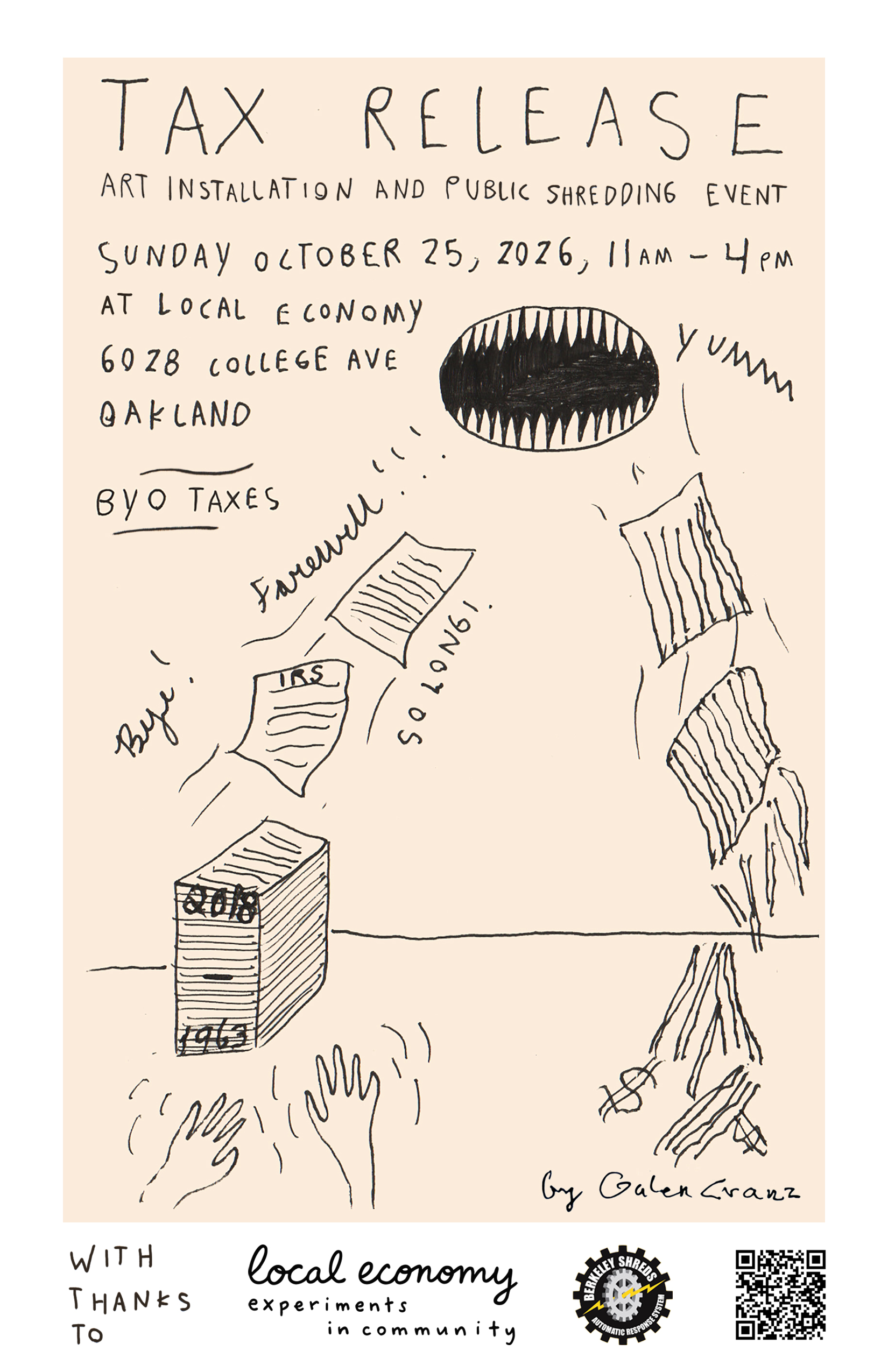
Matt O'Hara, in conversation with Rebecca Herman, discusses *The Flying Death*, a narrative history of how a modern pharmaceutical was born from Amazonian sources. The book traces the intersection of natural history, medicine, and indigenous knowledge, combining compelling storytelling with historical research.
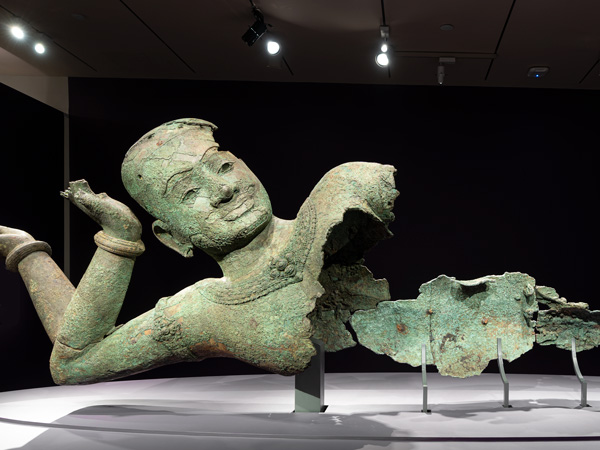
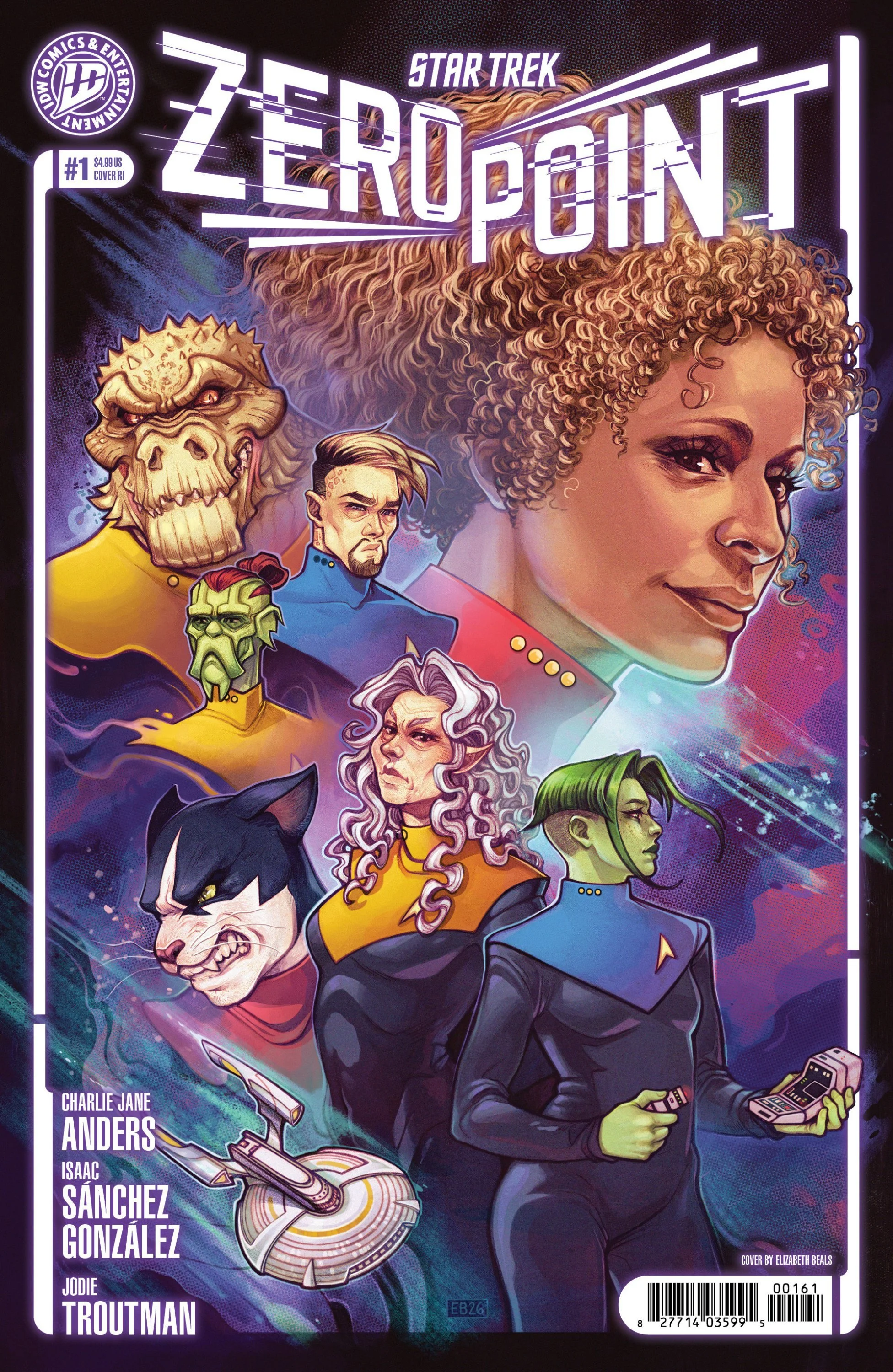
Two accomplished poets explore how their writing cultivates belonging through compassion, presence, and attentiveness to the present moment. Jane Hirshfield, an acclaimed poet, essayist, translator, and Zen practitioner, has received a Guggenheim Fellowship, the Academy of American Poets Fellowship, and in 2024 became the first English-language writer and first woman to receive the Zhongkun International Poetry Award. Colleen Morton Busch, author of the debut collection *Smolder* and *Fire Monks: Zen Mind Meets Wi-Fi*, brings her own practice of mindfulness to contemporary verse. Together they discuss how poetry and spiritual practice intersect in the work of attending fully to life.
A screening of Mud Frontier with Rael San Fratello, architect and designer exploring the fusion of 3D-printing technology and traditional adobe architecture. The artist will discuss innovative approaches to sustainable building and digital fabrication in conversation following the film.
A highlights tour of *Solid Pictures*, an exhibition exploring photosculpture—the precursor to 3D printing—with Assistant Curator of European Art Patrick R. Crowley. The exhibition features rare artifacts from François Willème's 1859 experiments translating photographic negatives into solid figures using projection and mechanical instruments, aiming to make affordable portrait sculpture accessible to the French middle class. Though commercially unsuccessful, Willème's work laid the groundwork for modern scanning, machining, and printing technologies. The exhibition opens a largely overlooked chapter in the history of art and technology, deepening our understanding of how contemporary digital fabrication emerged from 19th-century innovation.
A Death Café gathering hosted by EOLPeace at Book Passage to explore death, dying, and end-of-life questions in an intimate, structured dialogue format. Death Cafés, created by Jon Underwood in London, bring small groups together around tables to discuss mortality, grief, and meaning in a confidential, non-judgmental space. Led by Christine Comaford, this community event invites participants to reflect on death and dying through thoughtful conversation.
A discussion of *Bogland*, a book exploring peatlands, climate change, and ecological science. Merritt R. Turetsky, a leading researcher on permafrost and peatland ecology, discusses her work with science journalist Ed Yong, author of *An Immense World*. The event combines environmental science expertise with accessible science communication.
San Francisco Poet Laureate emerita Kim Shuck celebrates her new poetry collection *November Dance Shirt* with poet Lauren Ito and special guests at SFPL's monthly poetry reading. Shuck's work draws on her multiethnic background—Polish and Cherokee heritage—and her lifelong experience as a San Francisco resident. As Poet Laureate, she hosted free poetry and art workshops across neighborhood libraries and schools, and co-launched citywide initiatives honoring Native American Indigenous Peoples' heritage.
A screening of the International Indian Treaty Council's documentary examining the impacts of the California Gold Rush on Native peoples, followed by discussion with members of the International Indian Treaty Council. Part of the San Francisco Public Library's celebration of Indigenous Peoples' voices, featuring programs, workshops, and performances honoring Native and Indigenous communities.
A recurring romance book club for readers of all preferences—enemies to lovers, fake dating, forbidden love, historical, paranormal, and everything in between. This month the group discusses *An Offer From a Gentleman* by Julia Quinn. Meets the second Thursday of each month in person. Alternate formats (audiobook, Large Print) available upon request.
A celebration of *Selected Poems of Steve Dalachinsky*, the first comprehensive U.S. collection spanning a lifetime of work by New York's consummate outsider poet (1946–2019). Dalachinsky discovered poetry in a psychiatric hospital through Ginsberg's *Howl*, then lived as a true bohemian in SoHo, writing obsessively while selling LPs and attending free jazz performances by Charles Gayle and Cecil Taylor. Moderated by poet and collagist Garrett Caples with Michael Ruby, author of the biographical introduction, and appearances by friends and collaborators. The event marks the publication of this fugitive poet's work—long available only in small chapbooks and expensive European editions—now finally accessible to U.S. readers.
A hands-on workshop exploring the ancient process of nixtamal and the craft of tortilla-making from scratch. Chef Emmanuel Galvan guides participants through corn preparation, discusses heirloom corn varieties and their culinary nuance, then presses and tastes together. Participants leave with practical skills and homemade gorditas.
A discussion of Marlon James's new novel *The Disappearers*, which traces the lives of gay men in 1980s Jamaica after a violent mob attack, exploring how survivors navigate trauma, healing, and the compromises society demands of oppressed people. James, the first Jamaican author to win the Man Booker Prize (for *A Brief History of Seven Killings*), is a acclaimed novelist whose work bridges literary and speculative fiction, drawing on Caribbean culture and African legend. In conversation with journalist Shereen Marisol Meraji, James discusses how his fiction examines race, violence, resilience, and the human cost of systemic oppression. Hosted by City Arts & Lectures at the Sydney Goldstein Theater.
Poets Jack Crimmins, Melissa Eleftherion, and Bill Vartnaw from Taurean Horn, a Northern California independent press with a vital roster of contemporary poets. The event celebrates the press and its role in the regional literary scene.
An immersive exploration of transhumanism and human enhancement technologies—from genetics and AI to neural interfaces and longevity science. Hosted by technology strategist Bridget K. Burke with special guests, this event examines both the promise and the ethical questions raised by emerging technologies that could treat illness, restore abilities, or reshape normal human differences. When does treatment become enhancement? Who decides what counts as a limitation worth overcoming? The discussion invites critical thinking about the future of human bodies, brains, and identity.
A screening of short films by legendary Russian animator Yuri Norstein, including his masterpiece *Hedgehog in the Fog* (1975) and *The Tale of Tales* (1979), alongside rarely-seen works spanning from his 1968 debut through experimental pieces. The program totals 101 minutes of lyrical, visually striking animation exploring themes of loss, revolution, folklore, and the human condition. All films in Russian with English subtitles. Presented by The 418 Project.
A monthly moderated discussion group led by Abraxas Adams exploring themes that matter in daily life—drawn from philosophy, spirituality, science, and lived experience. Each session centers on a single carefully researched topic with a printed handout, evidence, and prompts designed to spark genuine conversation. Participants take turns sharing perspectives in a structured, respectful format where disagreement is welcome and no one dominates. No speaking required. Meets every second Saturday, 10:30 AM–12:00 PM at Manny's.
What happens when AI preserves—or recreates—a life after death? Join AI expert Bridget Burke for an exploration of digital afterlife technologies: memory boxes and archives, AI-assisted memoirs, recreated voices, digital avatars, and robots. The talk asks critical questions about digital identity ownership, family consent and privacy, and where preservation ends and invention begins. Burke will discuss practical ways to preserve what matters and the ethical implications of AI versions of ourselves speaking in our voices, answering questions posthumously, or appearing as avatars. Come ready to think imaginatively about memory, technology, and what we want to survive us.
The screening includes a panel discussion with special guests and serves as a fundraiser for the National Association for Civilian Oversight of Law Enforcement (NACOLE). A screening of the French film Case 137, directed by Dominik Moll, about an internal affairs officer investigating police brutality during the 2018 Yellow Vest protests in Paris. Starring César-winner Léa Drucker, the film examines institutional corruption and accountability in the criminal justice system.
Multi-award-winning mystery author Rhys Bowen presents her latest work in the acclaimed Royal Spyness series, To Crown It All, featuring Lady Georgiana Rannoch in a new adventure.
A guided walking tour of the Castro neighborhood tracing LGBTQIA+ resistance history, from the White Night riots through the AIDS crisis and beyond. Created by Shawn Sprockett, a former senior adjunct professor and practicing designer, the tour examines the trans doctors, lesbians who ran blood drives and wards, and the community that resisted two police riots and a plague. The 90-minute tour begins at the GLBT Historical Society and ends at the Lookout with a complimentary round of drinks. Part of Unspeakable Vice's three-part history of queer San Francisco, extending from North Beach (1770–1960) to the Castro's modern resistance.
An evening of readings from Writers Grotto authors, emceed by Leslie Kirk Campbell. This month's event is co-organized with The Writers Grotto to present writers, poets, and other artists while supporting the creative community. Hosted at Telegraph Hill Books.
A puppet and painted object play about Friedl Dicker-Brandeis, the artist who created a space for children to make art and find joy in the Theresienstadt concentration camp barracks using scraps of paper and a few painting supplies. Created and performed by Jennifer Levine, directed by Jeff Raz, with vocals by Diana Naparst and accordion by Brad Friedman. The production includes audience art-making and returns to Manny's before a European tour in April 2027.
A live storytelling series by Diaspora Arts Connection featuring personal narratives shaped by migration, identity, and life between cultures. Storytellers, artists, and community voices share experiences of family, displacement, memory, language, love, and belonging—ranging from humorous and intimate to reflective and emotional. The evening explores how stories bridge difference, challenge assumptions, and reveal the universal threads connecting people across cultural boundaries. Curated lineup to be announced.
Members of the Older Writer's Laboratory (OWL) share their poetry and prose in a community reading. Discover new voices and engage with Bay Area writers.
A facilitated salon exploring how AI is reshaping human connection and emotional life. As 27% of U.S. adults now use AI for social and emotional purposes—and a third consider their AI a friend—this gathering asks: what happens to human relationships when AI offers frictionless, accommodating connection? Hosted by Resonance Salons, the evening uses Socratic dialogue to explore how we can preserve and strengthen bonds with other people in an age of AI companionship. Dinner and drinks provided.
A celebration of *Out of the Darkness: Classic Short Fiction from Sweden*, a new University of Minnesota Press anthology of Swedish fiction in English translation. Speakers include editor and author Vendela Vida (founding editor of *The Believer*, author of *We Run the Tides*), David Katznelson (musicologist, record producer, and publisher), Ulf Olsson (Professor Emeritus of Literary Studies at Stockholm University and literary critic for Expressen), and Linda Haverty Rugg (Professor Emerita of Scandinavian Studies at UC Berkeley). The panel will discuss the selection, translation, and cultural significance of these classic Swedish short stories.
An evening exploring tarot through a Jewish mystical lens. Heather Cohen, an intuitive guide with backgrounds in tarot, astrology, Jewish mysticism, counseling, and expressive arts therapy, will lead candlelit readings and group interpretation of tarot imagery while examining connections between tarot and Kabbalah—the Jewish mystical tradition. Participants will discover how these traditions intersect, sip tea, and engage in reflection and shared discussion. No prior experience with tarot or Kabbalah required; ages 14+.
An evening of readings and discussion celebrating Pierre Joris' multifaceted literary legacy. Featuring Ariel Resnikoff and Nicole Peyrafitte reading from *In Between, Keep Moving: A Pierre Joris Reader*, a new selected volume spanning over fifty years of Joris' poetry, prose, poetics, translation, and collaborative work. Moderated by Solomon Rino of City Lights, the event explores Joris' distinctive translingual practice—his care for the shifting, intersecting languages that shape contemporary writing and meaning. Published on the anniversary of his death, the reader stands as an opening toward the continuing life of his work.
A celebration of cookbooks and cookbook culture centered on Debbie Berne's *Cookbooking: A Fan's Guide*, a pop history of the genre Berne designed and loved before writing her own book. Kate Leahy, cookbook author and host of the Everything Cookbooks podcast, leads a conversation with Bebe Black Carminito, author of *The Curated Board*, and Dianne Jacob, author of *Will Write for Food*, the standard guide to food writing. For cookbook enthusiasts, food lovers, and home or professional chefs.
A screening of the documentary *Living Harriet Tubman* (27 min, 2026) followed by a post-film discussion. Directors Brandon Tauszik and Theo Schear's film follows Nancy Whittle, a Fresno-based social worker and educator who has spent over three decades portraying Harriet Tubman at Civil War reenactments throughout California. As she approaches retirement, Whittle stages a final performance that challenges whitewashed narratives in these spaces while reflecting on her personal connection to Tubman and the legacy of the Underground Railroad. After the screening, Whittle, Tauszik, and Schear will discuss the making of the film, Civil War reenactments, and how American history is remembered and taught, moderated by KQED columnist Pendarvis Harshaw.
City Lights celebrates 90 years of New Directions Publishing, the legendary independent press founded in 1936 by James Laughlin on Ezra Pound's advice. The event features Barbara Epler, president and publisher; Declan Spring, executive vice president and senior editor; and Pulitzer Prize-winning poet Forrest Gander, A.K. Seaver Professor of Literary Arts at Brown University. New Directions has published modernist masters and contemporary international writers in translation, launching careers of Dylan Thomas, Marianne Moore, Tennessee Williams, and Gary Snyder, among many others. Special guests to be announced.
A celebration of Jen Siraganian's debut poetry collection *Everything Has Been Moved, Even the Dead* (Perugia Press, 2026), which traces Armenian-American identity, family history, and the Armenian Genocide through lyric and archival photographs. Siraganian, former poet laureate of Los Gatos and a Lucas Artist Fellow at Montalvo Arts Center, will read alongside Bay Area poets Judy Halebsky (author of *Sky=Empty*, New Issues Prize winner) and Amanda Moore. Halebsky is a translator and the author of three poetry collections. The event features new poems and a shared reading exploring themes of home, displacement, memory, and diaspora.
Rock music historian Richie Unterberger presents his new book *Do What You Fear Most: The History of the Velvet Underground*, exploring the groundbreaking band's merger of taboo-breaking lyrics, avant-garde instrumentation, and hard-charging rock'n'roll. Unterberger will show and discuss rare film and audio clips, examining Lou Reed's songwriting and vocal contributions alongside the work of John Cale, Nico, and other band members. Signed copies of the book will be available for purchase.
A discussion of Mark Twain's *The Adventures of Huckleberry Finn* and the history of its censorship in American schools. The novel has faced repeated challenges since its 1885 publication for Huck's unconventional behavior, socially subversive ideas, controversial language, and grammar. This event examines the literary, pedagogical, and cultural arguments surrounding the book's place in education.
A conversation between Mexican author Laia Jufresa and American novelist Colin Winnette celebrating the publication of Jufresa's debut English-language novel, *Wishbone*. The novel traces the interconnected lives of two women—Tor Sima, founder of the International Museum of Color in Oaxaca, and Vica Luft, a secretary and single mother in Edinburgh—across two decades and seven cities, exploring motherhood, friendship, art, and the bonds of chosen family. Jufresa is the author of *Umami* and the memoir *Veinte, veintiuno*, and was named to the Bogotá39 list of Latin America's outstanding writers under forty. Winnette's novel *Users* was a 2024 PEN/Faulkner finalist and a New York Times Editor's Choice.
An almost-monthly series of talks by Walker Brents III on poetry, mythology, folklore, philosophy, and related topics. Part of a nearly 20-year-old recurring program featuring 9–10 talks annually. Primarily broadcast via YouTube and Facebook; in-person listening available at the venue.
An evening of holiday storytelling with award-winning comedian and storyteller Don Reed, creator of Redwood Nights: Storytelling Under the Stars and author of the forthcoming memoir Here's Donnie! A cast of gifted storytellers will share true stories celebrating the joy, surprises, mishaps, and meaning of the holiday season—some hilarious, some deeply moving. For adults and high school students only.
A meet-and-greet signing event with author and food activist Florencia Ramirez. The afternoon includes a food demo at 11:00 AM followed by a book signing at 11:30 AM for her work on food justice and culinary activism.
A celebration of Las Posadas featuring San Francisco Poet Laureate Genny Lim and visual artist and poet Adrian Arias. This workshop is part of Lim's Academy of American Poets Laureate Fellowship project 'Words Without Walls,' a community-building series exploring cross-disciplinary responses to poetry across civic and cultural observances. Participants will discover how the languages of the arts can help free the written word beyond the page. The six-workshop series culminates in a performance at the San Francisco Main Public Library featuring Lim, intergenerational poets, and collaborating artists.
Zen teacher, poet, and author Norman Fischer discusses his new essay collection *The Great Road*, exploring what it means to engage fully in spiritual practice and embody our deepest aspirations. Fischer brings decades of experience in Zen Buddhism and contemplative writing to a meditation on practice, meaning, and transformation.
An evening exploring the history and cultural significance of Krampus, the Alpine folkloric creature linked to centuries-old witchcraft beliefs and darker pre-Christian understandings of the Christmas season. Author Al Ridenour, who wrote the definitive English-language study *The Krampus and the Old Dark Christmas*, delivers an illustrated presentation revealing how Krampus traditions connect to the spirit world. The evening includes live traditional St. Nicholas songs performed by singer Christina Linhardt, a curated collection of European Krampus video shorts (DIY horror films, disco shows, metal music videos), a rare excerpt from the 1955 German film *Der Struwwelpeter*, costumed Krampus performers for photo opportunities, local artisan vendors, and a book signing.
An artist walk and creative workshop led by Dev Heyrana, 2027 Osher Fellow and artist-in-residence on a recent scientific expedition to the Verde Island Passage in the Philippines. Participants will explore the California Academy of Sciences, find inspiration in what they observe, and create art together. All ages welcome, no experience necessary.
An open mic and poetry workshop celebrating local voices. The evening begins with a free writing workshop at 2:30 PM, followed by sign-ups and an open mic where performers share up to four minutes each, with a featured poet closing at 5:00 PM. Hosted by Chris 'L7' Cuadrado, a cultural worker and artist committed to amplifying the voices of colonized and oppressed communities through poetry, music, and radical thought. All Vinyl House Music throughout.
A creative workshop for ages 12–19 exploring portraiture, self-expression, and emotional awareness. Dev Heyrana, 2027 Osher Fellow, and photographer Priscilla Gragg—whose commercial work spans Nike, Gap, and Target campaigns—lead a hybrid portrait session and guided creative experience. Participants slow down, notice their feelings, and express themselves without pressure to find words. No prior art or photography experience required.
An audiovisual presentation exploring Opus One (1966–late 1990s), a visionary independent record label that released experimental and electronic music with psychedelic black-light-reactive album art in small pressings across four decades. Featuring audio samples and visual presentations of the label's striking covers, along with personal narration on how avant-garde communities survive in rural isolation. Presented by Brian Darr, a media historian and former SFPL librarian who has written for Senses of Cinema and the San Francisco Silent Film Festival, and Kerry Laitala, an experimental filmmaker and performance artist from the San Francisco Art Institute.
An end-of-year reading celebration and DIY book journal workshop at Book Society. Attendees share their favorite reads of 2026 on a Community Shelf, then craft a personalized reading journal for 2027 using provided templates and materials. The afternoon includes sparkling cider and closes with a toast to the new year. No artistic experience needed.
An open mic poetry event hosted by Gabriel Kittle-Cervine, inspired by previous Santa Cruz poetry series. The evening features a free workshop at 4:30pm, open sign-ups at 5:30pm, the main open mic from 6:00–7:00pm (4 minutes per performer), and a featured poet at 7:15pm. Named after the olive tree as a symbol of resilience and peace, the event welcomes poets of all ages and backgrounds to share work on a public stage. Vinyl House Music Artist provides music.
Book Society's Leading Ladies Book Club discusses Arundhati Roy's debut memoir *Mother Mary Comes to Me*, a candid and sweeping account of Roy's relationship with her single-mother activist Mary Roy, who founded a school in Kerala and advocated for women's property rights. Roy explores grief, ambivalence, and love across her own life from Kerala childhood through her years in Delhi and her career as a novelist and essayist.
Kim Stanley Robinson discusses his latest work, interweaving memoir and adventure narrative around his research trip to Antarctica and his long engagement with Apsley Cherry-Garrard's classic *The Worst Journey in the World*. Robinson traces his own expedition across the continent by snowmobile, helicopter, and airplane, following Scott's ill-fated 1911 polar attempt, and explores how Cherry-Garrard's account shaped his imagination and fiction for decades. A meditation on exploration, climate, and the places that haunt us.
An informal gathering exploring solarpunk as a hopeful vision for regenerative futures and systems change. Bobby Fishkin and Andres Acosta will facilitate open-ended conversation around radical collaboration, knowledge democracy, and collective reimagining of what's possible. Designed for systems-change agents, community builders, artists, and innovators to connect, dream collaboratively, and seed networks for change. Held at SF Green House, an indoor public open space (POPO) on 2nd Street; attendees can arrive anytime between 2–5 PM, with the gathering flowing into a street block party at 5 PM.
Michael Shellenberger and Alex Gutentag discuss their book *The Left's War on Reality*, examining left-wing policies through nine case studies. Shellenberger, CBR Chair of Politics, Censorship, and Free Speech at University of Austin and founder of Public.News, and Gutentag, Senior Editor at Public.News, argue that destructive outcomes from progressive policies result from deliberate choices rather than unintended consequences. A moderator will facilitate discussion.
A monthly poetry reading series featuring guest readers followed by an open mic for community poets. Hosted by Michael Koch and Jerry Ferraz on the first Thursday of each month.
A memoir of resilience, love, and self-discovery by Sarita Sarvate. Named after a freedom fighter, protagonist Aruna must fight for her own liberation in this moving exploration of identity and personal transformation.
A presentation of Native stories and music with Paul Steward, a tribal member of Elem Indian Colony of Pomo Indians of the Sulphur Bank Rancheria and lecturer of Native American/American Indian Studies at CSU. Steward specializes in California history and the local culture of the Bay Area and North Bay, drawing on his own upbringing on the reservation. Part of the Library's celebration of Indigenous Peoples Day programming.
Greg Orfalea discusses his memoir *Wonder and Shame*, which follows Frank's quixotic mission to teach baseball to traumatized orphans in a refugee camp of half a million people. The book explores how to hold onto fair play, honesty, and respect in the face of overwhelming human suffering and displacement.
A screening of My Cousin Vinny (1992), the acclaimed courtroom comedy starring Joe Pesci and Marisa Tomei, followed by an in-person conversation with screenwriter and producer Dale Launer. Launer's script is widely praised by legal experts as one of the most accurate and funny depictions of real courtroom procedure ever written. Launer, who also wrote Dirty Rotten Scoundrels and Ruthless People, has traveled from Los Angeles to discuss the film's writing, characters, and enduring legacy.
Veteran China expert and journalist Orville Schell discusses his investigation into China's prison labor network, the personal costs of reporting on state repression, and the enduring implications for human rights and press freedom. Schell brings decades of reporting experience and deep expertise in Chinese politics and society to bear on one of the most pressing geopolitical and humanitarian issues of our time.
A generative poetry workshop led by Marin County Poet Laureate Francesca Bell. Participants discuss poems and poetic devices, then write together to imaginative prompts. Bell is author of *Bright Stain* (finalist for the Washington State Book Award) and *What Small Sound*, and translated Max Sessner's *Whoever Drowned Here* from German. Her work appears in ELLE, Los Angeles Review of Books, New England Review, and other major publications. Held monthly in collaboration with the Marin Poetry Center.
Rhae Lynn Barnes discusses *Darkology*, a cultural and social history examining minstrelsy and its legacies through gripping writing and archival research. She appears alongside David M. Henkin, author of *Out of the Ballpark*, for a conversation on how performance, race, and American culture intersect across two centuries of popular entertainment.
A talk by David Y. Lei, retired businessman and board member of the Chinese Historical Society of America, on the history of Chinese American civil disobedience and litigation. Lei immigrated from Taiwan in 1956 and spent decades in San Francisco's Asian American community—first as a social worker in Chinatown in the late 1960s, later as a business owner, and subsequently as a cultural leader, directing the Chinese New Year Parade from 1977 to 2006. He explores how Chinese Americans have used the courts and direct action to advance their rights and community interests.
Paulina Borsook's 1997 critique *Cyberselfish* identified toxic cultural undercurrents in Silicon Valley's libertarian elite that have since become mainstream realities. In conversation with journalist and author Gil Durán (*The Nerd Reich: Silicon Valley Fascism and the War on Democracy*), Borsook examines how her "accidental prophecy" anticipated tech industry's ideological trajectory. A sharp historical reckoning with how tech culture shaped politics and democracy.
A screening of the documentary Steven Arnold: Heavenly Bodies (2019, 80 min.), directed by Vishnu Dass, former head of the Steven Arnold Museum and Archives. The film traces the life and visionary work of Los Angeles-based multimedia artist and filmmaker Steven Arnold (1943–1994), a pioneer of underground cinema and queer aesthetics who created surreal, shamanistic tableaux and legendary midnight screenings in San Francisco. Narrated by Anjelica Huston and featuring archival footage and interviews with collaborators including artist Ed Moses, actress Ellen Burstyn, Warhol Superstar Holly Woodlawn, Beat poet ruth weiss, and former members of The Cockettes drag theatre troupe.
A hands-on workshop for aspiring authors seeking guidance on developing a book idea from concept to first steps. Diane Conway, a writing coach praised by Anne Lamott for her intelligence, spiritual wisdom, and humor, leads participants through brainstorming techniques and practical next steps for turning a story concept into a publishable project. Ideal for writers at any stage who need direction and encouragement.
Dr. Giulietta Octavio reads from and discusses her book Code Calm: How to Stand Your Ground Without Losing Yourself, exploring how cultivating greater awareness and self-understanding can help readers maintain boundaries and authenticity in challenging situations.
An intensive workshop, illustrated lecture, and guided visualization exploring the figure of Lilith across mythology, literature, and modern reclamation. Scarlett Amaris, screenwriter of *H.P. Lovecraft's Color Out of Space* and author on occult studies, traces Lilith from ancient night spirits and Jewish protective traditions through her appearance in Romantic poetry and nineteenth-century art—Goethe, Dante Gabriel Rossetti, John Collier—examining how female refusal, sexual autonomy, and power outside sanctioned structures became coded as danger. The workshop includes an interactive reflection on inherited agreements and suppression, followed by a twenty-minute guided visualization inviting participants to meet the exiled or ungovernable aspect of self. Participation is fully optional; no disclosure required.
A memoir exploring spiritual longing and the search for an end to suffering through the author's experience as a Tibetan Buddhist nun. Paldrom Catharine Collins recounts both transcendent experiences and moments of disillusionment in her journey toward enlightenment.
A poetry open mic celebrating local voices across all ages and cultural backgrounds. The afternoon includes a free writing workshop (2:30 PM), open sign-ups (3:30 PM), and an open mic session (4:00 PM) hosted by Chris "L7" Cuadrado, a cultural worker and artist who draws from radical political traditions and liberation movements. A featured poet performs at 5:00 PM. Vinyl house music throughout. $10 suggested donation.
A celebration of Phoebe Thompson's debut novel *Girls Our Age*, which follows three women navigating their late twenties together. Thompson discusses her literary exploration of friendship, ambition, and growing up in contemporary life.
Tate Swindell and Thomas Antonic present a program centered on Allen Ginsberg's 1980 Graz poetry event with Peter Orlofsky and musician Steven Taylor, featured on the forthcoming double LP 'America: Give A Shit' (Unrequited Records). Antonic will discuss his new book, *The Three Wives of William Burroughs*. Swindell, a San Francisco-based archive curator and publisher, and Antonic, author of *Amongst Nazis: William S. Burroughs in Vienna 1936/37*, have been presenting variations of this program across Central Europe; this homecoming event brings together their research on the Beats' transatlantic literary and musical legacy.
What distinguishes the prose of great novels, and how have celebrated novelists shaped language into lasting sources of insight and aesthetic pleasure? Literary critic Robert Alter, UC Berkeley Professor Emeritus of Hebrew and Comparative Literature and author of *The Language of Fiction: The Craft of Writing and the Pleasures of Reading*, explores the literary devices and techniques novelists have used to create enduring fiction. In conversation with George Hammond, author of *Conversations With Socrates*.
Stacey Lindsay, author of *Being 40*, explores the Autumn Queen—a mythological archetype embodying courage, creativity, intuition, and power that has been conspicuously absent from how we narrate women's lives. Historically, the Maiden, Mother, and Crone dominated storytelling; Lindsay argues this erasure was deliberate and shows how to reclaim this missing stage. The event combines conversation about the Autumn Queen with hands-on creative practice: guided journaling, sketching, and crafting to uncover your own inner Autumn Queen, including designing a tarot card and making a personal ornament.
A four-week workshop on writing family history, led by Laurel Hilton. Learn how to begin researching, decide when to stop gathering material and start writing, and develop your own family narrative. Meets Wednesdays, January 20–February 10, 2027. Hosted at Book Passage.
FOG Design+Art Fair celebrates leading international art galleries and contemporary design dealers with four days of exhibitions and programming. FOG Talks features dynamic conversations with artists, designers, and technology leaders exploring current practice across visual arts and design. Single-day tickets ($35–$40) and four-day passes ($95–$100) include entry to both the main fair and FOG FOCUS, plus access to all talk sessions.
A screening of the International Indian Treaty Council's documentary on the California Gold Rush and its devastating impacts on Native peoples, followed by discussion with IITC members. Part of the Library's Indigenous Peoples Day programming featuring conversations, performances, and community resources honoring Indigenous voices.
An almost-monthly series of talks by Walker Brents III on poetry, mythology, folklore, and philosophy, hosted at Bird & Beckett Books & Records. Part of a 20-year tradition of 9–10 talks annually exploring diverse humanistic topics.
An introductory tour of Letterform Archive's collections led by Stephen Coles. Letterform Archive is a nonprofit organization dedicated to preserving, exhibiting, and providing access to typeface design history and related materials.
Wilderness guide Hannah Hindley discusses her luminous debut essay collection, which weaves together natural history and personal stories across eighteen lyrical pieces. The work explores encounters with aquatic life and the human connection to wilderness, blending scientific observation with lyrical reflection on nature, love, and belonging.
Christy Scott Cashman discusses her debut novel *What Happened in Beulah*, a coming-of-age mystery in which a teenage girl uncovers dark secrets of her Smoky Mountain town while searching for a missing classmate. Perfect for fans of *Where the Crawdads Sing*.
A practice-based workshop anchored in Katherine May's Wintering: The Power of Rest and Retreat in Difficult Times. Rather than a book report, this session explores rest as a radical practice — reframing winter (both seasonal and personal) not as failure but as necessary dormancy. Drawing on May's reframing of fallow, slowed-down seasons as integral to a whole life, participants reflect on how to integrate rest into their own rhythms and resist the cultural pressure to perpetually produce. The workshop provides space, ideas, and guidance to move from understanding the concept to actually practicing it.
How do historians assess U.S. presidents—their intelligence, competence, and ethical conduct? Dr. Gerald Henig, Professor Emeritus of History at California State University, East Bay and author of *America's Presidents: What Your History Teacher Never Told You*, explores little-known revelations about presidential character and behavior. Moderated by Dr. Michael Baker, Rear Admiral, U.S. Navy (ret).
Learn how civil libertarians transformed America's First Amendment from an unfulfilled promise into the world's strongest protection for free speech. Nico Perrino, Executive Vice President of the Foundation for Individual Rights and Expression (FIRE) and author of *Free Speech Generation: The Civil Libertarians Who Saved the First Amendment and Transformed America*, discusses the men and women behind this legal and cultural shift.
Journalist Emily Feng, White House Correspondent for NPR, discusses her book *Our Hearts Burned for Home*, which unearths the story of Uyghur exiles who fled China's expanding police state to become a pivotal force in the fall of Bashar al-Assad's regime in Syria. Feng explores the paradox at the heart of Beijing's repression: meant to crush dissent, it instead scattered and radicalized a generation, transforming thousands into militant actors on the Syrian front lines. A moderator will lead the conversation.
The 43rd annual Martin Luther King Jr. Convocation honors Dr. King's legacy of freedom, equity, and human dignity. Hosted by UC Santa Cruz's Office for Diversity, Equity, and Inclusion, the event features leaders and scholars who apply an equity lens across diverse, interdisciplinary fields, reflecting how civil rights advocacy intersects with every facet of daily life. Speaker to be announced.
How did South Africa's anticolonial liberation struggle paradoxically produce entrenched wealth concentration and enduring inequality? Scholar Mesrob Vartavarian examines the rise of privileged minorities—small, exclusive groups dominating political and economic life—and traces how they secured exclusive advantages including land seizures, racialized labor systems, and favorable state support from the Dutch colonial era through ANC rule. Rather than dismantling minority privilege, challenges from marginalized groups often reshaped and incorporated new actors into existing structures. Vartavarian offers a framework for understanding how structural advantage persists and evolves across African societies.
How did American scholars in the late 19th and early 20th centuries invent the concept of the 'Fertile Crescent' and use ancient Near Eastern history to construct Western civilization as an idea? Serena Shah, a PhD candidate in U.S. History at Stanford, explores American orientalism's effort to find historical rather than biblical origin stories for humanity—and how these scholars argued that Eastern civilizations' development of monotheism and empathy became foundational to modern democratic society. A lecture examining the production of knowledge in American universities and museums.
A discussion of *Carry My Strength: A Parent's Guide to Growing and Thriving Alongside Your Child*, featuring Debbie Raphael, M.D., a double board-certified child and adult psychiatrist. Dr. Raphael decodes the psychological forces shaping early parenthood, helping parents understand their own emotional patterns and build stronger connections with their children. Drawing on clinical concepts like reflective functioning, secure attachment, and mentalization, she offers actionable guidance on interrupting intergenerational trauma cycles and cultivating resilience. Event includes a reading and audience Q&A.
A book club for readers interested in yoga philosophy and ethics, held at Book Society. The group gathers to discuss texts that deepen understanding of yoga's philosophical foundations and ethical teachings, integrating meditation and journaling for reflection. This month focuses on the origins and sources of yoga's ethical teachings. Open to teachers, students, and anyone curious about the practice.
Award-winning nature writer Marina Richie discusses her book *Feathered Forest*, which entwines the lives of birds with a hidden vertical world of wild trees. The work blends narrative, perception change, and memoir to explore the interconnected ecosystems of the forest canopy.
Holocaust and genocide scholar Omer Bartov, Dean's Professor at Brown University, examines the moral and historical trajectory of Israel from its founding through contemporary conflict. Drawing on his book *Israel: What Went Wrong?*, Bartov traces how Zionism—a movement born to emancipate European Jewry from oppression—transformed into a state ideology of ethno-nationalism, and how a state founded in the Holocaust's aftermath now faces credible accusations of war crimes. He explores the roots of current violence, Palestinian displacement, the politics of the Holocaust, debates over genocide, and Israel's uncertain future with rigor and historical depth.
Composer Tarik O'Regan and oud virtuoso Joseph Tawadros discuss a new concerto for oud and Baroque orchestra, exploring the instrument's centuries-long influence across North African and Middle Eastern musical traditions and its connection to the modern guitar. O'Regan shares the creative process behind the work, while Tawadros demonstrates the oud's expressive range and cultural significance. Moderated by Stanford musicologist Matthew D. Morrison, the salon includes live performance by Tawadros and the Stanford Middle Eastern Ensemble, plus audience Q&A.
New York Times bestselling author Mike Chen discusses his novel *The Haunting of Santo Domingo Street*, a supernatural horror tale exploring gentrification, immigrant trauma, and family secrets when two cousins inherit a crumbling Victorian in San Jose haunted by the desperate history their father concealed. Chen appears in conversation with fellow Bay Area author Yangsze Choo, bestselling novelist of *The Ghost Bride* and *The Night Tiger*. The event features a reading from the novel and audience Q&A.
Bianca Stone, Vermont's poet laureate (2024–28) and author of four poetry collections including *What Is Otherwise Infinite* (winner of the 2022 Vermont Book Award) and *The Möbius Strip Club of Grief*, reads from her work as part of UC Berkeley's Lunch Poems series. Stone teaches poetry at Dartmouth College and at the Ruth Stone House in Vermont, where she hosts the Ode & Psyche Podcast. Her poems have appeared in The New Yorker, The Atlantic, and Poetry magazine. Lunch Poems, founded by Robert Hass, is UC Berkeley's noontime poetry reading series.
An informal gathering exploring solarpunk as a hopeful vision and practice for regenerative futures, systems change, and radical collaboration. Bobby Fishkin and Andres Acosta will facilitate open conversation around themes including regenerative community building, knowledge democracy, and collective entanglement. Designed for systems-change agents, artists, innovators, and community builders to connect, dream collaboratively, and explore new ways of knowing and being together. The gathering flows into a street block party at 5 PM.
A recurring poetry series held on the first Thursday of each month, featuring community readers followed by an open mic. Hosted by Michael Koch and Jerry Ferraz.
A panel discussion examining the first-year law curriculum and its role in legal education. Panelists include Alexis Hoag-Fordjour, Tania Valdez, Joy Milligan, K-Sue Park, Ji Seon Song, Mario Barnes, Etienne Toussaint, Zoë Polk, Russell K. Robinson, Thalia González, and Kate Weisburd — faculty and scholars from UC Law SF and peer institutions. Hosted by UC Law SF at the Cotchett Law Center.
In 1863, Russian warships unexpectedly arrived in New York and San Francisco, sparking Northern celebrations and raising hopes that Imperial Russia might support the Union should Britain and France recognize the Confederacy. Vladimir Alexandrov, B. E. Bensinger Professor Emeritus of Russian Literature and Culture at Yale University and author of *When the Russians Came: The Remarkable Story of the Friendship Between Imperial Russia and the Union During the Civil War*, explores this remarkable moment in US-Russian relations in conversation with George Hammond, author of *Conversations With Socrates*.
A trial reenactment of People v. Ebens, the pivotal 1982-1983 case stemming from the murder of Vincent Chin, performed by UC Law SF students and alumni. The case, which exposed systemic failures in the criminal justice system and galvanized the Asian American civil rights movement, is explored through courtroom dramatization and legal argument, illuminating how the trial's outcome challenged racism and discrimination in American law.
Grace Hwang Lynch explores her memoir *How to Cook Rice: On the Care and Feeding of an Immigrant Family*, a bittersweet journey navigating California suburbs, Asian American identity, and motherhood through the lens of food and family. Lynch is a San Francisco Bay Area writer specializing in Asian American food and culture, with bylines in NPR, Eating Well, KQED, and the San Francisco Chronicle; she was a finalist for an IACP Food Writing award. In conversation with Linda Shiue, MD, a Taiwanese American physician, professionally trained chef, and author of *Spicebox Kitchen*, who directs Culinary Medicine at Kaiser Permanente San Francisco.
A panel examining 45 years of activism and justice following Vincent Chin's 1982 murder, a pivotal moment in Asian American civil rights history. Keynote speaker Helen Zia, award-winning author and journalist whose work explores Asian American experiences and civil rights, joins civil rights attorney Adanté Pointer (who secured a record $21 million verdict against Fremont Police) and Russell Jeung, sociologist and co-founder of Stop AAPI Hate, to discuss hate crime, accountability, and the ongoing fight against anti-Asian violence.
From Gardens to Citizenship explores the cultural and political dimensions of horticulture in Latin America from 1870–1920, examining how women's engagement with gardening intersected with questions of identity, citizenship, and social change. Vanesa Miseres, Associate Professor of Spanish at the University of Notre Dame and author of *Mujeres en tránsito: viaje, identidad y escritura en Sudamérica* and *Gender Battles: Latin American Women, War, and Feminism*, brings expertise in nineteenth and early twentieth-century Latin American literature, gender studies, and cultural history to this lecture.
A workshop on imagery as a foundational technique for writing deep, meaningful fiction. Nina Schuyler explores how images function in prose — doing double or triple duty under pressure — and guides writers through craft strategies for deploying imagery to strengthen their work.
UC Santa Cruz's Teaching Symposium showcases innovative teaching practices, programs, and scholarly work from across the campus community. The event brings together faculty, instructors, and educators to share methodologies, discuss pedagogical challenges, and explore new approaches to learning and instruction.
Two leading scholars Saree and Ussama Makdisi present their concise, authoritative work naming and explaining anti-Palestinianism as a distinct form of bigotry, clarifying a concept that is often misunderstood or ignored in public discourse. The event explores how anti-Palestinian sentiment operates as ideology and practice, situating it within broader frameworks of political prejudice and discrimination.
A dialogue on home as concept, exploring its intersection with community, kinship, and political identity. Architectural historian Eva Hagberg and philosopher Emanuele Coccia, author of *Philosophy of the Home*, discuss how we design, regulate, inhabit, and imagine home—from intimate shelter to society's origin story. Part of the DIALOGUES global conversation series, presented in partnership with Aidlin Darling Design.
Robin Wall Kimmerer, author of Braiding Sweetgrass and The Serviceberry, explores humanity's relationship with the natural world through reciprocity, gratitude, and respect. A botanist, professor, and enrolled member of the Citizen Potawatomi Nation, Kimmerer bridges indigenous wisdom and scientific knowledge, inviting us to listen to plants as the earth's oldest teachers. Her work reveals how ecology can be understood through the lens of gift economies and mutual care.
A screening of a recent documentary (28 mins) exploring the legend of Yaobikuni—a young woman who ate mermaid flesh and gained immortality, eventually becoming a nun and traveling Japan for eight hundred years before returning to her birthplace in Obama City, Fukui Prefecture. Following the film, Michael Dylan Foster (UC Davis, author of *The Book of Yōkai*) and Hank Glassman (Haverford College, medieval Japanese religious culture specialist) discuss the legend, its Buddhist context, and the documentary's making.
A multidisciplinary roundtable exploring yōkai—Japanese supernatural creatures—through the lens of sound and images, past and present. Speakers include Michael Dylan Foster (UC Davis), author of *Pandemonium and Parade* and *The Book of Yōkai*, who serves as "Yōkai Navigator" for NHK World's documentary series; Fabio Rambelli (UC Santa Barbara), Distinguished Professor of Japanese Religions and Cultural History and author of *The Sea and the Sacred in Japan* and *Spirits and Animism in Contemporary Japan*, who is also an accomplished musician performing the shō (classical Japanese mouth organ); and Fumi Tomita (University of Massachusetts Amherst), a jazz bassist and composer.
Courtney Linn, author of *Inverness by Design: How Berkeley Made a Summer Place*, explores the intellectual and architectural connections between Berkeley and the coastal village of Inverness on Tomales Bay. A conversation examining how Berkeley's cultural and design traditions shaped a summer community on the coast.
The UC Berkeley Center for Korean Studies honors the 2026 winner of the Hong Yung Lee Book Award: I. Jonathan Kief, assistant professor at UNC Chapel Hill, for *Triangle Republics: Cross-Border Literary Transits between the Cold War Koreas and Japan* (Columbia University Press, 2025). Kief's groundbreaking work traces how North and South Korean literature circulated through Japan's diaspora communities between 1945 and the 1980s, revealing creative transnational exchanges that challenge conventional Cold War narratives of division. The ceremony includes remarks, book signing, and refreshments. Established in 2022 to honor Berkeley political scientist Hong Yung Lee's legacy, the award recognizes exceptional English-language scholarship advancing Korean Studies.
Claudia Breger, Villard Professor of German and Comparative Literature at Columbia University, presents her forthcoming book *Art's Assemblies: Political Aesthetics in Transatlantic Dialogue* (Stanford University Press, October 2026). The book argues for art's political power by staging dialogues between 21st-century theory—affect studies, queer theory, Black radical thought—and mid-20th-century German Jewish émigré thinkers responding to fascism (Adorno, Benjamin, Bloch, Kracauer, Arendt). Breger conceptualizes how artworks across media "assemble" heterogeneous elements, "archive" unfinished histories of violence, "fabulate" alternative futures, and "dream" amid nightmares. The talk draws on readings of Kafka and Else Lasker-Schüler alongside contemporary artists.
A monthly poetry event held on the first Thursday of each month. Featured poets read their work, followed by an open mic for community members. Hosted by Michael Koch and Jerry Ferraz.
The BlackStar Greaves Seminar is a three-day gathering for artists, filmmakers, scholars, and curators working in cinematic media. Hosted by Stanford University's Institute for Diversity in the Arts, the seminar explores the technical and creative aspects of media-making through sessions, artist presentations, and intimate peer exchange. Attendees will connect with peers and center their practice while engaging with the natural beauty of northern California. Open to curators, film programmers, filmmakers, film workers, and film scholars; proposals for sessions are invited through October 5, with general registration opening in November.
The 51st annual Berkeley-Stanford Conference on Russian, East European, and Eurasian Studies convenes scholars and experts to examine desire and dissent across the region. Co-hosted by UC Berkeley's Institute of Slavic, East European, and Eurasian Studies (ISEEES) and Stanford's Center for Russian, East European, and Eurasian Studies (CREEES), this flagship interdisciplinary conference brings together researchers, historians, and policy analysts to discuss contemporary and historical dimensions of resistance, cultural expression, and social movements in Russia and Eastern Europe.
Mexican-American writer Gerardo Sámano Córdova reads from and discusses his bestselling novel Monstrilio, a critically acclaimed work of speculative fiction. Sámano Córdova is currently Writer in Residence at Fordham University and holds an MFA from the University of Michigan's Helen Zell Writers' Program. He is also author of the forthcoming novel Imps!.
A distinguished lecture by acclaimed novelist Kamila Shamsie on Pakistan's history, politics, and culture. Shamsie, author of *Broken Verses*, *Home Fire*, and other works exploring South Asian identity and diaspora, brings her distinctive perspective on the nation's past and present. The lecture is hosted by UC Berkeley's Pakistan@Berkeley initiative, which supports interdisciplinary scholarship and public programming on Pakistan's role in global affairs, intellectual history, and cultural production.
A Book of the Civic Silk Road explores how knowledge of Ming China traveled across the Persianate and Ottoman worlds through a newly translated historical text. 'Ali Akbar Khatayi, a Persian merchant, spent six years in early-16th-century China and produced the most detailed foreign account of Ming government and society before European maritime expansion. His vivid descriptions of Ming bureaucracy, society, and customs anticipate modern theories of statecraft. Kaveh L. Hemmat (Benedictine University) and Hyunhee Park (City University of New York, John Jay College), co-editors and translators of the Book of China, discuss how Khatayi's account shaped intellectual exchange across Eurasia and compare it with contemporary Chinese sources.
An exploration of creative potential and reinvention for women and non-binary people in midlife and beyond, examining how to challenge societal narratives of invisibility and creative limitation. Two authors discuss their own journeys of artistic growth and the possibilities for deepening creative practice at any life stage.